Hōrin-ji Temple: A Shingon Buddhist Temple in Kyoto


Site at a Glance
- Rating
- 4.2
- Popularity
- Medium
- Country
- Japan
- Primary era
- Medieval
- External website
- Open
- Eras represented
- Medieval, Early Modern
- Civilizations
- Yamato
- Site type
- Religious
- Remains
- Temple
On this page14 sections
History
Hōrin-ji Temple is a Shingon Buddhist temple in Kyoto, Japan, traditionally founded in 713 during the early eighth century. Its formal name is Chifuku-san Hōrin-ji, and it belongs to the Gochi organization, a Shingon Buddhist body associated with the Five Wisdom Buddhas. The temple’s principal image is Ākāśagarbha, a bodhisattva associated with wisdom, memory, learning, and boundless space, who is commonly known in Japan as Kokūzō. The image is treated as a hidden sacred image.
Traditional foundation and early development
Temple tradition places an earlier shrine-palace called Kadonoi at the site. It attributes this foundation to the Hata clan, an immigrant community associated with early settlement and development in the Kyoto region. The tradition further describes the Hata as descendants of Qin Shi Huang, the first emperor of unified Qin China, through Yuzuki no Kimi. This claimed ancestry belongs to the temple’s foundation tradition.
In 713, Gyōki is traditionally said to have established a hall complex called Mokujōzan Kadonoi-dera at the request of Emperor Genmei. Gyōki was an eighth-century Buddhist monk known for religious work and public construction projects. The new institution was intended to secure peace for the state, encourage abundant harvests, and support the growth of industry. The foundation attribution to Gyōki and Emperor Genmei is traditional.
Hōrin-ji later served as an imperial prayer temple under successive emperors. Buddhist figures associated with periods of retreat there include Gonso, Kūkai, Kakuban, Myōe, and Nichiren. In 829, Kūkai’s disciple Dōshō is traditionally said to have installed an image of Ākāśagarbha that he had carved himself. Dōshō also repaired the Oi River and, in 836, constructed Hōrin-ji Bridge as a pilgrimage approach to the temple.
Renaming and medieval decline
The bridge was later called Togetsukyō by Emperor Kameyama, although its formal name remained Hōrin-ji Bridge until the Edo period. The temple itself was renamed Hōrin-ji in 868. In 874, its mountainside was cut back and its halls were renovated. During the Tenchō era, between 938 and 947, the monk Kūya is said to have stayed at the temple, gathered support, and enabled the construction of further halls and pagodas.
Fire during the Ōnin War damaged Hōrin-ji in 1467. The Ōnin War was a civil conflict in fifteenth-century Japan that caused widespread destruction in Kyoto. The fighting near the temple involved Hatakeyama Yoshinari and Jōjuin Kōsen, who confronted each other near the temple gate. Hōrin-ji subsequently declined.
Early modern rebuilding
In 1597, Emperor Go-Yōzei issued an imperial order seeking funds for the temple’s revival. With the devotion and support of Maeda Toshinaga, its halls and pagodas were rebuilt. The emperor also granted the temple the mountain name Chifuku-san. A large rededication ceremony took place in September 1607, marking the renewed institutional life of Hōrin-ji.
Destruction, reconstruction, and religious associations
Hōrin-ji was completely destroyed by fire in July 1864 during the Kinmon Incident, a major clash in Kyoto between Chōshū forces and troops supporting the shogunate. Chōshū forces had been stationed at Tenryū-ji on the opposite bank and were fighting shogunate and Satsuma forces when the temple was caught in the conflict.
The main hall was rebuilt in 1884, followed by further reconstruction of the temple buildings. A general revival was completed in 1914. After the Second World War, Hōrin-ji became affiliated with the Gochi organization of Shingon Buddhism.
Hōrin-ji is one of three major Japanese centers of Ākāśagarbha worship, together with Enzō-ji at Yanaizu in Aizu and Kongōshō-ji on Mount Asama in Ise. Devotion at the temple has long been connected with wisdom, improvement in the performing arts, and protection for people born in the Years of the Ox and Tiger. Hōrin-ji is also the thirteenth temple in the Kyoto Thirteen Buddhas Pilgrimage, a circuit of thirteen Kyoto temples associated with Buddhist figures and stages of spiritual development.
Ritual traditions
The temple’s religious calendar includes the Thirteen-Year Pilgrimage, also called the Wisdom Pilgrimage. Boys and girls who have reached their thirteenth counted year traditionally visit Hōrin-ji to pray for health and wisdom. A related tradition says that, after the visit, they must not look back before crossing Togetsukyō, or the wisdom received at the temple will return to the main hall.
Needle memorial services take place on 8 February and 8 December. In February, large needles bearing various colored threads are inserted into a large konnyaku as part of the commemoration. The December service includes a memorial rite for discarded needles gathered from across Japan. The February observance is traditionally linked to a hall built at Hōrin-ji by Emperor Seiwa for the veneration of needles.
On 10 March, a festival for improvement in the performing arts includes a kyōgen performance by the Shigeyama troupe. The Chrysanthemum Festival on 9 September features chrysanthemum wine and prayers for the removal of misfortune and for longevity. Each April, the Kyoto City Meat Cooperative conducts a memorial service for animal spirits before the Animal Memorial Monument at the entrance to the approach. Hōrin-ji is also connected with the deity associated with lacquerware.
Remains
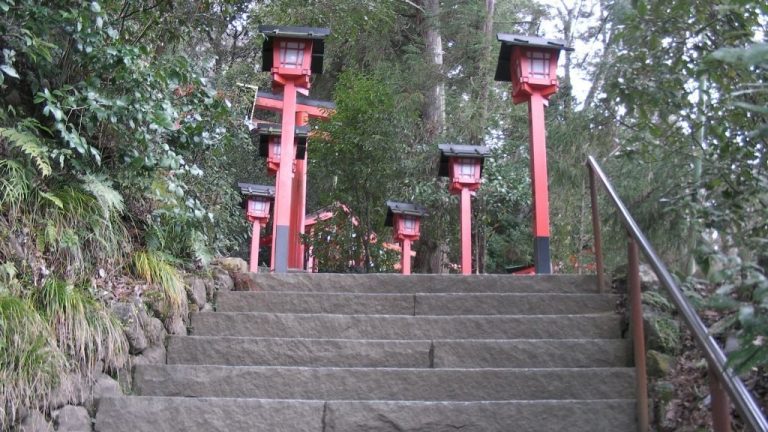
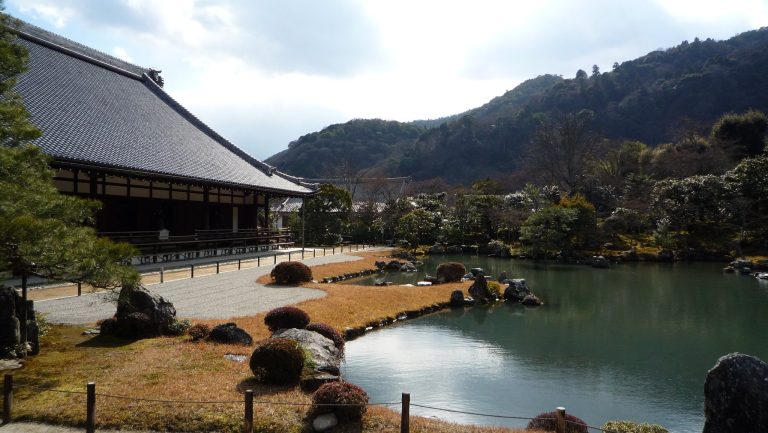
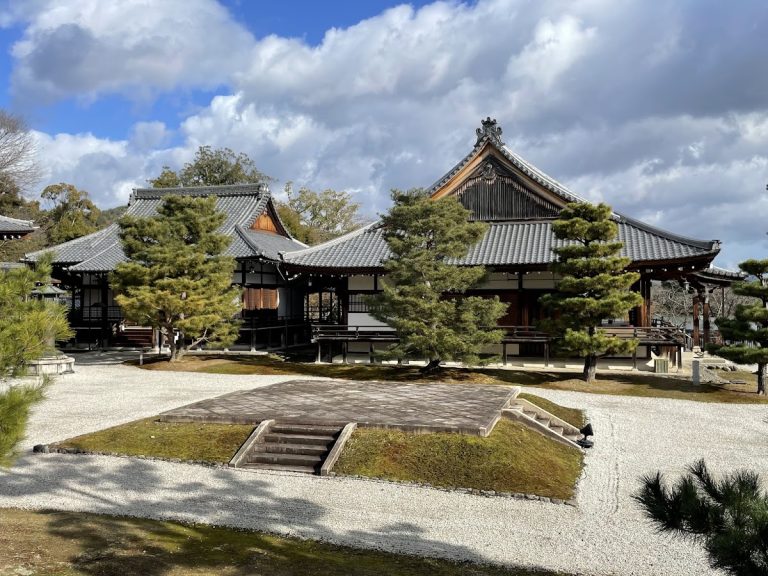
Hōrin-ji stands on the mountainside of Arashiyama, within a designated scenic area, under the mountain name Chifuku-san. The precinct includes the main hall, sacred images and animal figures, the Den-den-gu shrine, and the Animal Memorial Monument at the entrance approach. Hōrin-ji Bridge, later known as Togetsukyō, formed the historic approach used by pilgrims traveling to the temple and remained associated with Hōrin-ji after the later name came into use.
Temple buildings and approach
Main hall
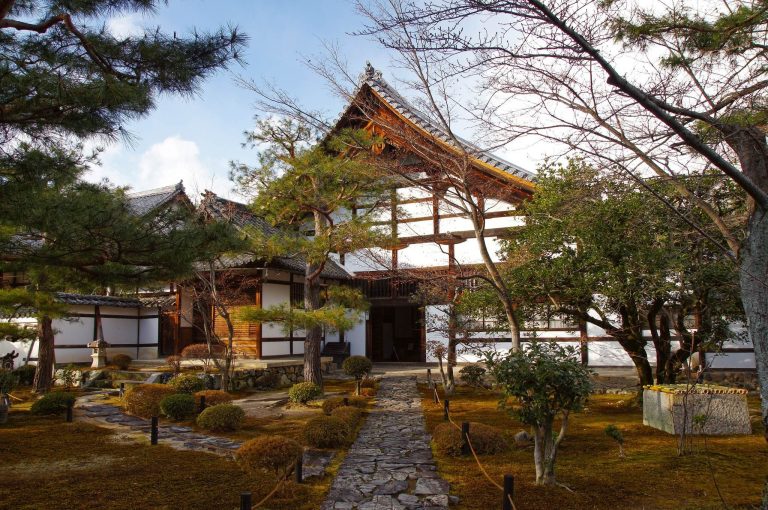
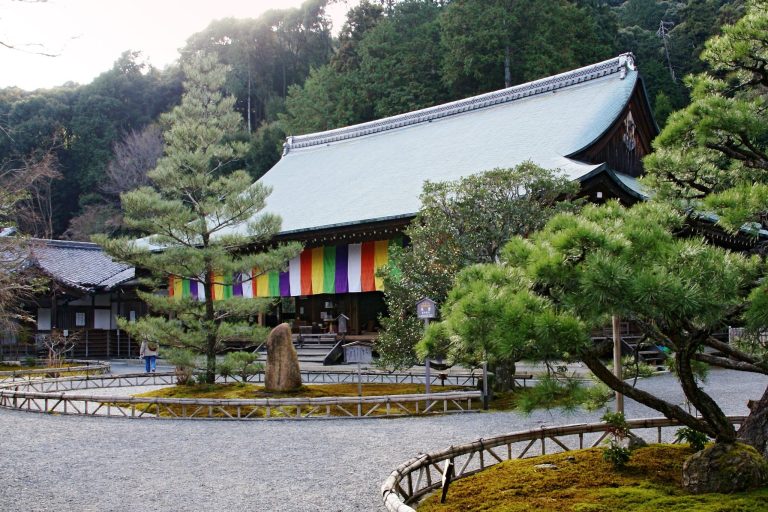
The main hall houses the principal image of Ākāśagarbha. The image is regarded as a hidden image and is not ordinarily revealed, giving the hall its central role within the temple’s worship. The hall belongs to the reconstructed group of buildings that followed the destruction of 1864, with its rebuilding completed in 1884.
Hōrin-ji Bridge and pilgrimage approach
Hōrin-ji Bridge was constructed by Dōshō in 836 as an approach for pilgrims traveling to the temple. Emperor Kameyama later gave it the name Togetsukyō, while the formal name Hōrin-ji Bridge continued until the Edo period. The bridge’s historical association with the temple continued after the later name became established.
Sacred figures and precinct features
Ākāśagarbha and animal figures
Statues of an ox and a tiger stand in the grounds because Ākāśagarbha is regarded as the protective deity of people born in those zodiac years. A sheep statue is also present because the sheep is regarded as Ākāśagarbha’s attendant animal. Together, these figures give physical form to traditions connected with the deity’s protection and worship at Hōrin-ji.
Den-den-gu
Den-den-gu is a shrine within the temple precincts dedicated to the protection of electricity and radio waves. Its presence adds a distinct modern technological association to the religious landscape of Hōrin-ji while retaining the shrine’s place within the temple grounds.
Animal Memorial Monument
The entrance approach contains the Animal Memorial Monument. It is the location of the annual animal-spirit memorial service held each April by the Kyoto City Meat Cooperative, connecting a physical feature of the approach with a continuing memorial practice.