Susa Shrine: A Shinto Shrine Associated with Susanoo-no-Mikoto


Site at a Glance
- Rating
- 4.5
- Popularity
- Medium
- Country
- Japan
- Primary era
- Unclassified
- External website
- Open
- Eras represented
- Unclassified
- Civilizations
- Unclassified
- Site type
- Religious
- Remains
- Sanctuary
On this page7 sections
History
Susa Shrine is a Shinto shrine in Izumo, Japan, traditionally said to have been founded in the age of the gods and dated to 776. Its principal deity is Susanoo-no-Mikoto, a major Shinto kami associated in myth with storms, purification, and the defeat of the serpent Yamata-no-Orochi. Since antiquity, the shrine has been regarded as Susanoo’s principal shrine.
Origins and Early Records
The eighth-century Izumo Fudoki, a record of Izumo Province’s geography, traditions, and institutions, relates that Susanoo-no-Mikoto came to the area after developing other parts of the land. He completed his work there, named the place Susa, and enshrined his spirit. The same record lists Susa Shrine by name. The shrine’s hereditary priestly Susa clan is traditionally said to descend from Kayanarumi, described as a son of Okuninushi.
The earlier shrine site is traditionally identified with Miyaoyama, north of the present grounds. The current location, near the center of a basin, is considered to have been occupied by the shrine by the medieval period. The tenth-century Engishiki, a compilation of laws, administrative procedures, and shrine registers, lists Susa Shrine as a minor shrine.
Names, Status, and Religious Practice
During the medieval period, the shrine was known as Jusan-sho Daimyojin and Omiya Daimyojin. In the early modern period it was called Susa Omiya, before its name was restored to Susa Shrine in 1871. It was classified as a village shrine in 1872, elevated to a prefectural shrine in 1873, and placed in the lower-grade national shrine category in 1900. This was a prewar state-sponsored ranking system for shrines. Susa Shrine is also the 18th entry in the Izumo Shinbutsu route, a regional list of shrines and temples associated with the historical region of Izumo.
Susanoo-no-Mikoto is accompanied at the shrine by his mythological consort Kushinadahime and her parents, Ashinazuchi and Tenazuchi. The annual festival takes place on April 18. The shrine’s principal religious observance is the Nenbutsu Odori, a ritual dance designated an intangible folk cultural property of Shimane Prefecture in 1961.
Protected Cultural Properties
In 1554, Amago Haruhisa dedicated a hyogo-kusari tachi, a Japanese sword with chain-link fittings in its mounting, to the shrine. Its blade is unsigned, and the sword was designated an Important Cultural Property of Japan in 1912. The main hall received designation as an important cultural property of Shimane Prefecture in 1966. A bugaku mask named Nasori, used in a traditional form of Japanese court dance accompanied by instrumental music, was designated in 1972. Fragments of black-leather-laced armor received designation in 2005.
Remains
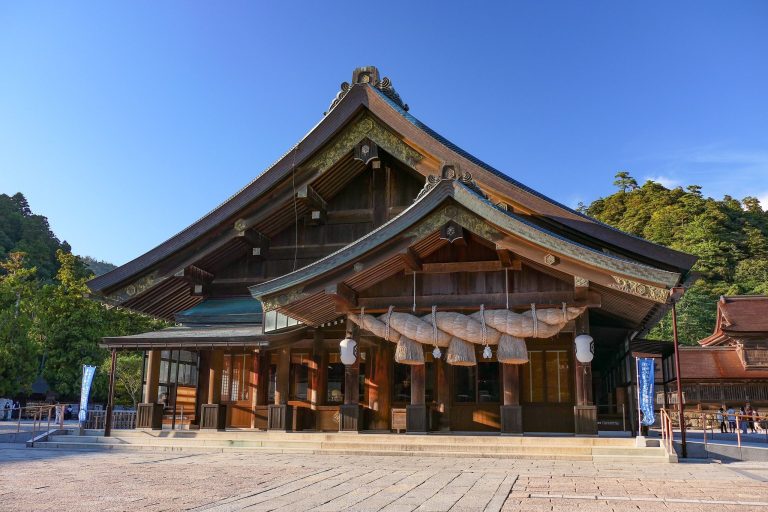
Susa Shrine stands on grounds that include a main hall, smaller shrines, and features associated with traditions about seven wonders. The principal building follows the Taisha-zukuri style, an ancient Japanese shrine form characterized by a raised timber structure and a steeply pitched roof.
Main Hall and Smaller Shrines
The main hall is built in the Taisha-zukuri style and forms the principal architectural feature of the grounds. A number of smaller shrines also occupy the precinct, creating a group of related religious buildings around the main hall.
Seven Wonders of the Grounds
Traditions about the grounds include seven wonders. Among them are a sacred tree said to be 1,300 years old, a cherry tree said to cast no shadow, and a saltwater well. These features form part of the shrine’s longstanding religious landscape.