Matsunoo Taisha: A Shinto Shrine in Kyoto


Site at a Glance
- Rating
- 4.3
- Popularity
- Medium
- Country
- Japan
- Primary era
- Medieval
- External website
- Open
- Eras represented
- Medieval, Early Modern, Modern
- Civilizations
- Ashikaga shogunate, Japanese, Tokugawa, Yamato
- Site type
- Religious
- Remains
- Sanctuary
On this page26 sections
History
Matsunoo Taisha is a Shinto shrine in Japan, at the western end of Shijo Street in Kyoto, traditionally associated with the Hata clan and conventionally founded in 701. Shinto is Japan’s indigenous religious tradition, centered on reverence for kami, sacred presences linked with deities, ancestors, natural features, and revered objects. Matsunoo’s history combines ancient mountain worship, imperial patronage, medieval estate management, and continuing rituals connected with agriculture and brewing.
Mountain worship and the Hata foundation
Worship at Matsunoo is traditionally said to have begun at an iwakura, a natural rock regarded as a place where a kami is present or worshipped, near the summit of Mount Matsuo. The mountain was revered as a kannabi, a natural feature treated as a sacred divine body. Near the summit, in Osugi Valley, the large rock known as the Goshinseki remains associated with this early sanctuary.
The shrine’s foundation is conventionally dated to 701, with 701 to 702 also given in some traditions. Hata no Imikitori is said to have established shrine buildings by imperial command and transferred the sacred presence from the mountain rock to the present site. The reason for choosing the lower location is uncertain. One tradition holds that worship was deliberately placed beside a large rock later exposed behind the main hall.
Hata no Chimarume is said to have served as the foundation’s female ritual attendant. In 718, her son Hata no Tsugafu supposedly became the shrine’s first ritual official, beginning a tradition in which members of the Hata lineage continued to serve Matsunoo for generations. The principal deities are Oyamakui no Kami and Nakatsushima-hime no Mikoto, the latter regarded as another name for Ichikishima-hime no Mikoto.
Traditions about the shrine’s divine origins are not entirely consistent. Oyamakui is connected with the mountain deity described in early mythological traditions, while a record associated with the Hata lineage states that a deity from Munakata descended onto the mountain. The place called Matsuzaki-Hio, or Hizaki-mine, in that tradition has been identified variously with Matsugasaki and with the summit of Mount Matsuo.
The Hata clan and the Heian capital
Matsunoo was closely connected with the immigrant-descended Hata clan from antiquity and served as its ujigami shrine, meaning the sanctuary of a clan or local tutelary deity. The Hata are traditionally described as descendants of Yuzuki no Kimi, who was associated with the Qin dynasty. From approximately the late fifth century onward, they built an important economic base in the Yamashiro region.
The clan developed the Katsura River basin and carried out flood-control works at the Katsuno weir. These activities formed part of the regional background to the later establishment of the capitals at Nagaoka and Heian. After the capital moved to Heian-kyo, Matsunoo was paired with the Kamo shrines as a western guardian of the capital. Matsunoo was praised as the “mighty spirit of the west,” in contrast with Kamo’s “severe deity of the east,” and received sustained imperial patronage.
A tradition recorded for 720 gives Matsunoo the title “Great Shrine.” In 784, Emperor Kanmu reported the transfer of the capital to Matsunoo and to the deity of Otagi, and the shrine’s deities received the rank of Junior Fifth Rank, Lower Grade. They were promoted to Junior Fourth Rank, Lower Grade, in 786. The shrine eventually reached Senior First Rank, Second Class Merit, in 866, while a later tradition records the highest rank of Senior First Rank, First Class Merit.
The 927 Engishiki, an early tenth-century compilation of court procedures and rites, lists Matsunoo Shrine as a two-seat Myojin-taisha in Katsuno District of Yamashiro Province. It was entitled to offerings at monthly rites and at the Ainame and Niiname ceremonies, which were associated with the court’s agricultural and harvest observances. By the middle of the Heian period, Matsunoo was one of the Twenty-Two Shrines, a medieval ranking of sanctuaries that received special imperial attention, and belonged to the Upper Seven, the system’s highest-ranking group.
Imperial visits, offerings of sacred treasures, and prayers are recorded during the reign of Emperor Ichijo and those of several later emperors. Shrine lands were also frequently donated. During the medieval period, these holdings developed into estates whose revenues and administrative rights were held by religious institutions or private proprietors. Matsunoo’s lands extended beyond Yamashiro into parts of Totomi, Etchu, Hoki, Tamba, Settsu, and other provinces. Four shrine households were granted in 767 and 769, further land and households followed in the ninth century, and Fujiwara no Tadamitsu donated estates in 1110.
Medieval patronage and estate administration
During the Kamakura period, Minamoto no Yoritomo visited Matsunoo and presented a prayer document, 100 ryo of gold, and ten sacred horses. During the period of the Northern and Southern Courts, the Muromachi shogunate assigned taxes from Yamashiro and Katsuno District to finance the rebuilding of shrine buildings.
The shrine’s estates were repeatedly affected by the political changes of the sixteenth century. After Oda Nobunaga entered Kyoto in 1568, the estates were temporarily entrusted to Ueno Hidemasa and were restored to the shrine in 1572. Hosokawa Fujitaka guaranteed the shrine’s tax revenues in 1575. Under Toyotomi Hideyoshi, Sugihara Ietsugu guaranteed the estates, although the shrine’s right to their income was restricted as government-held lands were created.
The Edo shogunate later confirmed either 1,078 koku of shuinchi or 1,333 koku of shrine lands. A koku measured the productive value of land, while shuinchi referred to land confirmed by a shogunal vermilion-seal document. The recorded allocation included 933 koku at Taniyamada in Katsuno District and 145 koku at Nishishichijo, the western temporary shrine.
Modern status and religious identity
Late in the Edo period, Matsunoo became an imperial-messenger festival shrine. In 1871, under the modern state shrine-ranking system, it was classified as a Kanpei-taisha, the highest category of state-supported shrine used from 1871 to 1946. In 1948, it became a Beppyo shrine of the Association of Shinto Shrines. The official name changed from Matsuo-sha to Matsunoo Taisha on August 30, 1950.
The shrine’s present parish area chiefly covers parts of Ukyo, Nishikyo, and Shimogyo wards. It is said to include about one-third of Kyoto’s urban area and approximately 40,000 households. Medieval traditions increasingly linked Matsunoo with sake production, and the shrine is now especially revered by brewers and makers of miso, soy sauce, and vinegar.
The origin of the sake association remains connected in shrine tradition with the Hata clan’s reputed brewing skills and with Hata no Sake no Kimi. Another interpretation places the formation of this religious identity in the medieval period, when the kyogen play God of Fortune first clearly describes the Matsunoo deity as administrator of the gods’ sake. The shrine also preserves traditions about turtles and carp as divine messengers. One story says that the deity travelled upstream through the Katsura River on a carp in the rapids and on a turtle in slower water.
Festivals and affiliated shrines
The annual Matsuo Festival consists of the Shinko and Kanko rites, traditionally called “the going” and “the return.” The festival is said to have begun during the Jogan era and was regulated in the Engishiki. It declined after the Onin War, a fifteenth-century conflict that damaged Kyoto and disrupted many institutions, and was later revived.
During the Shinko, six shrine deities are transferred to mikoshi, portable shrines used to carry kami in procession, while the Tsukuyomi deity is placed in a karahitsu, a portable sacred chest for a comparable ritual transfer. The procession crosses the Katsura River by boat, offers ritual dumplings at a riverbank sanctuary, and places the portable shrines at designated temporary shrines for three weeks.
During the Kanko, the portable shrines gather at Asahi-no-Mori, the site of the former Sai-ji temple, and receive a special sekihan offering. They then proceed to the Suzaku temporary shrine, cross Matsuo Bridge, and return to the main shrine. Because the buildings, portable shrines, and clerical headwear are decorated with aoi and katsura during the return procession, the festival is also called the Aoi Festival.
The shrine holds the Upper Hare Festival in November to pray for safe brewing and the Middle Rooster Festival in April to mark the completion of brewing. Brewing professionals from throughout Japan traditionally begin making sake after the Upper Hare rite. The Onda Festival in July prays for protection of rice fields from insects and is registered as an Intangible Folk Cultural Property of Kyoto City.
Matsunoo’s affiliated network includes two subsidiary shrines outside the main precinct and several branch shrines, including seven within the grounds. Matsunoo, Tsukuyomi, and Ichitani shrines are called the Three Matsunoo Shrines. Together with Sannomiya, Shino-Okami, and Koromo-de, they form the Seven Matsunoo Shrines. Tsukuyomi Shrine, about 400 meters south of the main shrine, entered Matsunoo’s sphere of influence at an early date. Its present location dates to 856, and it received high court ranks in 859 and 906.
Ichitani-Munakata Shrine stands near the southern end of Togetsukyo Bridge and consists of Ichitani Shrine and Munakata Shrine within one building. The two sanctuaries are traditionally understood to have originated as water-related local shrines at the point where the Katsura River leaves the Hozu Gorge. Other affiliated shrines include Mifune Shrine and Shotoku Taishi Shrine at Tsukuyomi Shrine; Sannomiya Shrine, Shino-Okami Shrine, and Taki-no-Mae in the northern section; and Koromo-de Shrine, Ikkyosha, Konpira Shrine, and Sorei Shrine in the southern section. Ikkyosha is recorded as existing in the Muromachi period, while Sorei Shrine enshrines people associated with the shrine’s history.
Remains
Matsunoo Taisha stands at the eastern foot of Mount Matsuo, a 223-meter sacred mountain at the western edge of the Kyoto Basin. The precinct covers approximately 120,000 tsubo and lies entirely within a scenic district. Its physical setting brings together the mountain sanctuary, the principal shrine buildings, a spring, an evergreen grove, affiliated shrines, gardens, and collections of religious sculpture.
Main sanctuary and precinct buildings
Main hall
The main hall, or honden, is a single-story sanctuary with three bays across the front and four bays in depth. It faces east and has a cypress-bark roof whose slopes extend equally toward the front and rear. This unusual arrangement is called ryunagare-zukuri, or double nagare-zukuri, a shrine form with roof slopes running in both directions, and is also known as Matsuo-zukuri. The ends of the box ridge have curved karahafu gables, a distinctive form described as having no other known example.
The present building followed a fire in 1285 and was rebuilt in 1397, during the early Muromachi period. Most of its structural members date from a major rebuilding in 1542, which is used as its construction date in current cultural-property descriptions. Repairs took place in 1851 and 1924, and roof replacement and other work followed in 1971. The main hall is an Important Cultural Property of Japan.
Sacred storehouse
A sacred storehouse stands north of the main hall in parallel alignment. It is built in the azekura technique, a log-construction method used for storehouses, and measures two bays by three bays. Its cypress-bark roof complements the sanctuary buildings. An illustrated map from the early Muromachi period shows a temporary sanctuary at this position, while Edo-period maps show a storehouse for mikoshi.
The mikoshi storehouse was moved south of the worship hall in 1863. The present sacred storehouse was built after that relocation, preserving the northern position within the central architectural group.
Connecting hall and corridor
A tsuridono, or connecting hall, adjoins the main hall at its worship porch. A board-floored corridor extends north and south from the eastern side of this hall, enclosing the main hall and sacred storehouse. The corridor has three gates: the central Chumon in front of the main hall, Hokuseimon to the north, and Nanseimon to the south. The connecting hall, corridor, and gates all have cypress-bark roofs and were rebuilt in 1851. A kitchen for sacred offerings stands toward the rear right of the corridor.
Worship hall
The worship hall, or haiden, stands at the center of the forecourt opposite the central gate. It has an irimoya roof, which combines hipped and gabled forms, and a cypress-bark covering. The building is used for the Great Purification and other rites, and its form is already shown in Edo-period plans.
Entrance gate and torii
The entrance gate is a two-story romon, a gate with two levels and no projecting roof between them. It has three bays, a single passage, and an irimoya cypress-bark roof. Topped out in 1667, it is approximately 11 meters high and has a restrained Japanese design without elaborate decoration.
The entrance torii carries a plaque reading “Matsuo Okami,” written by Imperial Prince Arisugawa Takahito. Twelve bundles of small sacred sakaki branches, called wakikanjo, hang from the gate. They are traditionally understood as preserving a primitive form of torii decoration.
Mountain sanctuary, spring, and woodland
Goshinseki and Mount Matsuo
Mount Matsuo rises behind the shrine as the natural setting of its oldest worship. In Osugi Valley near the summit, the Goshinseki remains associated with the ancient iwakura sanctuary. Shrine tradition identifies the mountain with the place where the deities descended, preserving the relationship between the elevated rock sanctuary and the buildings established below.
Kame-no-I
Behind the shrine buildings is Kame-no-I, a spring fed from Mount Matsuo. Shrine tradition holds that sake mixed with its water will not spoil, and brewers continue to take the water for use in production. The spring’s name is associated with the turtle, one of Matsunoo’s divine messengers.
Shrine grove
The main grove is an evergreen broad-leaved forest regarded as a mature climax forest of the Kyoto region. Wild Uncaria plants grow chiefly along streams within the grove. Their occurrence at Matsunoo is considered the northern limit of this vegetation in Japan and has botanical value. The grove is designated the “Wild Growth Area of Uncaria at Matsunoo Taisha” and is a natural monument of Kyoto City.
Gardens and landscape materials
Shofuen is a garden complex completed in 1975. Its Joko Garden uses stones resembling iwakura to evoke ancient ritual landscapes. The Kyokusui Garden represents a winding stream associated with Heian-period garden design, while the Horai Garden represents the island of Horai in the style of a Kamakura-period garden. An additional Improvised Garden was created outside the original plan.
Mirei Shigemori designed the Joko and Kyokusui gardens. His son Kanto designed the Horai Garden and supervised its completion after his father’s death. All the garden stones are green schist from Tokushima Prefecture.
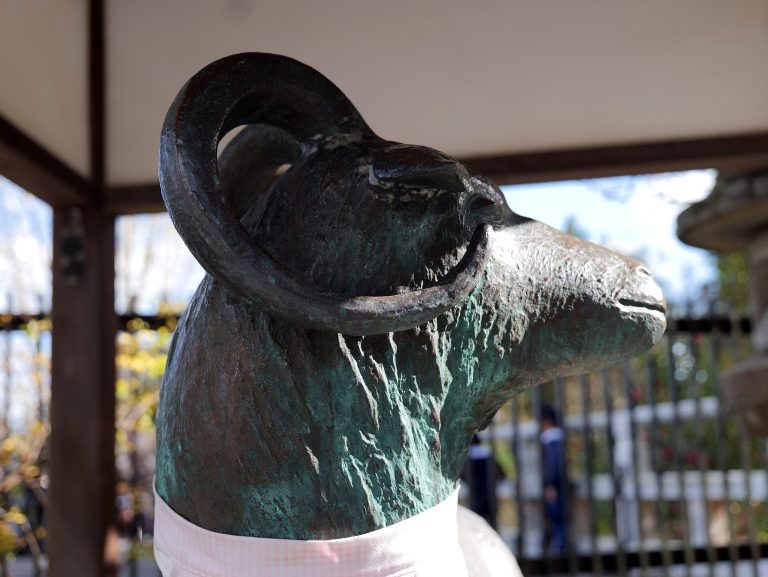
Since 1983, a large zodiac ema, a votive picture tablet, has been displayed annually at the entrance through the association Matsuo-kai. Based on an original by print artist Masao Ido, it measures approximately 3.2 meters high, 5.5 meters wide, and 15 centimeters thick, and weighs about 90 kilograms.
Religious sculpture and historical images
Principal kami images
The Treasure Hall preserves three wooden kami images, consisting of two seated male figures and one seated female figure. They are regarded as works of the Heian period and among the oldest surviving kami images in Japan. Tradition identifies the aged male figure with Oyamakui no Kami, the female figure with Nakatsushima-hime no Mikoto, and the mature male figure with Tsukuyomi no Mikoto, although these identifications remain uncertain.
Images from affiliated shrines
A further group of eighteen wooden kami images dates from the late Heian to the Kamakura periods. Most are single-block carvings, made primarily from one piece of wood while retaining the tree heart. Their former locations included Tsukuyomi Shrine, Ichitani-Munakata Shrine, Sannomiya Shrine, Koromo-de Shrine, Shino-Okami Shrine, Ikkyosha, and Konpira Shrine.
One seated female image from Ichitani-Munakata bears an inscription dated February 11, 1143, among the earliest known dated inscriptions on a Japanese kami image. The former Tsukuyomi image is particularly well preserved and is regarded as representative of late Heian religious sculpture. Another female image identifies the shrine chief priest as its donor and records its commissioning, the ritual opening of its eyes, and its makers.
Sixteen images from this group received designation as Tangible Cultural Properties of Kyoto Prefecture in 2013. The group of eighteen received national Important Cultural Property designation in 2025. The images are housed and exhibited with the three principal figures in the Treasure Hall.
Landscape painting
Matsunoo also possesses a colored picture on paper showing the shrine area from the east, with Mount Matsuo in the background. Made in the early Muromachi period, it preserves a historical view of the shrine landscape, although the precise setting represented in the picture is uncertain. The work is deposited at the Kyoto National Museum.
Subsidiary shrines
Tsukuyomi Shrine
Tsukuyomi Shrine lies about 400 meters south of the main shrine. Its precinct is associated with the ancient Myojin-taisha known as Katsuno-no-Tsukuyomi Shrine and is designated a historic site by Kyoto City. Mifune Shrine and Shotoku Taishi Shrine stand within its affiliated group.
Ichitani-Munakata Shrine
Near the southern end of Togetsukyo Bridge, Ichitani-Munakata Shrine houses Ichitani Shrine and Munakata Shrine in one building. The two sanctuaries occupy the place where the Katsura River emerges from the Hozu Gorge, a location traditionally associated with water-related local worship.
Other affiliated shrines
The northern section includes Sannomiya Shrine, Shino-Okami Shrine, and Taki-no-Mae. The southern section includes Koromo-de Shrine, Ikkyosha, Konpira Shrine, and Sorei Shrine, which enshrines people associated with the shrine’s history. The western temporary shrine, Nishishichijo, has an associated Take-no-Mae Shrine, while Doso Shrine is associated with Sannomiya Shrine. Oi Shrine, near the north end of Togetsukyo Bridge, formerly had a relationship with Matsunoo.
Together, the main buildings, sacred mountain, spring, woodland, subsidiary shrines, gardens, sculptures, and landscape image preserve material and ritual links between ancient mountain worship, medieval institutional development, and the shrine’s later architectural history.