Hōraisan Kofun: An Elite Burial Mound in Tokyo


Site at a Glance
- Rating
- 3.9
- Popularity
- Very Low
- Country
- Japan
- Primary era
- Classical
- External website
- Open
- Eras represented
- Classical
- Civilizations
- Yamato
- Site type
- Burial
- Remains
- Burial Mound
On this page9 sections
History
Hōraisan Kofun is a large elite burial mound in Tokyo, Japan, built during the fourth century in the Kofun period, an era when powerful individuals were buried in monumental mounds. It stands on the southwestern edge of the Musashino Plateau beside the left bank of the Tama River and forms one of the principal tombs of the Ebaradai Kofun Group.
Origins and Regional Importance
The tomb was probably constructed around the end of the fourth century, during the middle Kofun period. Another interpretation places its construction in the first half of the fourth century, during the early Kofun period. In either chronology, Hōraisan Kofun is regarded as earlier than the neighboring major tomb, Kikkōzan Kofun, and as the first chiefly tomb in the lower Tama River region.
Hōraisan Kofun and Kikkōzan Kofun represent the group’s major monumental tombs. Their position within the Ebaradai group reflects the concentration of elite burial monuments along the Tama River and on the adjoining plateau edge.
Damage, Investigation, and Protection
Residential development in 1934 led to the removal of soil from the rear mound. About two-thirds of that part of the tomb was destroyed, exposing its burial facility and bringing numerous grave goods to light. The recovered objects are now held by Keio University and the Ota City Local History Museum, while replicas are displayed in the Kofun Exhibition Room at Tamagawa-dai Park.
A marker was erected at the kofun in 1926. Tokyo designated it a historic site in 1952 and an “old site” in 1955. On March 18, 1996, it was reclassified as a Tokyo-designated historic site, when the present spelling of its name was adopted. The name had appeared in an older form as a place-name on a 1906 survey map. A confirmation survey accompanied improvements to the park in 1995, and the surrounding area was incorporated into Tamagawa-dai Park as a developed historic site.
Remains
Mound Layout
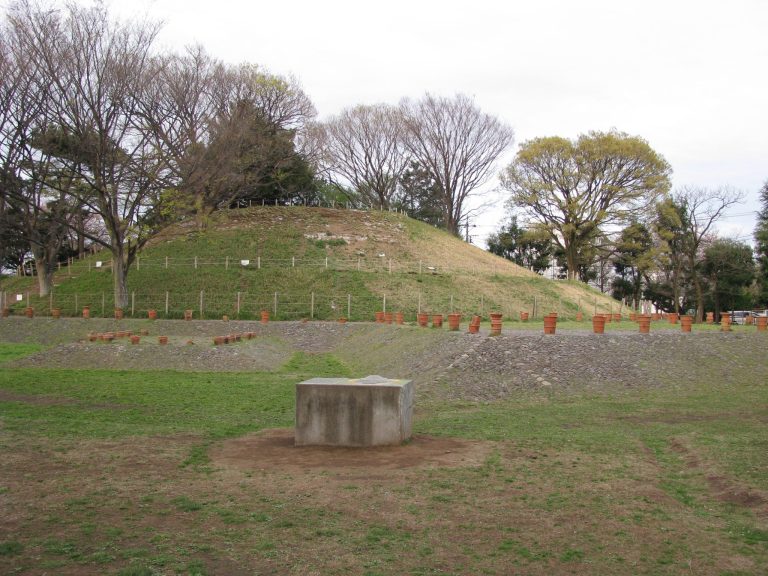
Hōraisan Kofun is a keyhole-shaped tumulus, a burial mound combining a rounded rear section with a projecting front section. The complete mound measures 97.5 meters in length. Its fan-shaped front points southeast toward Kikkōzan Kofun, the neighboring major tomb. A single terrace runs around the mound.
The rear circular mound was constructed in three tiers. It was approximately 52 meters in diameter and about 11 meters high, although roughly two-thirds of it was cut away in 1934. The front section was built in two tiers, measures about 37 meters across, and rises approximately 8 meters. The surviving portions are comparatively well preserved.
No stone revetment, meaning a covering of stones placed over the mound’s exterior, or haniwa, clay funerary objects arranged around some tumuli, has been identified on the outside of the mound.
Burial Facilities
Rear-Mound Burial Facility
The principal burial facility lies beneath the summit of the rear mound, approximately 3 meters below its top. It is a clay burial enclosure, in which a coffin or burial container was enclosed in compacted clay. Its exposure during the 1934 earth removal revealed numerous grave goods, which provide material evidence for the tomb’s funerary use.
Front-Section Burial Facility
A second burial facility is thought to lie within the front section. It has not been investigated, so its construction and contents remain unknown.
Plateau Setting
The kofun occupies the edge of a plateau overlooking the Tama River and forms part of the wider Ebaradai Kofun Group. Its surviving mound, including the rounded rear section and southeast-facing front, remains within the historic-site area of Tamagawa-dai Park.