Honren-ji Temple: A Buddhist Temple and Korean Diplomatic Mission Site in Japan


Site at a Glance
- Rating
- 4
- Popularity
- Very Low
- Country
- Japan
- Primary era
- Medieval
- Eras represented
- Medieval
- Civilizations
- Ashikaga shogunate
- Site type
- Religious
- Remains
- Temple
On this page11 sections
History
Honren-ji Temple is a Buddhist temple in Ushimado, Setouchi, Okayama Prefecture, Japan. It began as a Nichiren Buddhist institution and now belongs to the Hokkeshū Honmonryū branch, a tradition of Japanese Lotus-Sutra Buddhism, as a branch temple of Honkōji, the branch’s head temple. Its present Main Hall was reconstructed in 1492 during the Muromachi period, which preceded the Edo period of shogunal rule.
Origins and medieval development
Tradition attributes the establishment of a Lotus-Sutra hall, the predecessor of the present Main Hall, to Daikaku Daisōjō, a high-ranking Buddhist cleric and head priest of Myōkenji Temple in Kyoto. One tradition places the foundation in spring 1338, while the temple’s historical beginning is also dated to 1347. The circumstances remain uncertain because the name “Ushimado-ura Hokke-dō” first appears in surviving temple documents in 1450.
Daikaku is said to have instructed Ishihara Sado-no-kami, a member of Ushimado’s local ruling family, in devotion to the Lotus Sutra. He then led Ishihara into Buddhist religious practice, an association traditionally connected with the establishment of the hall. The present Main Hall succeeded that earlier building and was reconstructed in 1492.
Ushimado and the Korean missions
Ushimado developed from ancient times as a Seto Inland Sea port where ships waited for favorable winds and tides. During the Edo period, the Korean diplomatic missions to Japan, official embassies sent by Korea to the Japanese shogunate, called at the port. Okayama Domain was responsible for receiving the missions when they arrived.
The Korean missions visited Japan twelve times during the Edo period. Honren-ji lodged the three ambassadors during the third through sixth missions. From the seventh mission onward, the ambassadors stayed at a teahouse, but Honren-ji continued to accommodate other members of the delegations and hosted meetings with dignitaries from Okayama Domain.
Protection and continuing traditions
In 1994, the temple precinct became part of the Sites of the Korean Diplomatic Missions, a National Historic Site, together with Fukuzen-ji in Fukuyama and Seiken-ji in Okitsu. Honren-ji also preserves nine scrolls of historical documents connected with the Korean envoys. These scrolls are designated Okayama Prefectural Important Cultural Properties, alongside related plaques and Chinese poems kept at the temple.
Ushimado continues to maintain the Karako Odori, a boys’ folk dance traditionally said to have originated with the Korean diplomatic missions and to have been modeled on their customs. The tradition provides a continuing local association with the embassies that once passed through the port.
Remains
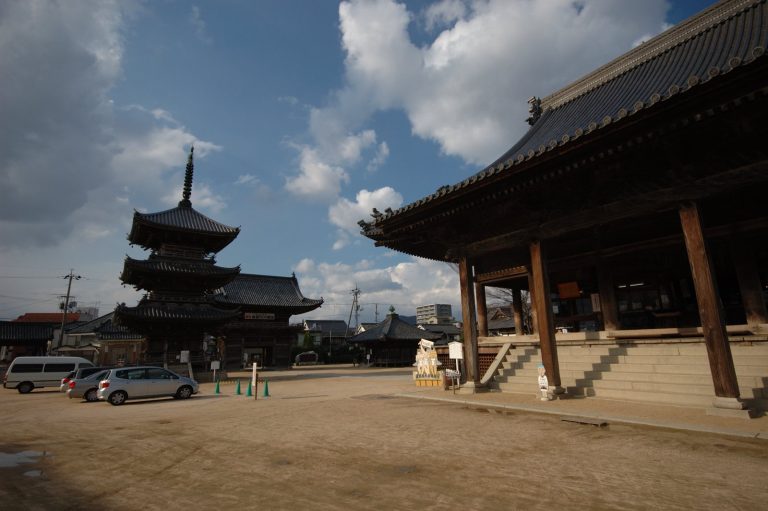
The surviving temple precinct brings together the reconstructed Main Hall, the Banshin-dō, the Middle Gate, the Soshi-dō, and a Three-story Pagoda. A guest hall associated with the Korean envoys also contains a garden traditionally attributed to Kobori Enshū, a Japanese architect, garden designer, and tea master of the early modern period.
Principal temple buildings
Main Hall
The Main Hall is the present successor to the earlier Lotus-Sutra hall and took its current form through reconstruction in 1492. It is one of the principal buildings in the precinct and is designated a National Important Cultural Property.
Banshin-dō
The Banshin-dō consists of eastern, central, and western shrine structures or chapels dedicated to protective Buddhist or syncretic religious deities associated with temple worship. The complex is designated a National Important Cultural Property.
Middle Gate
The Middle Gate forms part of the historic temple grounds and is designated a National Important Cultural Property. Its position within the precinct links the principal buildings and shrine structures that make up the surviving complex.
Soshi-dō and Three-story Pagoda
The Soshi-dō and Three-story Pagoda are additional buildings within the grounds. Both hold Okayama Prefectural cultural-property status, adding to the range of preserved structures within the temple precinct.
Diplomatic remains
The guest hall formerly used by the Korean envoys contains a garden traditionally attributed to Kobori Enshū. Honren-ji also preserves nine scrolls of historical documents relating to the missions, together with associated plaques and Chinese poems. These materials complement the surviving buildings by preserving evidence of the temple’s role in receiving and hosting the Korean delegations.