Bizen Old Kilns: A Historic Japanese Pottery-Kiln Complex


Site at a Glance
- Rating
- 3.7
- Popularity
- Low
- Country
- Japan
- Primary era
- Early Modern
- External website
- Open
- Eras represented
- Medieval, Early Modern
- Civilizations
- Ashikaga shogunate, Tokugawa
- Site type
- Economic
- Remains
- Production Complex
On this page15 sections
History
Bizen old kilns are an archaeological complex of pottery kilns in Bizen, Japan, used from the late Muromachi period through the end of the Edo period. The complex includes the Inbe Minami-Ogama, Inbe Nishi-Ogama, and Inbe Kita-Ogama sites. Together, they preserve the remains of large-scale kiln production associated with the long development of Bizen ware.
Origins of Bizen ware
Bizen ware developed from Sue pottery, an early Japanese high-fired stoneware tradition. It emerged as a distinct ceramic tradition during the Kamakura period, conventionally dated to 1185–1333, when changing lifestyles increased demand for hard, durable vessels for everyday use. Before the large communal kilns were established, smaller kilns were scattered in the mountain areas of Uraibe and Kumayama in the former province of Bizen.
As Bizen ware became popular and its distribution extended beyond the surrounding area and the Kinki region, larger kilns were built at the foothills from the late Muromachi period, which lasted from 1336 to 1573. Their construction supported the mass production of pots, jars, sake bottles, mortars, and other practical wares.
Expansion and domain control
The rustic character of Bizen ware was valued in the tea ceremony during the Momoyama period, the late sixteenth-century era that led into the Edo period. Production at the large kilns reached its peak from the Momoyama period through the beginning of the Edo period, which lasted from 1603 to 1868. During the Edo period, the Ikeda clan, a powerful territorial family governing Okayama Domain, placed the kilns under domain administration and granted special privileges to the families operating them.
From the middle of the Edo period, ceramic production expanded across Japan, and sales of Bizen ware declined. The need for mass production diminished, domain protection weakened, and maintaining the large kilns became increasingly difficult. During the Tenpō era, from 1830 to 1843, smaller and more efficient kilns were introduced. The older large kilns were then abandoned or reduced in scale, and their operation ended by the close of the Edo period.
Reduction and historical recognition
The Inbe Kita-Ogama kiln remained in use into the middle of the Edo period. When it required rebuilding in 1720, sufficient funds could not be raised. A petition to the domain resulted in a reduction of the kiln to one-third of its original length, illustrating the practical difficulties facing large-scale production at the time.
Minami-Ogama was designated a National Historic Site on May 13, 1959. Nishi-Ogama and Kita-Ogama had earlier been designated Bizen City historic sites, in 1976 and 1971 respectively. Both were added to the national designation on February 12, 2009, when the designation name was changed to Bizen pottery kiln ruins. Bizen is also associated with the Six Ancient Kilns, a modern classification of Japan’s historically important ceramic-producing centers proposed by the scholar Koyama Fujio.
Remains
The complex is arranged around kiln groups built into or alongside the foothills of several mountains. The Minami-Ogama site lies at the northern foot of Mount Kayabara, Nishi-Ogama at the eastern foot of Mount Iō, and Kita-Ogama on the southern foot of Mount Furo around Inbe Shrine. The surviving kilns are climbing kilns, or noborigama, built along a slope so that heat could move through connected firing spaces or a continuous tunnel-like structure.
Minami-Ogama kilns
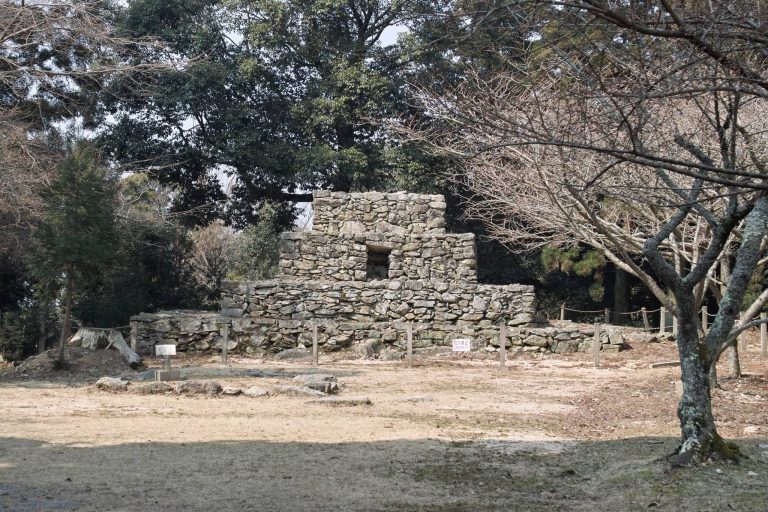
Minami-Ogama contains east, central, and west kilns, together with a discard mound holding damaged pottery and kiln tools. The three principal kilns extend up the mountain slope and have arched ceilings supported by earthen pillars. Their construction partly cuts into the hillside, combining the natural slope with the kiln structure.
East kiln
The east kiln measures approximately 54 meters in length and 5 meters in width. It is described as the largest pottery kiln in Japan. A single firing there could produce about 34,000 to 35,000 pieces, take approximately 35 days, and consume around 56 to 60 tons of firewood.
Central and west kilns
The central kiln is about 30 meters long and 2.3 meters wide, while the west kiln measures approximately 31 meters long and 2.8 meters wide. These kilns produced everyday vessels such as pots, jars, sake bottles, and mortars, as well as large jars, tea utensils, flower vessels, and other utility pottery.
Tenpō kiln
West of the west kiln are the remains of a smaller Tenpō kiln built around 1840. It measured approximately 18.5 meters long and 4.5 meters wide and continued operating until about 1885–1886. Its reduced size reflects the later move toward more efficient kiln production.
Earlier kiln on Mount Kayabara
A small Heian-period kiln was found halfway up Mount Kayabara at an elevation of about 70 meters. The Heian period dates conventionally from 794 to 1185. Measuring approximately 4–5 meters long and less than 1 meter wide, the kiln provides physical evidence of pottery firing at the location during an earlier period.
Nishi-Ogama site
Nishi-Ogama lies on the eastern foot of Mount Iō, where traces of three kilns have been identified. The largest measures approximately 40 meters long and 4 meters wide. The group mainly produced vases, jars, sake bottles, and mortars, along with large jars, tea utensils, and flower vessels.
Kita-Ogama site
Kita-Ogama lies on the southern foot of Mount Furo, around Inbe Shrine. Four kiln traces have been identified, and their surviving positions show how production was distributed around the shrine and its slopes.
Kiln divided by the shrine road
One kiln measures approximately 45 meters long and 4.7 meters wide. The road from Amatsu Shrine to Inbe Shrine divides it, and the kiln is believed to have been built during the Momoyama period.
Northwestern kiln group
Three other kilns run parallel to the northwest slope of Inbe Shrine. The northwesternmost measures approximately 47 meters long and 5.4 meters wide. Historical documentation places this kiln in the Ōei era, from 1394 to 1427, during the early Muromachi period, while objects recovered from the site date from the latter half of the Muromachi period.
Reduced kiln
The Kita-Ogama kilns produced pots, jars, sake bottles, mortars, large jars, tea utensils, and flower vessels. The kiln that required rebuilding in 1720 was reduced to one-third of its former length after the funds needed for reconstruction could not be raised, leaving the physical remains connected to the later decline of large communal production.