Tsuruyama Maruyama Kofun: An Early Kofun-Period Burial Mound in Japan
Site at a Glance
- Rating
- 3.1
- Popularity
- Very Low
- Country
- Japan
- Primary era
- Classical
- External website
- Open
- Eras represented
- Classical
- Civilizations
- Unclassified
- Site type
- Burial
- Remains
- Burial Mound
On this page8 sections
History
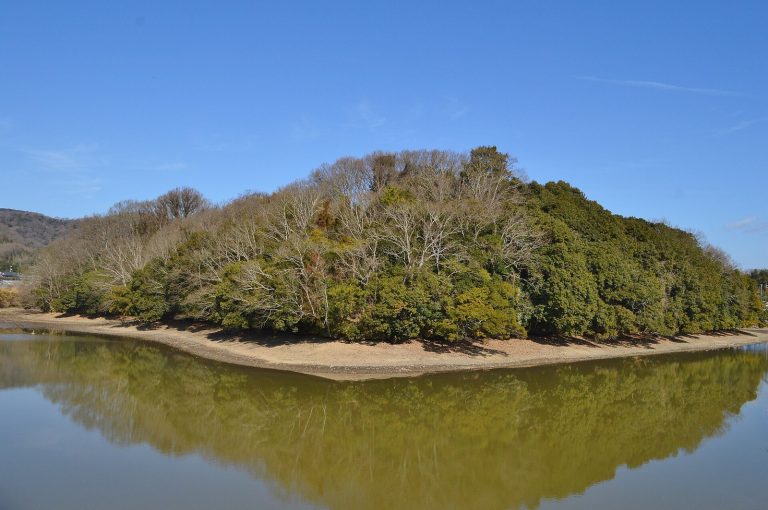
Tsuruyama Maruyama Kofun is a burial mound in Bizen, Okayama Prefecture, Japan, built by the ancient Japanese society of the early Kofun period during the latter half of the fourth century. The Kofun period, which lasted approximately from the third to the seventh century, was an era when large burial mounds were constructed for members of the ruling elite. Although chief mounds in southeastern Okayama were commonly keyhole-shaped, Tsuruyama Maruyama Kofun has a circular form with an attached extension, making it an especially distinctive example in the region.
Discovery and archaeological investigation
The stone burial chamber was discovered by local residents in 1936. Archaeological investigations followed, including work by the archaeologist Sueji Umehara and others. Their findings were reported in 1938, and later investigations by Kyoto University examined the chamber and its contents.
Protection and interpretation
The site was designated a National Historic Site of Japan on October 11, 1957, under the name “Maruyama Kofun.” Fourteen excavated artifacts and one rubbing of the stone sarcophagus received designation as Okayama Prefectural Important Tangible Cultural Properties on March 8, 2019. The materials are held by or stored at the Okayama Prefectural Museum, the Kurashiki Archaeological Museum, the Bizen City Museum of History and Folklore, and the Bizen City Center for Buried Cultural Properties. Together, the unusual mound design, distinctive coffin, and rich burial assemblage provide important evidence for early Kofun-period burial practices in southeastern Okayama.
Remains
The mound stands on Tsuruyama, an independent hill. It is circular and measures approximately 45 meters from east to west and 54 meters from north to south. Fukiishi, protective stones laid over a burial mound, were recognized on its surface, together with a row of cylindrical haniwa, clay objects arranged on or around kofun. A projecting extension approximately 15 meters wide is attached to the southeastern side.
Burial structures
Stone burial chamber
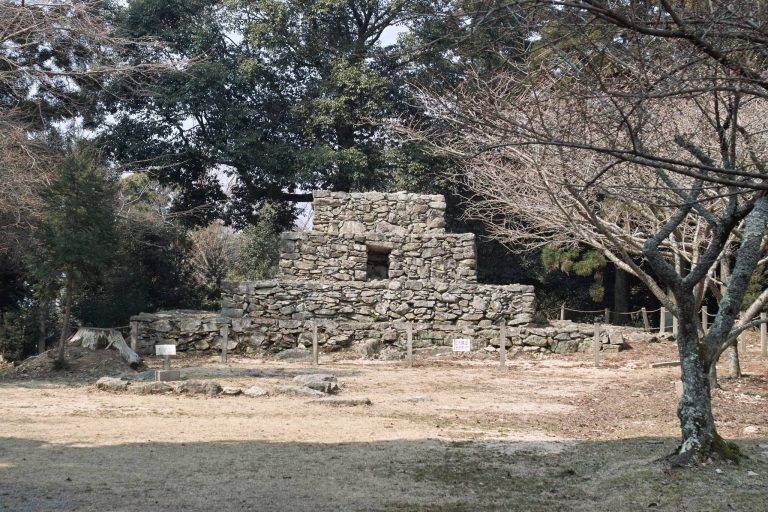
A pit-type stone burial chamber, built below ground within the mound, was placed at the summit. It measures about 4 meters long and 1.5 meters wide. Its ceiling was formed from four shaped tuff stones. Some of these stones have projections and round holes associated with ropes used to raise and lower the sarcophagus.
House-shaped sarcophagus
The chamber contained a house-shaped sarcophagus, a stone coffin whose form imitates a building. It was made from volcanic tuff brought from Kagawa Prefecture, probably from the eastern part of the prefecture. Carved designs on its surface include house and sun motifs, giving the coffin an unusually decorative appearance. The stone chamber has since been reburied.
Grave goods
The burial included approximately 30 bronze mirrors, of which 17 survive, along with numerous other objects. These include magatama beads, iron swords and arrowheads, box-shaped vessels, jars, and stands. Most of the excavated materials are held by the Tokyo National Museum, while bronze mirrors are also held by the Okayama Prefectural Museum. The Kurashiki Archaeological Museum holds two wheel stones and three tubular stone objects. The Bizen City Museum of History and Folklore holds a square-patterned compass mirror and three tubular beads, while the Bizen City Center for Buried Cultural Properties holds a crucible-shaped stone object and the rubbing of the sarcophagus. The latter two collections are not permanently displayed.