Holy Cross Church, Woodchurch: An Anglican Parish Church in Birkenhead
Site at a Glance
- Rating
- 4.3
- Popularity
- Very Low
- Country
- United Kingdom
- Primary era
- Medieval
- External website
- Open
- Eras represented
- Medieval, Early Modern, Modern
- Civilizations
- British, English, Norman
- Site type
- Religious
- Remains
- Church
On this page8 sections
History
Holy Cross Church, Woodchurch, is an active Anglican parish church in Birkenhead, United Kingdom, whose nave fabric originates from the twelfth century and whose present form combines Gothic and Gothic Revival characteristics. It belongs to the Diocese of Chester, within the Archdeaconry of Chester and the Deanery of Birkenhead, and follows a modern Anglo-Catholic tradition that places particular emphasis on Catholic liturgy, sacramental practice, and church decoration.
Early foundations and medieval development
The circular shape of the churchyard may point to a foundation before the Norman Conquest, possibly Saxon or Romano-British, although this remains an interpretation rather than a firmly established construction date. The north wall of the nave is Norman, a style associated in England with the period after 1066 and with heavy masonry and robust construction. The south aisle, chancel, and tower were added during the fourteenth century, expanding the earlier church and establishing much of its medieval plan.
A portion of a Class D Anglo-Saxon wheel cross was found in the church grounds during the late nineteenth or early twentieth century and later incorporated into the chancel wall. This type of cross has a circular, wheel-like form. The cross probably stood intact in the churchyard until the seventeenth century, when many comparable monuments were destroyed by Puritans, English Protestants who sought further reform of the Church of England.
Later alterations and parish history
The south aisle was rebuilt in the sixteenth century, when the south porch was also added. Heavy diagonal buttresses were placed against the tower in 1675, and a vestry was built in 1766. The parish registers begin in 1571. A charity board dated 1741 and bread shelves dated 1641 and 1670 reflect later aspects of the church’s parish administration and charitable life.
The rood screen, a partition between the nave and chancel traditionally associated with a representation of the Crucifixion, was installed in 1934. Bernard A. Miller designed it and Alan Durst carved it. A bomb damaged the remains of the Jesse window in the south aisle in 1941, and the window was restored in 1945. Hubert Worthington added the north aisle in 1964 and 1965, completing the church in 1965 and giving it its combination of historic Gothic fabric and Gothic Revival work.
The church was designated a Grade II* listed building on 29 July 1950. This English heritage category is used for buildings of particular importance that are more than ordinarily special, but below Grade I. The organ was built by Rushworth and Dreaper in 1938 and rebuilt by the same firm in 1997. The present ring of eight bells was cast in 1971 by the Whitechapel Bell Foundry.
Remains
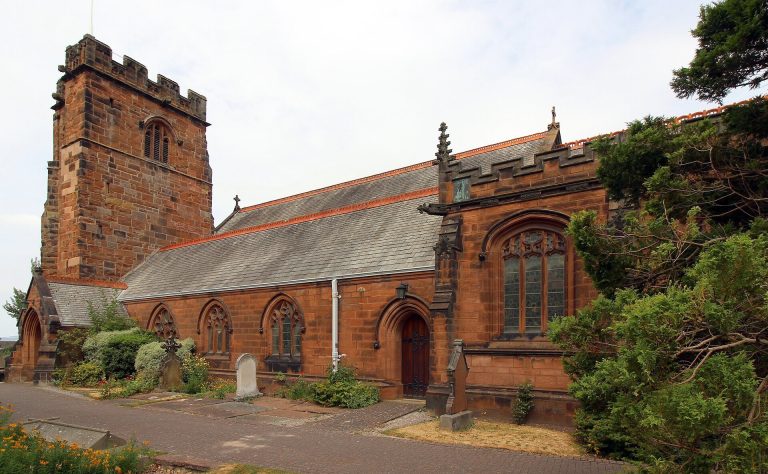
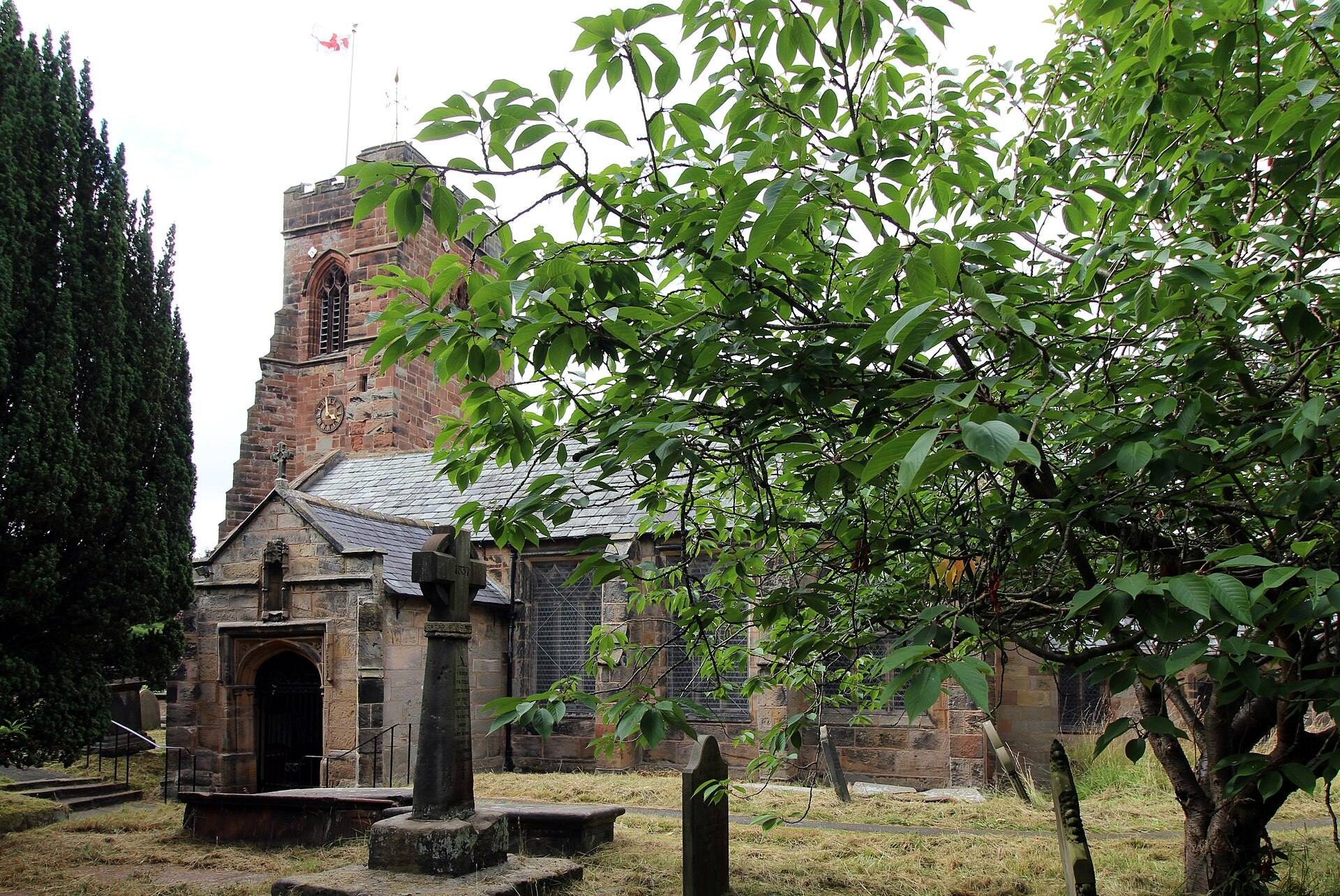
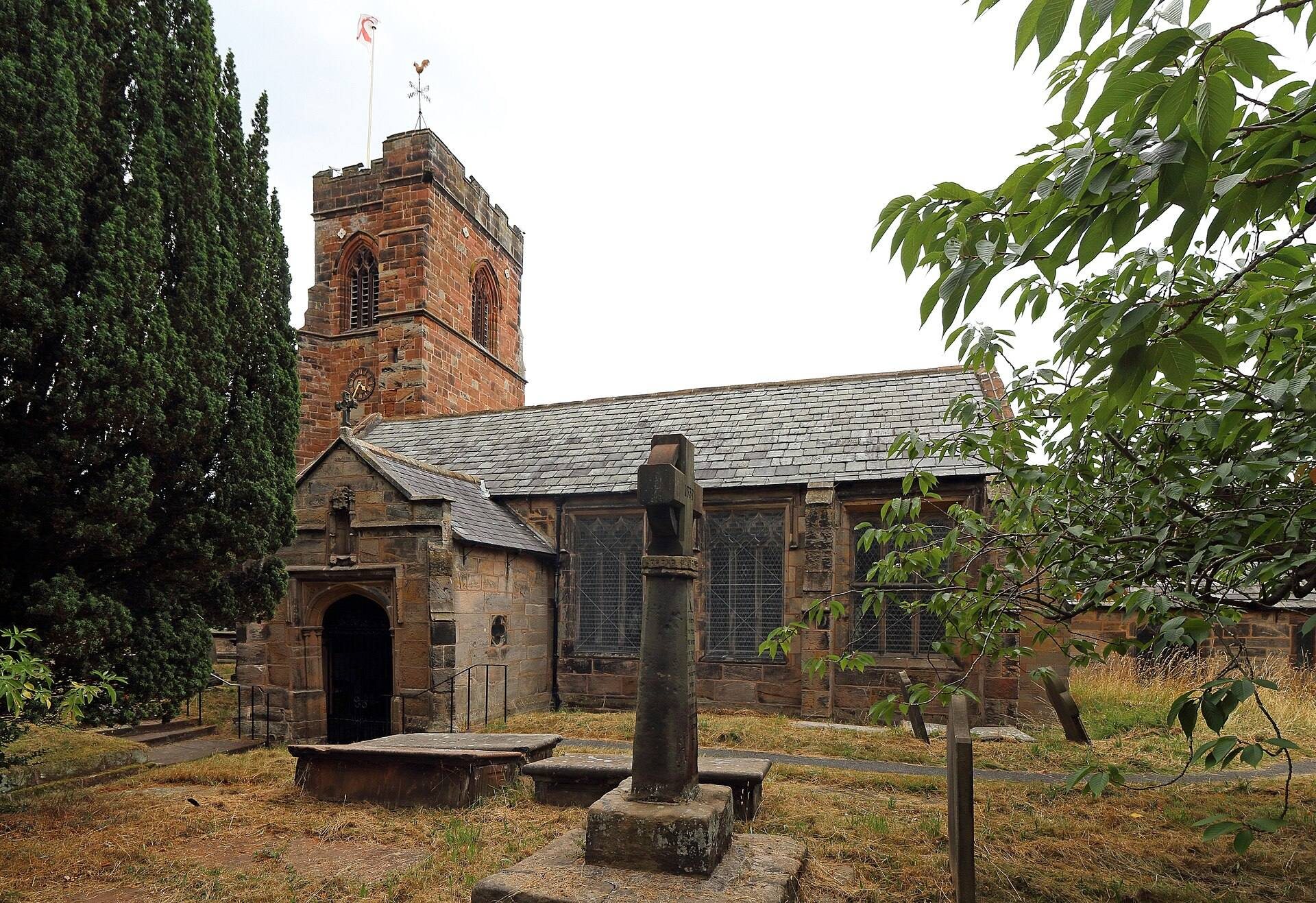
Holy Cross Church is built of stone, with mainly slate roofs and copper covering the later additions. Its plan consists of a nave with north and south aisles, a chancel, vestry, and south porch. The chancel inclines northward, and the church retains elements ranging from the medieval period to the twentieth-century completion of the building.
Tower and medieval fabric
The tower rises in two stages, with an unusually high lower stage. Massive stepped buttresses occupy its northwestern and southwestern corners, while a square stair turret stands at the southeast. The upper part is embattled. Within the chancel wall, the fragment of the Anglo-Saxon wheel cross provides an early medieval feature within the later stone structure.
Porch, glass, and interior furnishings
The south porch contains a shallow piscina, a wall basin traditionally used for washing sacred vessels, together with grooves said to have been made by sharpening arrows. Its windows include medieval stained glass, and the chancel also retains old stained glass. The west wall of the south aisle contains the reconstructed remains of Kempe’s Jesse window, a design depicting Christ’s genealogy through the biblical figure Jesse. The south chancel window, also by Charles Eamer Kempe, dates from 1875.
The chancel contains three seventeenth-century wooden epitaph panels bearing the coats of arms of local people. Randle Holme painted the panels. Fifteenth-century carved wooden bench ends remain in the chancel, while a late-fifteenth-century octagonal font is carved with angels and scenes of the Passion, the suffering and crucifixion of Jesus Christ. Medieval encaustic tiles, whose patterns are formed by inlaying contrasting material into clay surfaces, remain in the floor.
Memorials and carved work
A monument by W. Spence commemorates Margaret Hughes, who died in 1802. Alan Durst also carved a processional cross from ivory in 1937. These later works stand alongside the medieval furnishings and the 1934 rood screen, preserving several distinct phases of carved and commemorative work within the church.
Bells and organ
The tower houses a ring of eight bells cast in 1971 by the Whitechapel Bell Foundry. The ring is said to be one of the lightest in Britain. The organ is an electronic extension organ with two manuals and a concave radiating pedal board, with the complete instrument enclosed in two boxes. Each manual runs from Low C to C4 with 61 keys, while the pedal compass extends from Low C to C1 with 30 keys.
The Swell division has Contra Salicional 16 feet, Stopped Diapason 8 feet, Salicional 8 feet, Flute 4 feet, Flautina 2 feet, Larigot 1 and one-third feet, Twenty Second 1 foot, Contra Tromba 16 feet, Tromba 8 feet, and Octave Tromba 4 feet. The Great division contains Bourdon 16 feet, Open Diapason 8 feet, Stopped Diapason 8 feet, Salicional 8 feet, Octave Diapason 4 feet, Flute 4 feet, Dulcet 4 feet, Nazard 2 and two-thirds feet, and Fifteenth 2 feet.
The Pedal division includes Acoustic Bass 32 feet, Sub Bass 16 feet, Salicional 16 feet, Octave 8 feet, Bass Flute 8 feet, Salicional 8 feet, Octave Flute 4 feet, Tromba 16 feet, and Octave Tromba 8 feet. Several stops are derived from or repeated in other divisions. The controls provide Swell to Great, Swell to Pedal, and Great to Pedal couplers, three thumb pistons for each of the Great and Swell divisions, three toe Pedal pistons, three toe Swell pistons, and a reversible Great to Pedal toe piston, with double-touch pedal operation.