Hollola Church: A Medieval Parish Church in Finland


Site at a Glance
- Rating
- 4.6
- Popularity
- Low
- Country
- Finland
- Primary era
- Medieval
- External website
- Open
- Eras represented
- Medieval, Early Modern, Modern
- Civilizations
- Grand Duchy of Finland, Russian, Swedish
- Site type
- Religious
- Remains
- Church
On this page7 sections
History
Hollola Church is a stone church in Hollola, Finland, built between 1495 and 1510 during the late medieval period. Its sacristy was completed in 1495, the nave in 1500, and the entrance in 1505. Before the Reformation, the church was Catholic and dedicated to Saint Mary. It is now an Evangelical Lutheran parish church.
Foundation and Catholic use
A local legend credits the church’s construction to the giants Hollo and Martta, with Hollo said to have given his name to the parish. In one version, the giants first tried to build the church on Kapatuosia Hill, but the foundation stones rolled to the present site during the night. Another version says that a giant carried the stones across Pyhäniemi Bay.
During its Catholic period, the church contained at least four altars. The principal altar was dedicated to Mary, the mother of Jesus and a central figure of Christian devotion. An altar on the southern wall was probably dedicated to Saint Henry, traditionally regarded as the medieval Christian patron saint of Finland. Wooden statues of saints were kept in cupboards associated with the altars.
Reformation and later changes
Lightning struck the church on 28 June 1642, setting its roof structure on fire. Repairs after the blaze also brought changes associated with the Protestant Reformation, the sixteenth-century transformation that replaced Catholic ecclesiastical structures with Protestant forms of worship in northern Europe. Benches and a pulpit were installed in the nave during the 1650s, and the windows were enlarged.
Burials of wealthy and noble people continued inside the church after the Reformation and lasted until the nineteenth century. The most notable tomb is the von Essen tomb near the altar. After Didrik von Essen was buried there, 17 coats of arms were left in the church.
The nave became too small during the eighteenth century. A mezzanine was built in 1783 and enlarged in 1798 before later being demolished. The church was renovated in 1934 and 1935 according to plans by the Finnish architect Carolus Lindberg. Another renovation followed in 2005 and 2006.
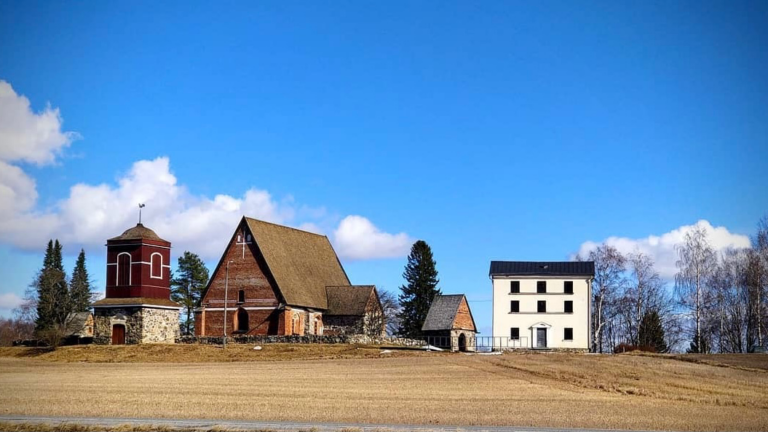
Hollola Church, its bell tower, the former Hollola rectory, and their surroundings are classified by the Finnish Heritage Agency as a nationally significant built cultural environment. The group also forms part of the nationally valuable Kastari-Hatsina-Kutajoki landscape.
Remains
Medieval church interior
The surviving church is a stone building whose medieval interior retains evidence of its Catholic origins and later Protestant alterations. During the Catholic period, the main altar stood at the foot of the eastern column, with a mezzanine above the choir. Some of the wooden saint statues once kept in the altar cupboards are now placed at different locations inside the church.
The medieval windows were small, and the northern facade was built without windows because of fears associated with evil forces. The windows were enlarged during the repairs that followed the 1642 fire. Near the altar, the von Essen tomb remains in the church, while 17 coats of arms survive to the left of the altar. A chair formerly used by the clergy is now held in the collections of the National Museum of Finland.
Organ and later furnishings
A 33-stop organ supplied by the Martti Porthan organ factory was installed in 1994. Its facade follows the style of late Baroque organs associated with Gottfried Silbermann, an eighteenth-century German organ builder.
Bell tower and rectory
The church’s neoclassical bell tower was designed by Carl Ludwig Engel, a German-born architect known for his neoclassical work in Finland, and built between 1829 and 1831. The former rectory belongs to the same building group as the church and bell tower.