Holy Cross Church: A Medieval Brick Church in Hattula, Finland


Site at a Glance
- Rating
- 4.7
- Popularity
- Low
- Country
- Finland
- Primary era
- Medieval
- External website
- Open
- Eras represented
- Medieval, Early Modern, Modern
- Civilizations
- Russian, Swedish
- Site type
- Religious
- Remains
- Church
On this page9 sections
History
Holy Cross Church is a late medieval Lutheran church in Hattula, Finland, built in the Gothic tradition mainly between 1472 and 1490. It is one of the oldest ecclesiastical buildings in the Häme, or former Tavastia, region and became an important pilgrimage destination during the Middle Ages.
Parish origins and the medieval church
The Hattula parish is thought to have been founded in the early thirteenth century, probably before 1250. Its first official documentary mention dates to 1318, while the church itself was first mentioned in 1324. A wooden church probably served the parish during its early history and is said to have remained in use for more than two centuries.
The date of the present building’s foundation has been placed at different points between the early fourteenth and early sixteenth centuries. Current scholarly dating places its construction in the late fifteenth century, principally from 1472 to 1490. Its brick construction is associated with the contemporary development of Häme Castle under the Tott family, a Swedish noble family influential in Finland during the late Middle Ages. Similarities in materials and building methods suggest that the church and the castle may have been erected at approximately the same time by the same craftsmen.
Pilgrimage and religious change
During the Middle Ages, Holy Cross Church attracted pilgrims, people who travelled to a sacred place as an act of religious devotion. Danish documents describe it as a suitable pilgrimage destination. A local tradition also records that Russian attackers entered the church during their winter invasion of Finland in 1496.
The church’s religious history changed during the sixteenth-century Reformation, a movement that challenged aspects of Western Christianity and led to the establishment of Protestant churches. It subsequently served the Lutheran Church, the Protestant tradition that emerged from that movement. Precious-metal crowns formerly belonging to the church were confiscated during the Reformation.
Repairs and changing use
Lightning struck the church in the 1580s, prompting its first major repair. A second strike in 1752 led to the replacement of the roof. The church ceased to be Hattula’s principal church in 1857, when a new church was completed. It has never had heating and is used mainly for summer worship, together with special winter events.
Holy Cross Church and its cultural landscape are designated as a nationally significant built cultural environment in Finland. The site is also recognized as a nationally significant Finnish cultural-heritage site, reflecting the importance of its architecture, paintings, and historical setting.
Remains
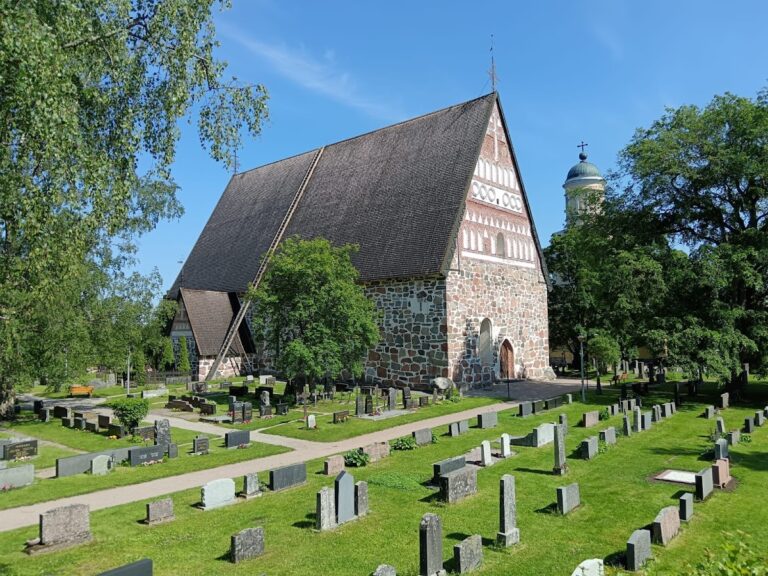
Holy Cross Church is a basilican Gothic building made almost entirely of exposed red brick. A basilica plan has a central nave flanked by aisles, while Gothic architecture is a medieval church tradition associated with pointed forms, strong vertical emphasis, and elaborate structural and surface decoration. The church is exceptional among Finland’s medieval churches, which were generally built of grey stone. Alongside Turku Cathedral, it is identified as one of Finland’s medieval brick churches and as the only one besides it.
Church plan and exterior
The church has three aisles of equal height, with the central aisle wider than the two outer aisles. Two rows of pillars divide the interior into four bays. The sacristy, the room used to store liturgical objects and prepare for worship, and the porch stand on opposite sides of the building. Together they form the arms of a crosswise arrangement that gives the church the appearance of a Latin cross. Stone foundations protect the brick walls from ground moisture.
Cross motifs and ornamental bands made from shaped bricks decorate the façades. Massive buttresses, projecting supports that reinforce the walls, rise at the exterior corners. Brick masks appear above the western window and in the corners of the buttresses, while a painted Crucifixion scene decorates the façade above the eastern window.
Paintings and furnishings
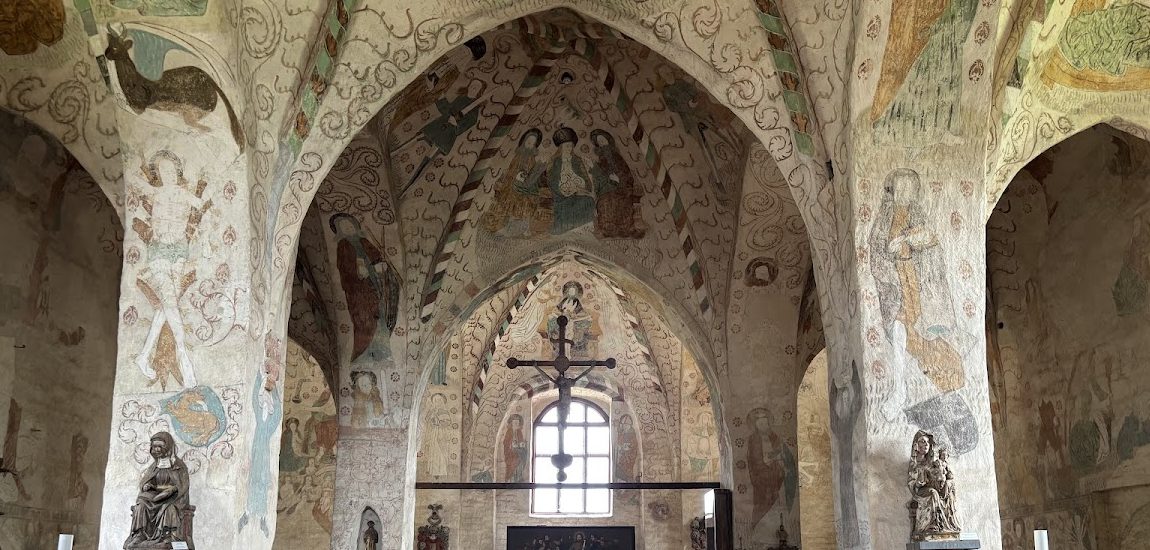
The monumental sacristy has large windows in each wall and buttresses at its corners. Lime paintings, made by applying pigments to lime plaster, cover the choir, sacristy, porch walls, and other interior surfaces. The principal paintings probably date from around 1513 to 1516 and belong to the period of Bishop Arvid Kurki of Turku, the principal medieval episcopal see in Finland. They have also been tentatively associated with the group of artists later responsible for paintings in St Lawrence Church at Lohja. The scenes depict biblical narratives and legends of the saints, and the paintings are among the best-preserved medieval church paintings in Finland. Other painted work in the church dates from approximately 1510 to 1922.
About 40 wooden sculptures remain in the church, most dating from the fifteenth century. They include representations of Saint George and the Virgin Mary. A medieval-style chandelier hangs from the vault, while the altarpiece, which depicts Holy Communion, was painted in 1782.
Pulpits and later furnishings
The pulpit made in 1550 is the oldest surviving pulpit in Finland and one of the oldest in the Nordic countries. A second pulpit was produced in the seventeenth century, giving the interior furnishings a further layer of post-Reformation history.
Churchyard and bell tower
A stone wall encloses the church and churchyard, and a cemetery surrounds the building. Beside the church stands a bell tower built in 1813. Its lower section is constructed of natural stone, while the upper section is wooden and painted red. The original bells were transferred to Hattula’s second church. The present bells came from the former Vuoksela Church in Karelia, in territories that no longer belong to Finland.
An old granary stands near the road within the church grounds. It has been reused as a church information centre and handicraft shop.