Myōhon-ji Temple: A Nichiren Buddhist Head Temple in Kamakura


Site at a Glance
- Rating
- 4.3
- Popularity
- Low
- Country
- Japan
- Primary era
- Medieval
- External website
- Open
- Eras represented
- Medieval, Early Modern, Modern
- Civilizations
- Japanese, Kamakura shogunate, Tokugawa
- Site type
- Religious
- Remains
- Monastery
On this page13 sections
History
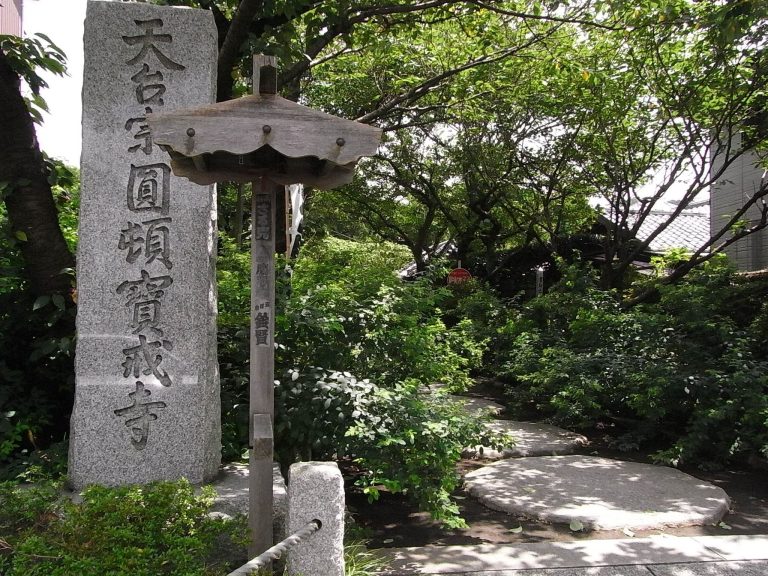
Myōhon-ji Temple is a Nichiren Buddhist head temple in Kamakura, Japan, founded in 1260 in the religious tradition established by Nichiren, the thirteenth-century Buddhist teacher whose teachings centered on devotion to the Lotus Sutra. The temple was traditionally founded by Nichiren with the support of Hiki Yoshimoto, and its formal name is Chōkō-zan Myōhon-ji. Its principal object of worship, or honzon, is the Three Sacred Treasures: the Buddha, the Buddhist teaching, and the Buddhist community or clergy.
The Hiki family and Hiki Valley
Myōhon-ji stands in Hiki Valley, where the Hiki family maintained its residence during the Kamakura period. Hiki Yoshikazu was a powerful retainer of Minamoto no Yoritomo, the military ruler who established the Kamakura shogunate. The family was closely linked to the shogunal house. Hiki Nun served as Yoritomo’s wet nurse and was Yoshikazu’s adoptive mother. Yoshikazu’s wife was the wet nurse of Minamoto no Yoriie, while Yoshikazu’s daughter Wakasa married Yoriie and gave birth to Ichiman.
In 1203, a succession conflict divided the Hiki and Hojo families. The Hiki family supported Ichiman, while the Hojo family supported Yoriie’s younger brother, the future Minamoto no Sanetomo. Yoshikazu was secretly preparing an attack on Yoriie and the Hojo family when the Hojo faction discovered the plan and assassinated him at Nagoe. The Hiki family withdrew to Hiki Valley, where it was defeated. Its members set fire to their residence before taking their own lives. Tradition says that Wakasa threw herself into a well, or possibly a pond, after Ichiman’s death in the fighting.
Yoshimoto and the New Shakado
Yoshimoto, Yoshikazu’s youngest son, was the only member of the immediate family to survive. He was placed in the custody of Wada Yoshimori and later exiled to Awa Province. As an adult, he served Emperor Juntoku in Kyoto and accompanied him to Sado when the emperor was exiled after the Jokyu War. That conflict, fought in 1221, was an unsuccessful attempt by imperial supporters to challenge the Kamakura shogunate.
Yoshimoto was eventually pardoned and returned to Kamakura after his niece Take no Tsubone, Yoriie’s daughter, became the consort of Kujo Yoritsune, the fourth shogun. Take no Tsubone died after a stillbirth in 1234, bringing Minamoto no Yoritomo’s direct lineage to an end. Her will is said to have requested a hall for her personal image of Shakyamuni Buddha. The New Shakado was built in Hiki Valley in 1235, and Take no Tsubone was buried beneath it.
In 1243, Sengaku, who was said to have descended from the Hiki family, became abbot of the New Shakado. Three years later, on Yoritsune’s order, he completed a collation of manuscript versions of the Man’yoshu, Japan’s earliest major anthology of poetry, whose poems date mainly from the fourth through the eighth centuries.
Foundation as a Nichiren temple
Yoshimoto converted to Nichiren’s teaching in 1253. In 1260, he established and donated a new Hokke-do, or hall dedicated to the Lotus teaching, in memory of his parents, Yoshikazu and his mother. Tradition holds that Nichiren gave Yoshikazu the posthumous name Chōkō and his mother the name Myōhon. These names formed the temple’s formal name, Chōkō-zan Myōhon-ji.
After Nichiren’s death, Myōhon-ji passed to Nichiro, one of Nichiren’s six senior disciples. The temple became the base of the Hiki Valley lineage, which supervised Haseyama Hondo-ji and Choeizan Honmon-ji. The three temples were known collectively as the “Three Chōs and Three Hons,” a name referring to the “Chō” beginning of their mountain names and the “Hon” beginning of their temple names.
Lineage administration and later changes
Myōhon-ji and Honmon-ji were administered by one head priest under a dual-mountain, single-headship system until 1941. In 1591, after Tokugawa Ieyasu entered Edo, the lineage’s twelfth joint head, Butsujoin Nissei, moved the headquarters to Honmon-ji. Myōhon-ji then established an office of administrative superintendent, equivalent to a deputy head, to oversee the Hiki Valley complex. The abbot of Hongyo-in, the temple’s main subtemple, traditionally held this position.
The move of the lineage headquarters to Ikegami did not alter the equal status of Myōhon-ji and Honmon-ji. At its height, the complex included two main subtemples and sixteen branch cloisters. It also had 165 directly affiliated temples jointly connected with the Hiki Valley and Ikegami mountains, together with a fief yielding 1,500 mon of official-seal revenue.
In 1842, materials dismantled from the main hall of Kannō-ji, along with a Buddhist shrine cabinet, were transferred to Myōhon-ji after Kannō-ji was abolished during the Tenpo Reforms. The materials were stored beneath the Founder’s Hall and later used to rebuild the Founder’s Hall at Kuon-ji on Mount Minobu after that temple was destroyed by fire on January 10, 1875.
In 1941, the temple’s dual-mountain, single-headship system became a single-mountain, single-headship system. Myōhon-ji was elevated from a temple of historical distinction to a sacred-site temple in 2004. In 2016, it was recognized as a component cultural property of Japan Heritage. It is one of the five head temples of the Ikegami lineage and forms part of Kanagawa Prefecture’s special historic-landscape preservation district. The Kamakura Rōshi-kō, a group of thirteen temples, continues the traditions of the Hiki Valley branch after the Nichiren school ended its former head-temple and branch-temple system in 1941.
Remains
Myōhon-ji occupies the valley landscape of Hiki Valley in Ōmachi, Kamakura. The grounds include a garden and a group of religious and commemorative structures, with the Founder’s Hall forming the principal architectural focus. The garden’s right-hand side contains the tombs of the Hiki family and their relatives, transferred from Ankokuron-ji during the 1920s.
The central temple precinct
Founder’s Hall
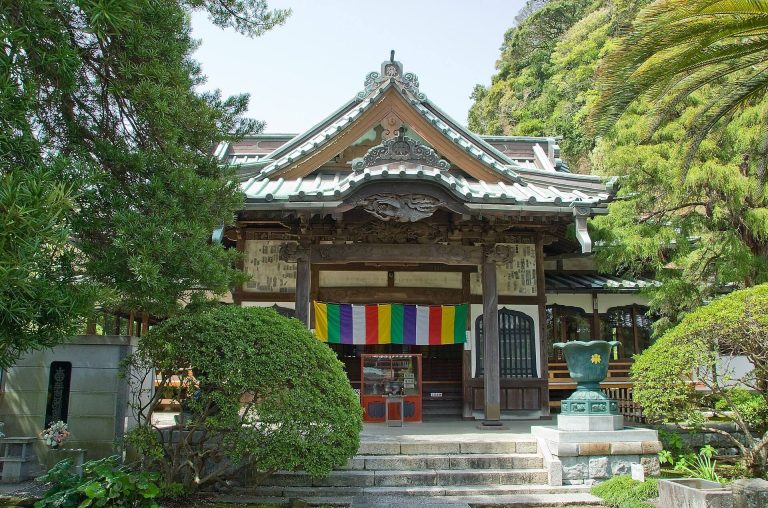
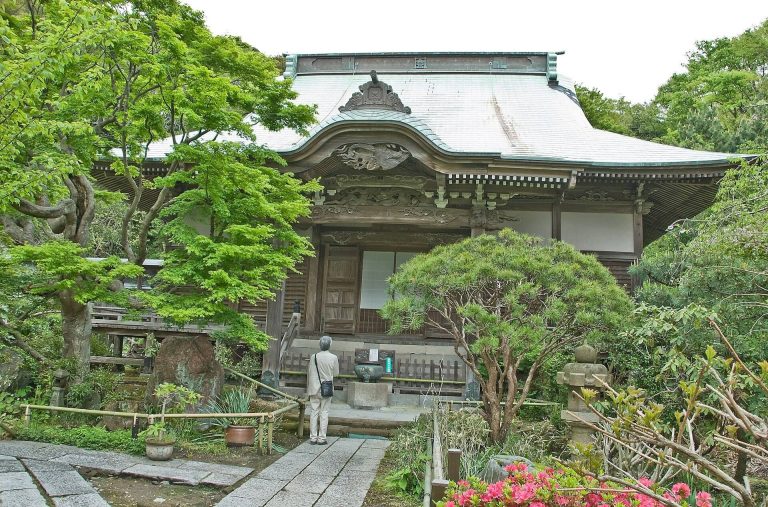
The Founder’s Hall, also called the Soshi-do, is the largest and most prominent building on the grounds. Its principal object of worship is a wooden image of Nichiren made in the fourteenth century by the priest Nippo, who lived from 1259 to 1341. The hall preserves the image as the central devotional focus of this Nichiren Buddhist temple.
Two-Heaven Gate
The Two-Heaven Gate, or Niten-mon, was built in 1840. Painted bright red, it stands directly in front of the Founder’s Hall and contains paired statues of Tamonten and Jikokuten. These figures are two of the Four Heavenly Kings in Buddhist tradition, guardian deities commonly placed at entrances to protect sacred spaces.
Bronze statue of Nichiren
A large bronze statue of Nichiren, constructed in 2002, stands directly in front of the Founder’s Hall. Its position places a modern image of the temple’s founder within the central grounds, near the hall that houses the fourteenth-century wooden image.
Jakushi Myojin precinct
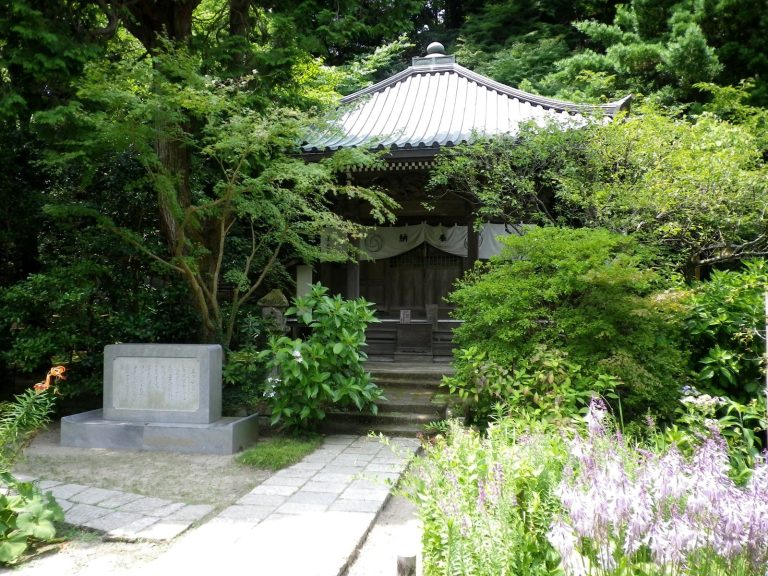
Jakushi Myojin worship hall
The Jakushi Myojin worship hall, also called Jakushi-do, is associated with the tradition that Wakasa’s spirit became a serpent after her death. According to the tradition, the spirit possessed and afflicted the daughter of Hojo Masamura. Masamura responded by building the hall to pacify it. Jakushi Myojin is a protective deity associated with relief from affliction attributed to a serpent spirit.
Snake-Shape Well
The well beside Jakushi Myojin is called the Snake-Shape Well, or Jagyo no I. It is linked to the tradition that Wakasa threw herself into a nearby well after learning of Ichiman’s death. The well therefore forms a physical part of the Hiki family traditions preserved within the temple grounds.