Hohenurach Castle: A Medieval Hilltop Fortress in Germany


Site at a Glance
- Rating
- 4.7
- Popularity
- Medium
- Country
- Germany
- Primary era
- Medieval
- External website
- Open
- Eras represented
- Medieval, Early Modern
- Civilizations
- Holy Roman Empire
- Site type
- Military
- Remains
- Castle
On this page18 sections
History
Hohenurach Castle is a ruined hilltop castle in Germany above the town of Bad Urach. The Counts of Urach built it between 1030 and 1050, creating a medieval stronghold on a summit overlooking the Ermstal valley. Its later history was closely connected with the territorial development of Württemberg, whose rulers expanded the castle, converted it into a state fortress, and used it as a prison.
From Urach possession to Württemberg residence
The Counts of Urach originated in the East Frankish region near Würzburg. In 1239, they pledged Hohenurach to the Counts of Württemberg. After the Urach family divided into the Freiburg and Fürstenberg lines, the Counts of Fürstenberg sold half of the castle to Württemberg in 1254. Württemberg acquired full ownership in 1265.
A major rebuilding and expansion began in 1428 under Count Ludwig I of Württemberg. The Treaty of Nürtingen, concluded on 25 January 1442, divided Württemberg between two territorial branches. Ludwig then developed Urach as the residence of his part of the territory. After the Treaty of Münsingen reunited Württemberg-Urach and Württemberg-Stuttgart on 14 December 1482, Ludwig’s son, Count Eberhard V, later Duke Eberhard I, moved the residence of the united territory back to Stuttgart.
Imprisonment and the Württemberg fortress system
Hohenurach also served the ruling family as a place of confinement. In 1490, Eberhard had his cousin Heinrich of Württemberg imprisoned there on the pretext of alleged mental illness. Heinrich lived at the castle with his family, isolated from the outside world, until his death on 15 April 1519. His second-oldest son, Georg I of Württemberg-Mömpelgard, was born at Hohenurach in 1498.
Duke Ulrich of Württemberg lost his territory to the Swabian League in 1519. This military alliance of imperial estates in southwestern Germany defeated Ulrich and contributed to the political circumstances that led to Hohenurach’s later military transformation. After Ulrich regained Württemberg in 1534, Hohenurach was judged part of an increasingly unsound defensive system. Between 1535 and 1555, it was converted into one of seven Württemberg state fortresses, meaning strategically important strongholds maintained by the territorial government. Ulrich spent approximately 22,000 gulden on the works between 1535 and 1550.
During the Schmalkaldic War, the 1546 to 1547 conflict between the Holy Roman Emperor and the Protestant Schmalkaldic League, imperial forces commanded by the Duke of Alba forced Hohenurach to surrender in 1547. The occupying troops badly treated the fortress. Duke Christoph subsequently spent 19,087 gulden on restoration between 1550 and 1556.
The siege of 1634 to 1635
Hohenurach endured its most demanding military episode during the Thirty Years’ War, the European conflict fought from 1618 to 1648 amid religious, dynastic, and territorial struggles. After the Battle of Nördlingen, Gottfried Holtzmüller was sent to Urach on 30 August 1634 with 150 dragoons on the orders of Bernhard of Saxe-Weimar. A dragoon was a mounted soldier trained to fight on foot as well as on horseback. The castle was commanded by the Württemberg captain and Urach forest master Georg Albrecht von Bettendorf. His 50-man militia suffered 30 deaths during fighting in the Ermstal.
Imperial commander Walter Butler surrounded Urach and captured the wagon fort at Dettingen an der Erms. The siege of the town began on 21 October 1634. After twelve days of fighting, Holtzmüller fled with his troops, senior town officials, and the municipal treasury to Hohenurach. Imperial forces then established a systematic blockade under Baltasar Mora, with 2,154 soldiers quartered in the surrounding villages.
Holtzmüller attempted to hold the fortress until the last man. The prolonged defense led to sorties for food and ammunition, hostage-taking, and forced payments from local inhabitants. The village of Upfingen was burned after refusing to provide grain. On 15 April 1635, an Ulm relief expedition led by Captain Martin Sperbitz tried to bring 60 hundredweight of flour through the blockade. Sperbitz arrived with 50 dragoons and 30 musketeers from Hohenneuffen, while Holtzmüller launched a simultaneous sortie. The defenders and the relief force killed 35 imperial soldiers and drove the remainder from their fieldworks. Holtzmüller was shot in the face and lost his eyesight.
As the defenders’ strength declined after the Peace of Prague began to take shape in May 1635, Holtzmüller handed command to his brother, Ensign Johann Holtzmüller. Gottfried Holtzmüller later escaped to Neuffen with 30 men, but the Württemberg captain Johann Philipp Schnurm refused them entry, so Holtzmüller continued to Ulm. With no relief expected from Duke Eberhard in Strasbourg and other Protestant strongholds moving toward surrender, the starving garrison capitulated on 24 July 1635. The defenders withdrew with their personal weapons but without baggage, and an imperial half-company under Lieutenant Weißweil occupied Hohenurach.
Occupation, repair, and military decline
Relations between the occupying forces and the local population deteriorated after Count Otto Reichstruchsess of Friedberg-Scheer assumed supreme command. As Obervogt, a senior territorial official with supervisory and judicial responsibilities, of the Achalm pledge, a territory held under a pledge arrangement and administered separately from Württemberg, he became involved in disputes between Württemberg and Tyrolean officials over forest rights and taxes. In 1646, he compelled 30 forced laborers from Urach’s administrative villages to repair fortifications and construct palisades.
Friedberg-Scheer was removed and transferred the fortress to the Bavarian captain Johann Schabinger. Bavarian forces withdrew in September 1649 after the peace settlement, and Hohenurach and the Achalm pledge returned to the Duchy of Württemberg. Urach’s citizens petitioned for the fortress to be blown up because they regarded it as a continuing source of unrest. Duke Eberhard instead ordered thorough repairs between 1663 and 1669 and added external works.
Lightning struck the powder tower of the large outer defensive enclosure in 1694 and destroyed parts of the fortress. Hohenurach then lost its military importance and was used mainly as a prison. The fortress was abandoned in 1761.
Prison and ruin
Several notable prisoners were held at Hohenurach. The philologist and poet Nicodemus Frischlin was imprisoned there for a polemical work against the Württemberg court. He died during an attempted escape on the night of 29 to 30 November 1590. Württemberg privy councillor Matthäus Enzlin was transferred to Hohenurach from Hohenneuffen in 1609 after proceedings involving corruption, embezzlement, abuse of office, and breach of an oath of abjuration. He was executed by beheading at Urach on 22 November 1613.
After abandonment, parts of the fortress were dismantled for the construction of Grafeneck Palace. Demolition began in summer 1765, and tiles and other building materials were transported to Grafeneck. Friedrich Rheinwald, the commercial councillor and owner of the Urach ironworks, purchased the iron doors, gates, grilles, stoves, boilers, cannon, and live ammunition. He placed the ammunition in the Erms River, believing that the water would wash out or neutralize the powder. When he later tried to melt it down, bombs and grenades exploded, damaging the furnaces, walls, windows, and iron grilles. Two smiths were seriously injured.
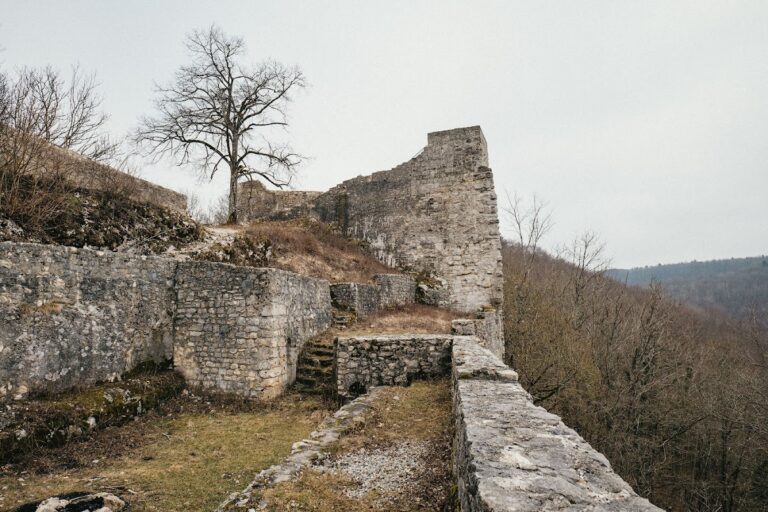
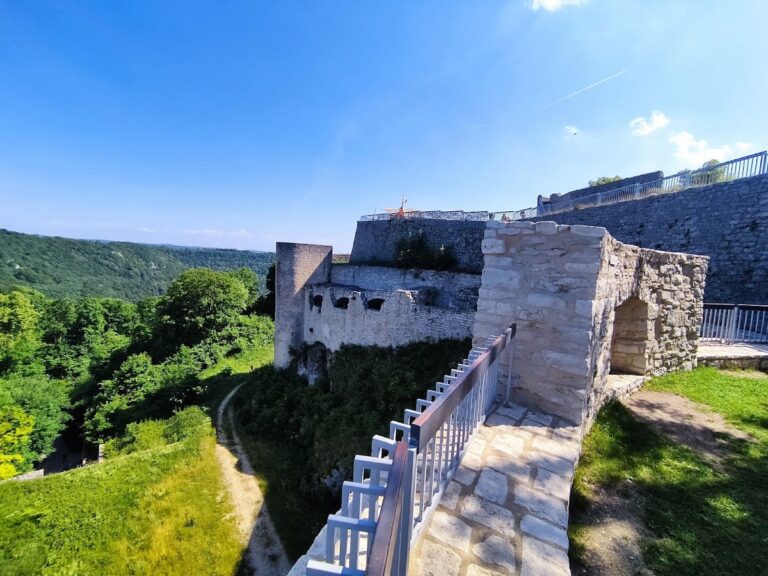
Unauthorized removal of usable stone from the fortress walls continued for decades. The last recorded official demolition took place in 1815, when sections were dismantled for a foal stable belonging to the Rutschenhof. Between 1860 and 1870, Philipp Freiherr von Hügel, head of the Urach forestry office, cleared and prepared the overgrown ruin so that it could be reached safely. The ruin was closed with its access path in summer 2011 after frost damage from a severe winter threatened collapses. Extensive repairs followed in 2012. Since 2015, the state of Baden-Württemberg has carried out further stabilization and archaeological investigations in four phases, planned to continue through 2024.
Remains
Summit layout and defensive terraces
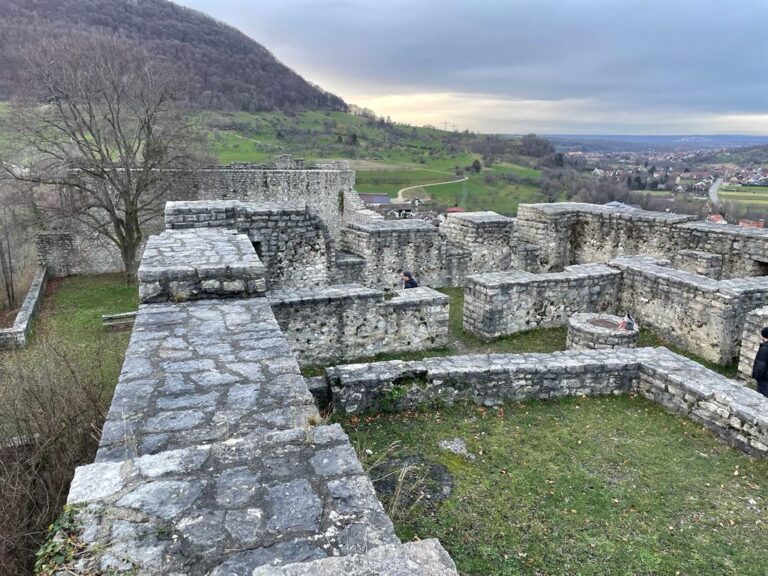
Hohenurach occupies a summit 692 metres above sea level, approximately 250 metres above the Ermstal valley and Bad Urach. The ruined complex has an approximately triangular plan, with sides measuring about 280, 230, and 110 metres. Its buildings and defenses were arranged in three stepped sections on terraces, the Lower Castle, Upper Castle, and Inner Castle. This arrangement placed the principal residential complex on the highest terrace while extending defensive works down the slope.
Lower Castle
The Lower Castle contained a triangular breastwork cut from the rock and a chapel. The breastwork formed part of the lower defenses, while the chapel served the religious needs of the castle community. This terrace is now overgrown and inaccessible.
Upper Castle
The Upper Castle was a square stronghold with massive walls. Its southern main entrance was protected by the Upfinger Tower, a gun tower. The approach passed through an elongated outer work and three gates, followed by moats, a drawbridge, and a guardhouse. The entrance sequence concentrated access through successive defensive positions before the upper terraces could be reached.
Inner Castle and palace area
Palace courtyard
From the Upper Castle, access led to the highest terrace and the Inner Castle, the principal palace area. Its courtyard formed an irregular quadrilateral and contained two wells. Two main buildings bordered the courtyard, which stood at the center of the residential complex.
Palace defenses
A large powder tower stood along the western side of the palace courtyard. The palace hill was enclosed by a continuous outer defensive enclosure, known as a Zwinger. A Zwinger is an outer defensive area positioned between or beyond the principal fortifications. The enclosure joined the residential core to the wider defensive plan of the fortress.
Outer defensive works and towers
Northeastern enclosure
The smaller Zwinger on the northeastern side, facing Urach, contained three gun towers. Its position formed an additional defensive line beyond the palace hill and helped protect the side of the complex oriented toward the town.
Western enclosure
The larger western Zwinger had another powder tower and an associated enclosing wall. Together, these works extended the fortress’s defensive perimeter beyond the central palace area.
Dettingen Tower
The Dettingen Tower stood at the northern corner of the complex and looked down into the valley. Like the Upfinger Tower, it was later used as a prison, giving the defensive structure a further role after Hohenurach’s military importance had declined.
Structural survival and conservation
Before the 2011 closure, the ruin was in very poor structural condition. Frost action had damaged the masonry, and some sections threatened to collapse. Stabilization works restored access, while the later conservation campaigns also incorporated archaeological investigation. The surviving terraces, walls, towers, wells, and defensive enclosures continue to express the successive transformation of Hohenurach from a medieval comital castle into a large Württemberg fortress.
Nearby sites