Castle of Tarifa: A Caliphal Fortress on the Strait of Gibraltar


Site at a Glance
- Rating
- 4.5
- Popularity
- Medium
- Country
- Spain
- Primary era
- Medieval
- External website
- Open
- Eras represented
- Classical, Medieval, Early Modern
- Civilizations
- Almohad, Crown of Castile, Marinid, Roman, Umayyad
- Site type
- Military
- Remains
- Castle
On this page11 sections
History
Castle of Tarifa is a tenth-century Islamic fortress in Spain, built in 960 by Abd al-Rahman III, caliph of Córdoba, as part of a plan to establish a small town at Tarifa. Its central fortress followed the caliphal military tradition of the Islamic state that ruled much of al-Andalus from the tenth to the early eleventh century. A stone inscription set into one of the gates dates the construction to April 960 and names Abd al-Rahman ibn Badr, a freed minister of the caliph, as its supervisor.
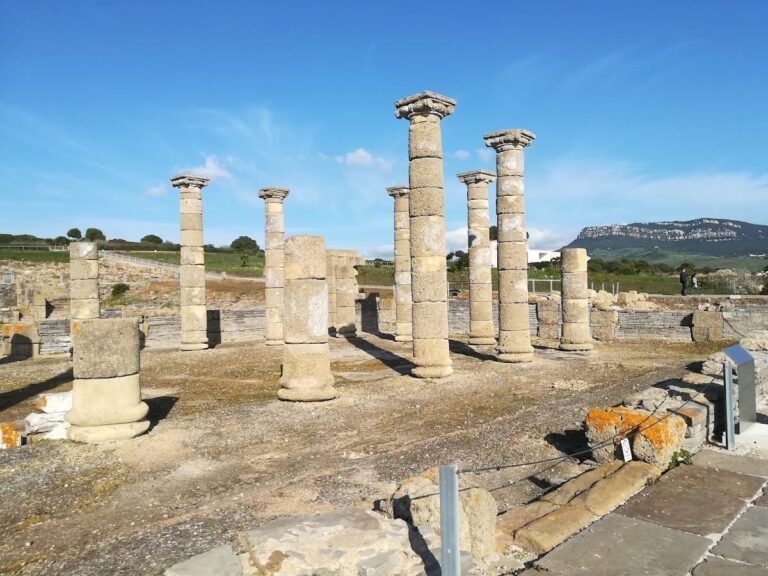
The stronghold protected troops assigned to defend the Strait of Gibraltar and those involved in operations toward Morocco. A Fatimid attack on Almería in 955 may have encouraged its construction. Tarifa’s position at the southern end of the Iberian Peninsula gave the castle a continuing military purpose, while remains of Roman structures point to earlier activity at the site.
Almohad control and expansion
Under Almohad rule, Tarifa became one of the principal defensive positions guarding the Strait. The Almohads, a North African Islamic dynasty that ruled much of the Maghreb and al-Andalus during the twelfth and thirteenth centuries, also used the town as a base for Moroccan fighters. Its harbor supported this military role. The Almohads reinforced the castle during the twelfth century, and in 1146 their caliph Abd al-Mu’min moved his armies from Algeciras to Tarifa.
The Almohads abandoned the town in 1231. Control then passed to Ibn Hud of Murcia before Sancho IV of Castile took Tarifa in 1292 during the Reconquista, the long expansion of Christian kingdoms into territories ruled by Muslim states in the Iberian Peninsula. The castle was entrusted to Alonso Pérez de Guzmán, a Castilian military leader whose defense of Tarifa later earned him the name Guzmán el Bueno, or “the Good Guzmán.”
Siege, Castilian rule, and later defense
In 1296, forces led by the rebellious Infante Don Juan and the Marinids besieged Tarifa. The Marinids were a later North African dynasty that intervened in the defenses of the town. Pérez de Guzmán refused to surrender the castle in exchange for his son’s life, an act that established the association between the fortress and the Guzmán name. The Guzmán family later became linked with the dukes of Medina Sidonia.
The castle continued to be adapted after the conquest. The Marinids altered the Jerez Gate at the end of the thirteenth century and strengthened a northern defensive enclosure, while Christian builders made further changes during the fourteenth century. In the seventeenth century, the fortress was restored for defense against attacks by Barbary pirates. During the Peninsular War, known in Spain as the War of Independence, it served as the operational center of Spanish forces resisting at Tarifa.
The castle was declared a historic-artistic monument in 1931 and is recognized as a Spanish Cultural Heritage monument of cultural interest. It remains the property of Spain’s Ministry of Defence.
Remains
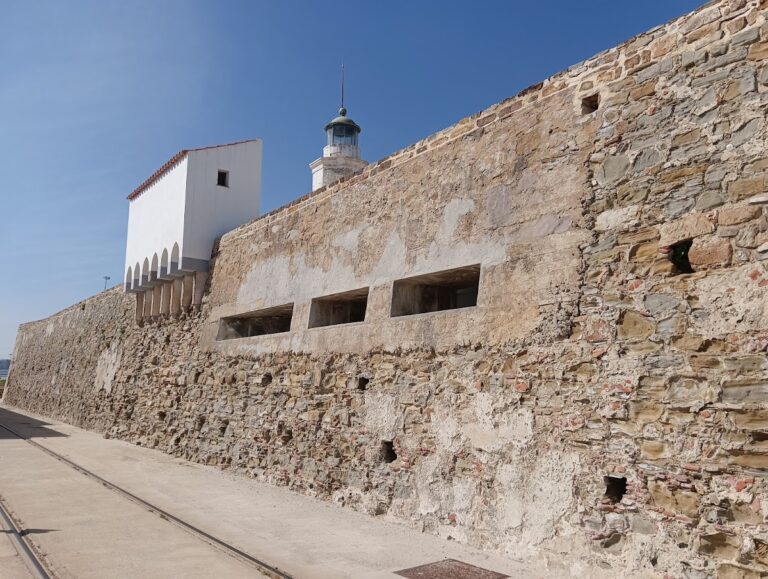
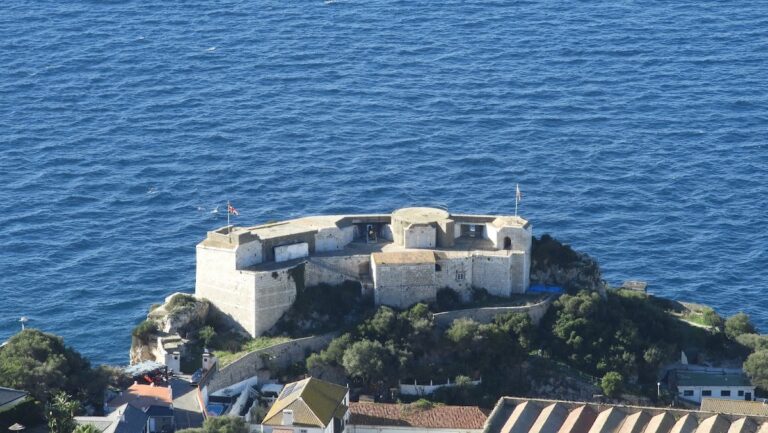
The surviving fortress has a trapezoidal plan adapted to the rocky escarpment on which it stands. Its central caliphal nucleus, or alcázar, was built from stone blocks laid alternately lengthwise and crosswise. A large defensive wall surrounds the castle, including a section overlooking a drop toward the sea. Outside the central fortress is a Castilian masonry barbican, an outer defensive enclosure, with a wall-walk and merlons. A narrow passage separates it from the inner castle.
The caliphal fortress and towers
The original alcázar was enclosed by about fifteen strong rectangular towers with limited projection beyond the wall face. Their projections measure about 190 to 210 centimetres, and their fronts are approximately 3.9 metres wide, except at the corners. Thirteen towers survive, although most have been rebuilt. Diamond-point merlons crown the walls, having been added after the Castilian conquest.
The massive construction gives the fortress a carefully ordered arrangement of volumes, with residential and administrative spaces subordinate to its military purpose. The walls include sections measuring approximately 6.7 to 9.4 metres in length. The castle is regarded as one of the better-preserved caliphal fortresses, and its surviving fabric conveys the strength of its defensive design despite its relatively sparse decoration.
Entrances and the northern defenses
Western and eastern entrances
The western entrance is approached along a straight route preceded by a dog-leg opening in the defensive wall. Its present form consists of a semicircular arch beneath a barrel vault. The eastern entrance occupies the probable original access point and connected the fortress with the town. A gate dating from the period of the taifa kingdoms, the small successor states that followed the breakup of the Córdoba caliphate, now stands there.
Jerez Gate and Gothic Gate
The Jerez Gate is an older Almohad structure on the northern side, set between two towers. It has a straight opening, two complete internal arches made with non-radial stone blocks, four stone corbels, and a small vault resting on those supports. A Castilian forecourt was added at the level of the fortification towers in the fourteenth century.
A separate Gothic Gate lies within the coracha, a protected walled connection between a fortress and an external tower or water-access point. It provides access from outside to the wall-walk.
Tower of Guzmán el Bueno
At the western end of the defenses stands the octagonal albarrana tower known as the Tower of Guzmán el Bueno. An albarrana tower is detached or partly detached from a fortification and linked to it by a wall or passage. This tower forms part of the barbican and was connected to the castle by a sea-facing coracha. Its upper terrace joins the castle through the circular wall-walk. The tower’s form later inspired the keep of the Castle of Santiago at Sanlúcar de Barrameda.
Barbican, enclosures, and military courtyards
The barbican originally enclosed the entire medina, or fortified town, with the castle occupying its southwestern angle. Much of this wider circuit was later lost as Tarifa expanded. Three fortified enclosures surrounded the castle. The eastern enclosure helped protect the old town, another protected a suburb, and a third defended the suburb’s northern extension. The Almohads built the third enclosure in the mid-twelfth century, and the Marinids strengthened it at the end of the thirteenth.
Square, rectangular, and L-shaped towers with projecting corners supported the three enclosures. The wider town defenses also included a brick wall and a moat, whose surviving form was comparable to contemporary fortifications at Seville. These outer defenses placed the central castle within a larger system intended to protect Tarifa’s urban areas as well as the fortress itself.
The present western military courtyard contains sixteenth-century buildings associated with the Palace of Fadrique Enríquez, Marquis of Tarifa. On the eastern side, a second and larger military courtyard contains a well and buildings dating from the sixteenth and eighteenth centuries. Together, the courtyards preserve the later military and residential development of the fortress within its older defensive framework.
Religious buildings beside the castle
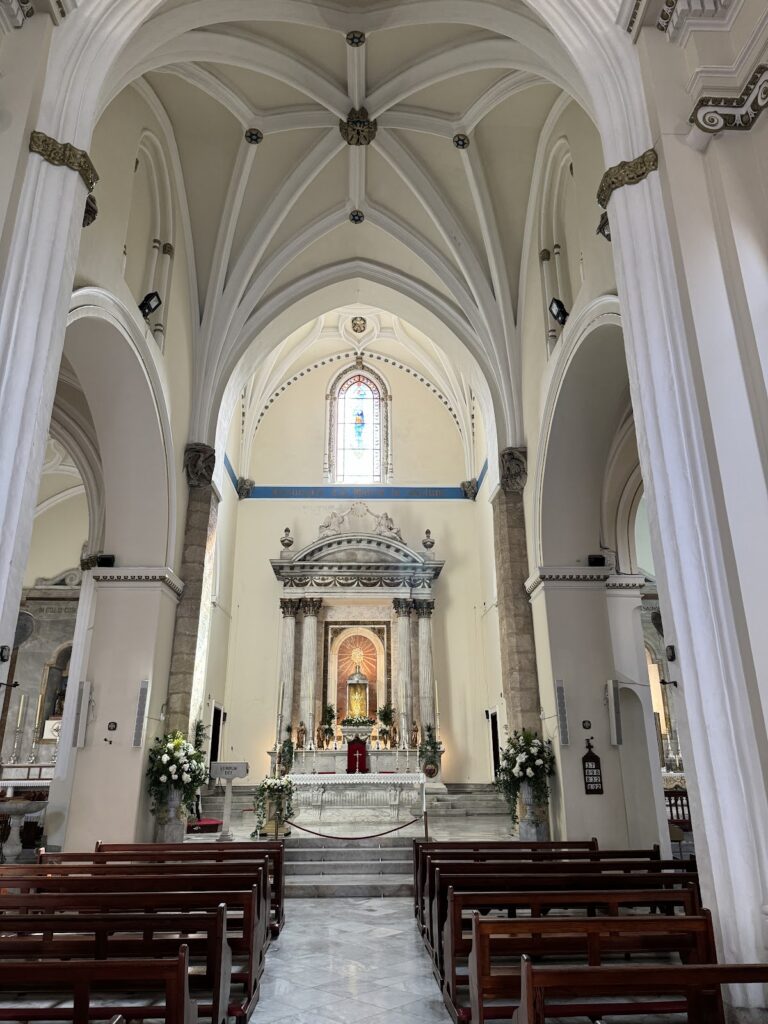
Tarifa’s principal mosque stood on the rock parallel to the castle’s eastern façade. It was retained after the Christian conquest and later converted into the Church of Saint Mary. The present Church of Saint Matthew may occupy the site of an earlier Almohad mosque, a possibility associated with a stone monument inside the church. These buildings preserve the religious changes that accompanied the transfer of Tarifa from Muslim to Christian rule.