Hohenneuffen Castle: A Medieval Fortress in Germany

Site at a Glance
- Rating
- 4.7
- Popularity
- Medium
- Country
- Germany
- Primary era
- Medieval
- External website
- Open
- Eras represented
- Medieval, Early Modern
- Civilizations
- Duchy of Württemberg, Holy Roman Empire
- Site type
- Military
- Remains
- Castle
On this page9 sections
History
Hohenneuffen Castle is a medieval stone fortress ruin above Neuffen in Germany, built between 1100 and 1120 by Mangold von Sulmetingen on the northern edge of the Swabian Alb. Its elevated position gave it a strategically advantageous role, while later rebuilding turned the medieval castle into an early modern territorial fortress.
Prehistoric and medieval origins
The hill was settled in prehistoric times and became an outpost of the Heidengraben oppidum during the late La Tène period, a later Iron Age era in central and western Europe dated here to approximately 450 to 1 BC. An oppidum was a large fortified settlement or regional centre. Hohenneuffen’s activity was especially associated with the first century BC.
The pre-Germanic name Neuffen has several proposed explanations. One interpretation connects it with a Proto-Celtic word meaning “holy” or “sacred,” raising the possibility of a religious function. Other explanations relate the name to a steep slope or mountain flank. These interpretations concern the name and early setting rather than a confirmed purpose for the prehistoric site.
Mangold von Sulmetingen built the stone castle between 1100 and 1120 and later adopted the name von Neuffen. The fortress was first documented in 1198, when it belonged to the noble von Neuffen family. Among its members was Gottfried von Neifen, a minnesinger, meaning a medieval German-speaking courtly poet and singer.
Noble ownership and territorial fortification
At the end of the thirteenth century, Hohenneuffen passed to the Lords of Weinsberg. They sold it to the Counts of Württemberg in 1301. Its defensive position was demonstrated during the Reichskrieg of 1312, an internal conflict within the Holy Roman Empire, the medieval and early modern political entity that encompassed much of central Europe. The castle could not be captured during that conflict.
During the late medieval period, Hohenneuffen began changing from a noble castle into a territorial fortress. Duke Ulrich of Württemberg directed major fortification works in the first half of the sixteenth century or around its middle. The expanded complex included outer defences, towers, bastions, casemates, and facilities for a permanent garrison.
The fortress surrendered to troops of the Swabian League in 1519. The League was a regional alliance of princes and cities in southwestern Germany. Hohenneuffen resisted an attempted capture by insurgents during the German Peasants’ War of 1524 to 1525, after which its principal fortifications remained largely unchanged for about two centuries.
Siege, imprisonment, and decline
Imperial forces besieged Hohenneuffen for fifteen months during the Thirty Years’ War, the major European conflict fought from 1618 to 1648. On 22 November 1635, commander Johann Philipp Schnurm surrendered after hunger and declining morale had weakened his troops. He had negotiated permission for the garrison to leave with its weapons and possessions, but the terms were violated. The soldiers were forced into the Imperial army, and Schnurm lost his property.
A nineteenth-century tradition tells that the besieged fed their last grain to a donkey, killed the animal, and threw its grain-filled stomach over the walls to suggest that supplies remained plentiful. The episode has no documentary confirmation, but the donkey became a mascot of Neuffen.
Hohenneuffen also served for centuries as a state prison for important prisoners. Friedrich, a young Count of Helfenstein, died in 1502 while attempting to escape. In 1512, Duke Ulrich imprisoned Georg Fischer, abbot of Zwiefalten Abbey, at the castle. The Tübingen reeve Konrad Breuning was imprisoned and tortured there before being beheaded in Stuttgart in 1517. Matthäus Enzlin, a senior Württemberg court official, suffered a similar fate in the seventeenth century. Joseph Süß Oppenheimer, a Jewish court financier and personal financial adviser to Duke Karl Alexander, was held at Hohenneuffen for several weeks in 1737 before being transferred to Hohenasperg and executed near Stuttgart in 1738.
Duke Karl Alexander of Württemberg planned to convert the castle into a modern fortress based on eighteenth-century French fortification principles. He died before the work was completed, and his successor, Karl Eugen, abandoned the scheme because of its high cost and doubtful military value.
In 1793, the destruction of the fortress and the sale of its building materials were approved. Hohenneuffen ceased to be used in 1795, was formally released for demolition in 1801, and began to be dismantled two years later. People from the surrounding area used the inexpensive materials, rapidly reducing the fortress to ruins.
Protection and political history
Württemberg authorities began safeguarding the remaining fortifications in 1830. The ruins became a popular attraction from the 1860s, and an inn opened in a surviving upper-bailey building in 1862.
During the Second World War, the castle housed an air-defence observation post. On 2 August 1948, Reinhold Maier, prime minister of Württemberg-Baden, convened the governments of Württemberg-Baden, Württemberg-Hohenzollern, and Baden at Hohenneuffen. The meeting sought closer cooperation among the three southwestern German states but produced no immediate agreement. It nevertheless began the process that led to the formation of Baden-Württemberg in 1952.
A memorial information plaque for the 1948 Three-States Conference was installed in the historic conference room on 6 October 2008. A Staufer stele, a commemorative column associated with the medieval Hohenstaufen dynasty, was inaugurated near the castle approach on 3 May 2014 to commemorate cooperation between the Lords of Neuffen and the Staufers.
Remains
Hilltop setting and fortress layout
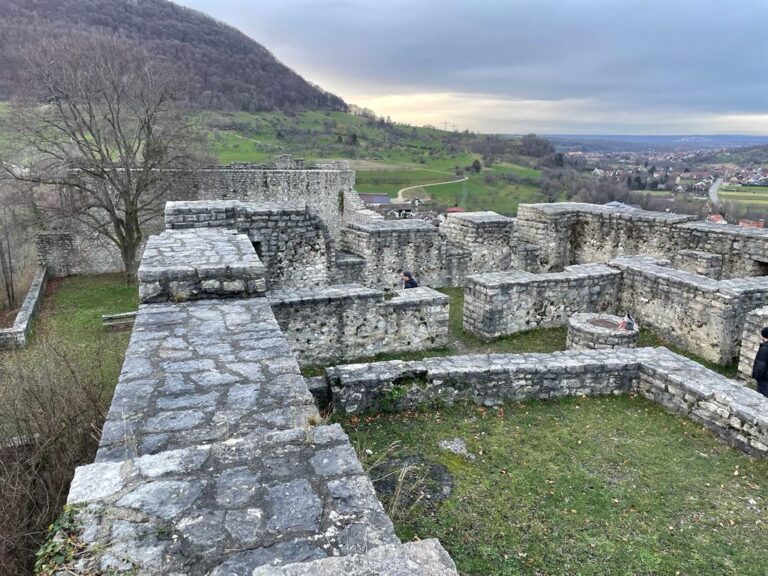
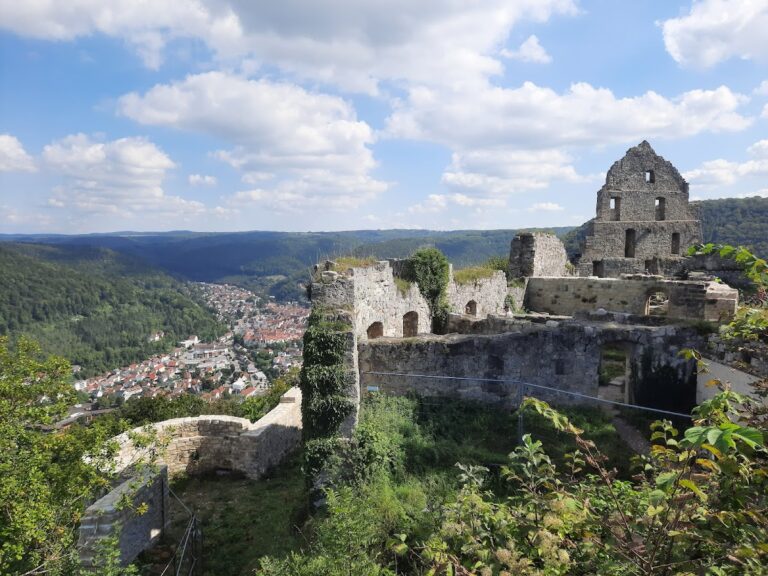
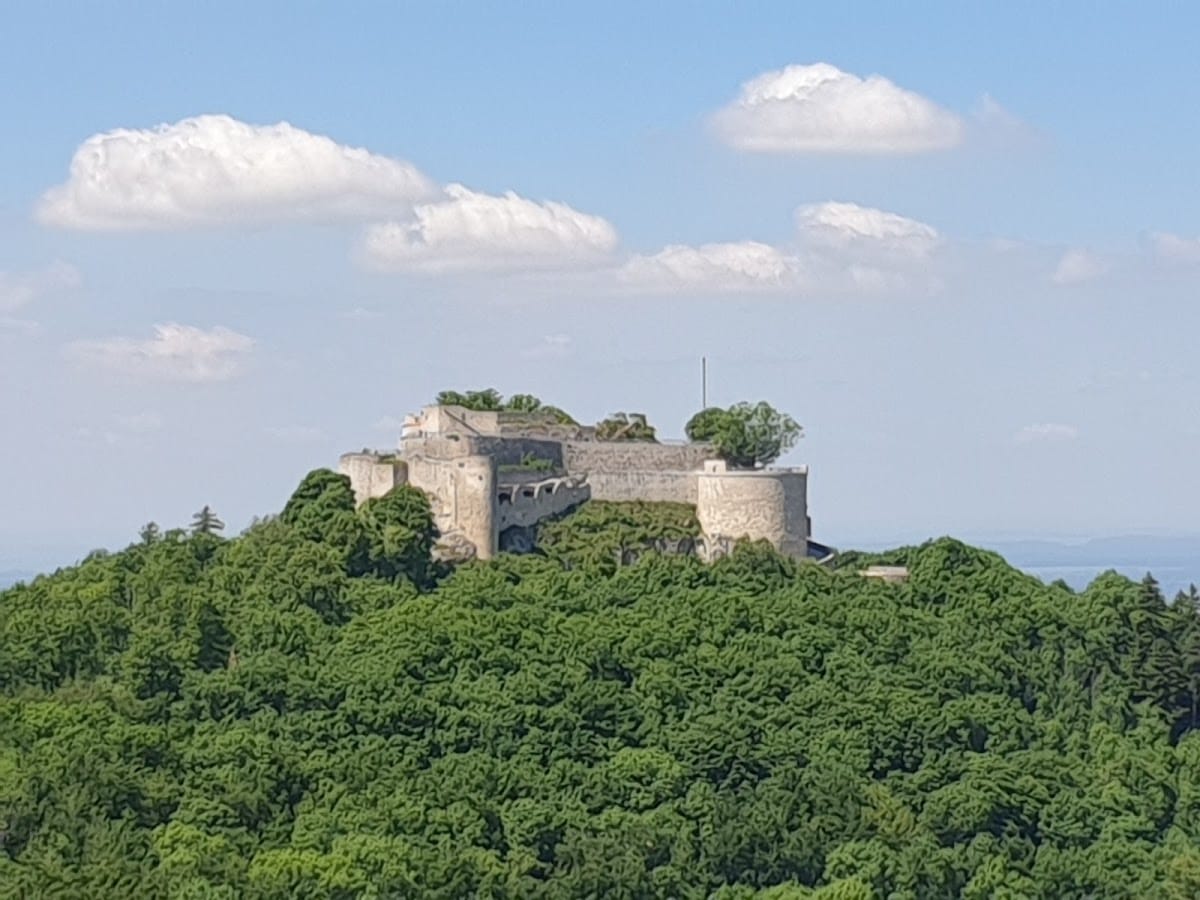
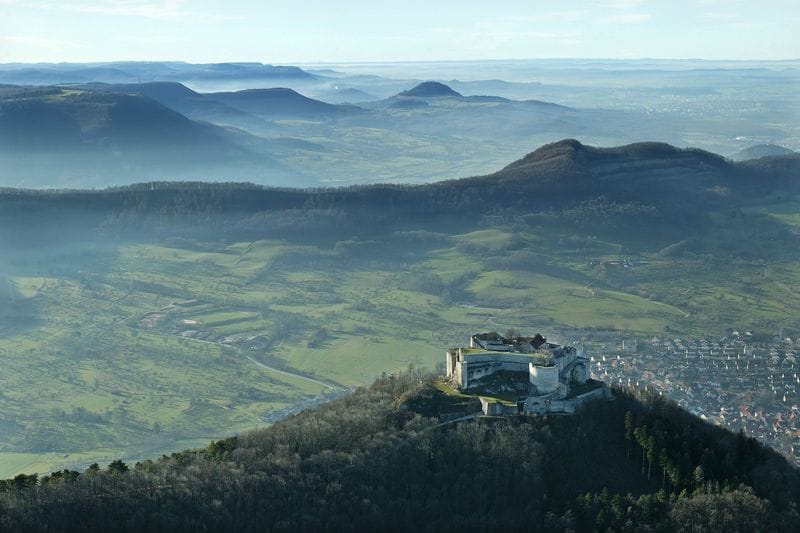
The ruins occupy a large late-Jurassic white-Jura limestone rock at approximately 744 metres above sea level, above the town of Neuffen on the edge of the Swabian Alb. The hilltop position provided broad views over the surrounding land and placed the fortress on mountain-edge terrain with defensive value. The surviving complex preserves parts of both the outer walls and the inner fortifications.
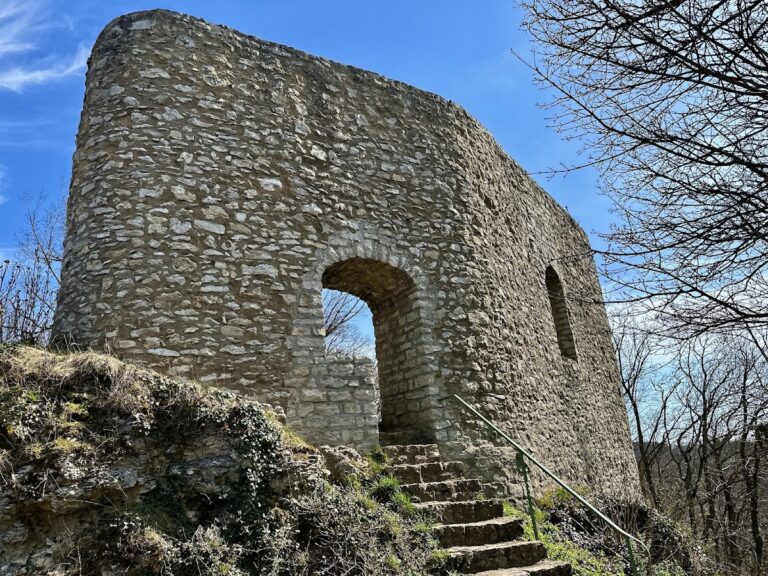
A gate leads toward the citadel, the strongly fortified inner part of the complex, while a road runs between the outer and inner walls. The arrangement reflects the progressive transformation of the medieval stone castle into a larger early modern fortified complex. Stone and brick were used in the construction, and some of the surviving casemates remain accessible.
Sixteenth-century defences
The sixteenth-century fortress included outer works, a barbican, round towers, bastions, a commandant’s building, casemates, stables, an armoury, and two cisterns. A barbican was an advanced defensive structure protecting an entrance. The bastions were projecting fortifications designed to allow defensive fire along the faces of the walls, while the casemates were fortified chambers protected against attack. The cisterns stored water for the fortress.
Upper bailey and approach
The upper bailey, an enclosed upper courtyard or section of a castle, contains the surviving building in which the inn was established in 1862. Beside the castle approach stands the Friedrich Bastion. The Staufer stele was erected there in 2014, adding a modern commemorative feature to the historic approach while the surrounding defensive fabric remains in ruinous form.
Nearby sites