Schloss Urach: A Medieval Castle and Württemberg Residence in Germany



Site at a Glance
- Rating
- 4.3
- Popularity
- Low
- Country
- Germany
- Primary era
- Medieval
- External website
- Open
- Eras represented
- Medieval, Early Modern
- Civilizations
- Duchy of Württemberg, Holy Roman Empire
- Site type
- Domestic
- Remains
- Palace
On this page15 sections
History
Medieval origins and the Counts of Urach
Schloss Urach is a medieval castle and later dynastic residence in Germany, built by the Counts of Urach in the valley by the mid-eleventh century in connection with Hohenurach Castle. The older moated castle served as the counts’ urban residence while also allowing them to monitor and, when necessary, block movement through the valley.
In 1264–1265, the castle and its associated lordship passed to the Counts of Württemberg. Heinrich of Urach sold his holdings to Count Ulrich I of Württemberg because of financial difficulties, bringing Urach into the territory of the Württemberg ruling dynasty.
A Württemberg residence
A new residence was built beside the older moated castle around 1400 for a branch of the Württemberg dynasty. Count Eberhard III and his Milanese-born wife, Antonia Visconti, are considered to have commissioned the building, which was modeled on Stuttgart’s Old Castle. The residence formed part of a castle-like precinct on the edge of the old town and was able to accommodate a substantial court household.
Following the division of Württemberg in 1442, Ludwig I of Württemberg selected Urach as his residence city and moved into the town castle. Urach then became the capital and official residence of the County of Württemberg-Urach. The castle was also the birthplace of Count Eberhard V of Württemberg, also numbered Eberhard I in the Urach succession, who lived from 1445 to 1496, and of Duke Christoph of Württemberg, who lived from 1515 to 1568.
Expansion and court life
In 1474, Eberhard V extensively modernized the castle for his marriage to Barbara Gonzaga of Mantua. The ground-floor court hall was converted into a dining room for the entire court, while the principal hall received monumental painted decoration with ancestral coats of arms and the lord’s motto.
After Württemberg was reunited in 1482 and the court moved to Stuttgart, Urach lost its function as a governmental and official residential center. The former residence continued to serve intermittently as a hunting lodge, a retreat for the ducal family, alternative accommodation, and a setting for festivities.
War, renovation, and changing use
Spanish troops serving under the Duke of Alba occupied the castle in 1546 during the Schmalkaldic War, a conflict between the Protestant Schmalkaldic League and the forces of the Holy Roman Emperor. Imperial troops occupied it again in 1634 during the Thirty Years’ War, the major European conflict fought from 1618 to 1648. Extensive renovation followed under Duke Eberhard III in 1663–1664.
Around 1600, parts of the interior were refitted in richly ornamented late-Renaissance forms. The Renaissance was a European artistic and architectural period that emphasized classical forms, while its late phase favored elaborate decoration and richly ornamented interiors. Under Duke Carl Eugen, the complex received its final eighteenth-century modernization, including the former dining room known as the White Hall.
In the late eighteenth century, the old moated castle at the core of the complex was demolished under Carl Eugen. Its rubble was used to drain the Swan Lake. As later rulers increasingly ceased to use the former residence, almost all of its furniture was sold at auction in 1819. The interiors were then converted into an apartment for the town pastor, and stables were installed on the ground floor.
Conservation and museum history
A major renovation in the 1960s followed the conservation principles of that period. Many interior components were replaced with modern steel and concrete structures, while valuable historic fabric was discarded without documentation. Photographs of this intervention are displayed in the museum. Schloss Urach is state-owned and managed by State Palaces and Gardens of Baden-Württemberg. The complex houses a museum.
Remains
The castle precinct
The present precinct consists of a gate tower, a professor’s building, a gatekeeper’s building, and the main castle. Together, these structures preserve the outline of a residence complex that developed beside the older fortified site at the edge of the old town.
Main castle
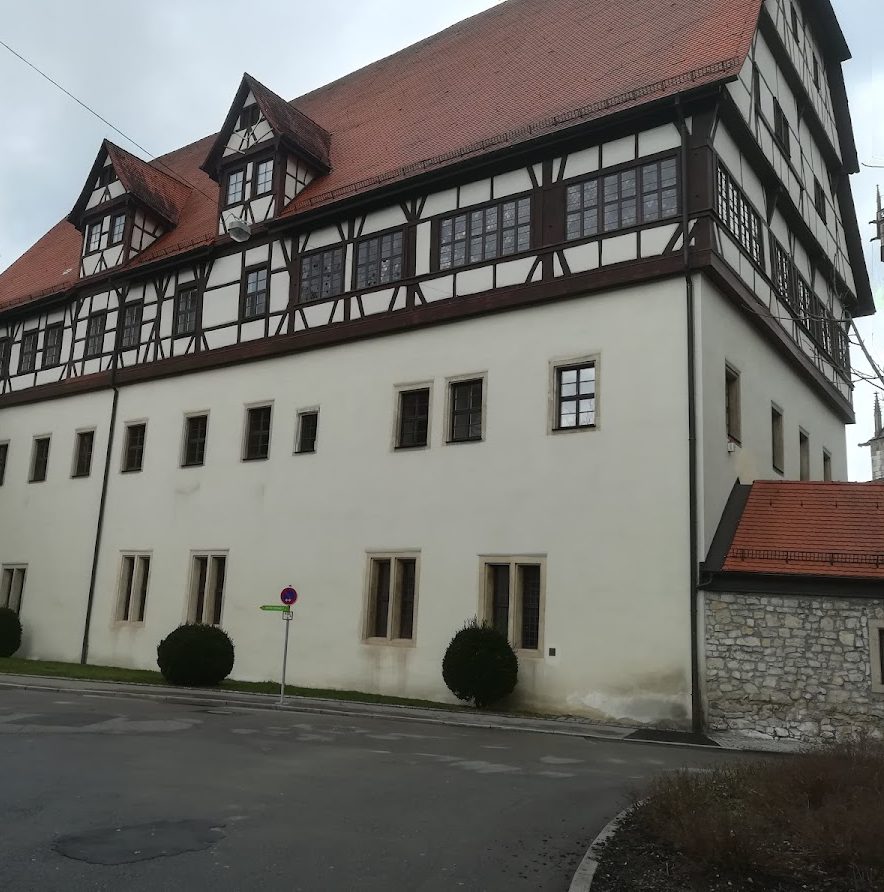
The main castle is a rectangular building from around 1400, covered by a saddle roof. Its later additions include a western extension with a hipped roof, another rectangular tower-like extension, and a large tower on the southern side. The building represents the new residence that was established beside the earlier moated castle.
Former residence arrangement
The new residence was originally a hall building in the outer bailey. Its ground and first floors were occupied mainly by large, elongated rooms. Additional living quarters were provided from the beginning on the second floor and in the attic, although only remnants of these upper rooms survive.
Halls and interior decoration
Dürnitz
The ground-floor court hall, or Dürnitz, was fitted out in 1474 with an elaborate four-aisled vault. A Dürnitz was a large heated hall in a medieval or early-modern German residence, commonly used for communal dining and other court functions. At Schloss Urach, this hall became the dining room of the entire court.
First-floor hall
The first-floor hall received monumental painted decoration in 1474. Ancestral coats of arms and the castle lord’s motto covered the hall, linking its ceremonial appearance to the dynastic identity of the Württemberg court.
Golden Hall
The Golden Hall is a richly paneled ceremonial room in the late Renaissance style. It has a flat ceiling, windows on three sides, and Corinthian columns dividing the room. Corinthian capitals are classical column capitals decorated with ornament resembling acanthus leaves. The walls and columns are extensively gilded, giving the room its name.
Museum collections
The museum contains elaborately decorated sledges dating from the seventeenth to the nineteenth century. These objects preserve part of the courtly culture associated with the residence’s later use as a ducal retreat and venue for festivities.
Nearby sites