Jōnozuka Kofun: An Early Fifth-Century Keyhole Burial Mound in Japan

Site at a Glance
- Rating
- 4
- Popularity
- Very Low
- Country
- Japan
- Primary era
- Classical
- External website
- Open
- Eras represented
- Classical
- Civilizations
- Yamato
- Site type
- Burial
- Remains
- Burial Mound
On this page7 sections
History
Jōnozuka Kofun is a keyhole-shaped burial mound in Wakasa, Japan, built around the beginning of the fifth century during the middle Kofun period. A kofun is a monumental Japanese burial mound, and the middle Kofun period was the central phase of the third- to seventh-century era when large elite tombs and regional political authorities became especially prominent. Jōnozuka is regarded as the earliest of Wakasa’s major chiefly tombs and predates Shiroyama Kofun.
The Wakibukuro Tomb Group
The mound forms part of the Wakibukuro Kofun Group within the wider Kaminaka Kofun Group. Seven kofun were established on the western foothills of Mount Zenbu, of which five are currently confirmed to survive. Jōnozuka stands in the central part of the Wakibukuro group. Together with Nishizuka Kofun and Nakatsuka Kofun, the group is regarded as a “Valley of the Kings,” a concentration of tombs associated with regional rulers of Wakasa.
The person buried at Jōnozuka is unknown. The Wakibukuro and Kaminaka groups are thought to represent chiefly tombs belonging to the Kashiwade clan, a powerful hereditary lineage traditionally associated with supplying food to the court. The proposed connection also draws on the name of nearby Mount Zenbu and on records that associate the clan with service in Wakasa since the time of Emperor Kōgen. Kōgen belongs to Japan’s legendary early imperial chronology, whose dates and historicity remain uncertain.
Investigation and protection
Jōnozuka Kofun was designated a National Historic Site on December 24, 1935. Archaeological excavation took place in 1992, followed in 2008 by ground-penetrating radar and electrical-resistivity surveys conducted by the Nara National Research Institute for Cultural Properties and Wakasa Town. These investigations helped examine the mound and its surrounding area without relying solely on excavation.
Remains
Jōnozuka is a zenpō-kōen-fun, a keyhole-shaped mound formed by a circular rear section joined to a square front section. It is approximately 100 meters long and was built in three tiers. The rear section measures about 64 meters across and rises roughly six meters, while the front section is approximately 48 meters wide and 36 meters long. Most of the mound’s original form survives, and its surfaces were covered with fukiishi, a stone revetment that also covered the circular rear section.
Mound orientation and setting
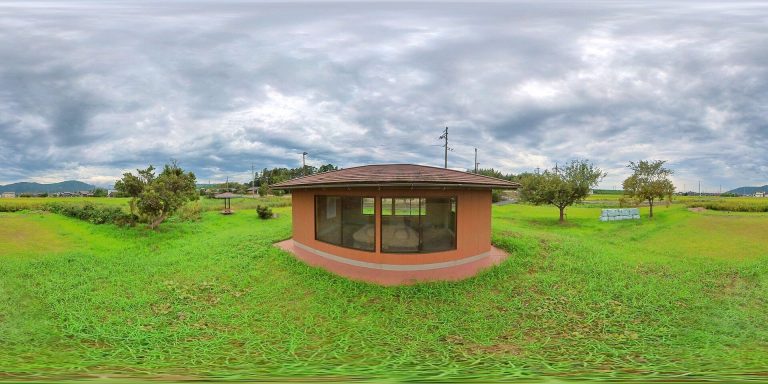
The square front section points north, an orientation opposite to that of Nishizuka Kofun and Nakatsuka Kofun. The burial facility itself has not been identified. The mound lies at the western foot of Mount Zenbu, west of the tracks of the JR West Obama Line, with farmland around it.
Surrounding moat
A shield-shaped moat enclosed the mound. The inner slope of the moat’s outer bank was faced with fukiishi, continuing the use of stone revetment around the monument. Spear-shaped wooden objects and wooden boards were recovered from the moat. The former moat area now lies beneath rice paddies.
Haniwa and excavated objects
Fragments of haniwa, clay objects placed around burial mounds, have been found around Jōnozuka. They include cylindrical forms, morning-glory-shaped examples, and house-shaped examples. Wooden haniwa were also discovered still standing upright. Grave goods consisted mainly of wooden and metal pieces, including objects of Korean and Chinese origin. Excavated haniwa are displayed at the Wakasa Museum of History and Culture.