Hochosterwitz Castle: A Sixteenth-Century Fortress in Austria


Site at a Glance
- Rating
- 4.5
- Popularity
- Medium
- Country
- Austria
- Primary era
- Early Modern
- External website
- Open
- Eras represented
- Medieval, Early Modern
- Civilizations
- Habsburg, Holy Roman Empire
- Site type
- Military
- Remains
- Castle
On this page14 sections
History
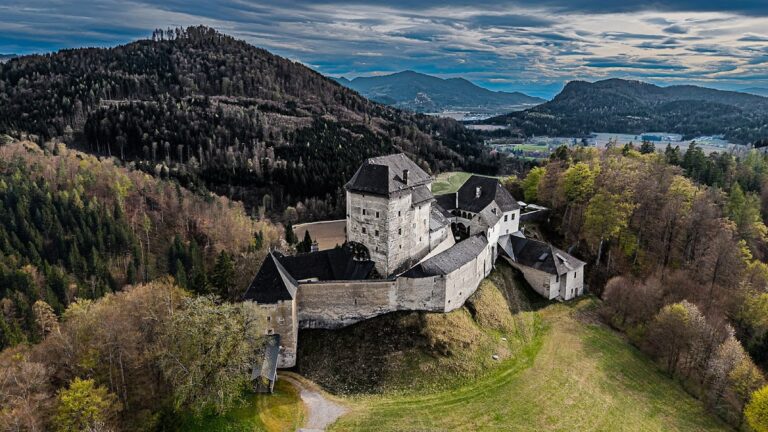
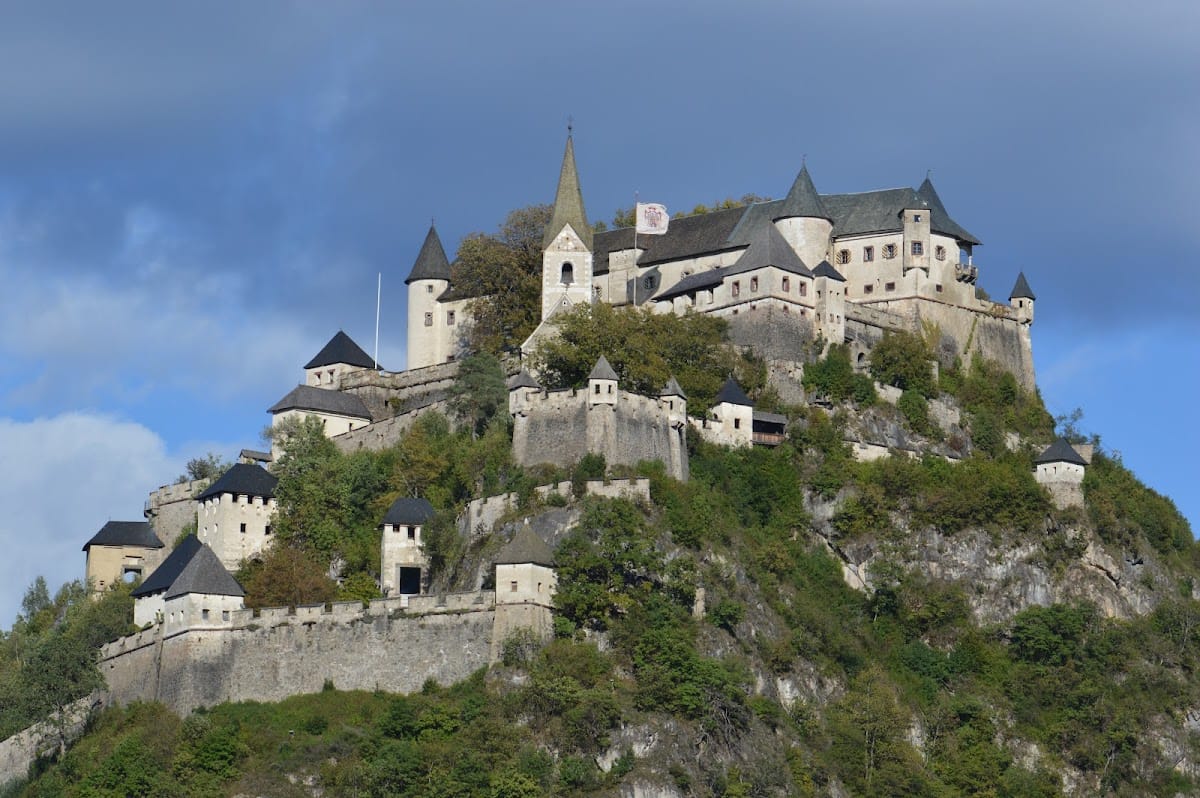
Hochosterwitz Castle is a hilltop fortress in Austria that took its present Mannerist form during the sixteenth century under the Khevenhüller family. It stands at Launsdorf on an isolated dolomite rock, whose earlier settlement history reaches back to the Bronze Age. In its mature form, the castle became a principal fortress of Carinthia during the Habsburg effort to counter Ottoman incursions.
Early settlement and medieval ownership
The castle rock was occupied from the Early Bronze Age onward. Finds associated with the Hallstatt and La Tene cultures, Iron Age societies of central Europe, together with numerous Roman-period objects, include spindle whorls, loom weights, and iron slag. These remains point to a permanent settlement before the medieval fortress took shape.
The earliest written reference dates to 860, when Louis the German, the king of East Francia, donated property in Carantania to the Salzburg archbishopric. Carantania was an early medieval Slavic principality in the eastern Alps and a predecessor of the later region of Carinthia. The place-name appeared as Astarvizza, probably from a Slavic expression meaning “sharp mountain,” although a Celtic-Roman origin has also been proposed.
Hochosterwitz remained under the Salzburg archbishopric until the middle of the twelfth century. It then became a fief of the territorial ruler held by the Schenks of Osterwitz. This family retained the castle until 1478, and its members held the hereditary office of cupbearer to the dukes of Carinthia. A Gurk diocese fief register from around 1200 refers to the castle as a castrum, meaning a fortified place. A medieval description from 1388 identifies a square tower, residential rooms, a small chapel, and defensive walls with crenellations and loopholes.
The Osterwitz succession and Habsburg control
The Osterwitz family entered economic decline after Georg of Osterwitz died in Turkish captivity following the invasion of 1475. In 1478, Hans of Osterwitz surrendered Hochosterwitz to Emperor Frederick III, a Habsburg ruler who received the castle after the family relinquished it. The property subsequently changed hands several times.
In 1509, Frederick’s successor, Emperor Maximilian I, granted Hochosterwitz as a fief to Matthäus Lang von Wellenburg. Lang was Bishop of Gurk and later Archbishop of Salzburg, and he enlarged the castle. After Lang’s death, the property was pledged to Georg von Khevenhüller in 1541. Khevenhüller purchased it in 1571, beginning the continuous Khevenhüller ownership that has shaped the castle’s present appearance and collections.
Georg von Khevenhüller and the sixteenth-century fortress
As governor of Carinthia, Georg von Khevenhüller rebuilt and expanded Hochosterwitz between 1570 and 1583. The works produced the present fortified complex, described at the time as Carinthia’s principal fortress. The Habsburgs, a central European ruling dynasty whose Austrian branch governed territories including Carinthia, were strengthening defenses at Riegersburg, Vienna, Graz, and Klagenfurt during the same period to meet the threat of Ottoman attacks.
The defensive design belongs to a period when firearms were replacing the weapons associated with medieval chivalry. Fourteen successive gates and fortified approaches forced an attacker to overcome each entrance separately while remaining exposed to fire from several directions. The castle was not conquered in its sixteenth-century form. A marble inscription in the courtyard preserves Georg von Khevenhüller’s instruction that his descendants should not sell, donate, pledge, or otherwise diminish the estate. It also calls on them to preserve Christian faith, virtue, moderation, and family unity.
A popular tradition connects the castle with Countess Margarete of Tyrol, also known as Margarete Maultasch. According to the story, she besieged Hochosterwitz, and the defenders deceived her by throwing a slaughtered ox filled with grain over the walls to suggest that supplies remained plentiful. The medieval chronicler Jakob Unrest recorded the tradition, although the siege is considered historically very unlikely.
Later changes and interpretation
An independent water supply was established in 1961, when estate manager Raimund Ruhdorfer discovered a spring during an inspection round. Between 2012 and 2015, a guard tower was converted into the Khevenhüller Guard Museum, which presents military uniforms and equipment from the sixteenth century to the present. Modern Christian relief motifs were added to the gates during the twenty-first century. The castle complex also contains a historical museum with Khevenhüller weapons, documents, paintings, and prehistoric objects.
Remains
Hochosterwitz occupies an isolated dolomite rock east of St. Veit an der Glan, on the right bank of the Gurk and north of Magdalensberg. The rock rises approximately 160 to 175 metres above its surroundings, and the highest point of the castle reaches about 711 metres above sea level. A principal road winds for roughly 620 metres through the rocky terrain, crossing clefts, running beside walls cut into the rock, and widening at points into defensive positions before reaching the main castle.
Fortified approaches and gates
Outer gates
Fourteen substantial gates protect the rising approach, and five originally had drawbridges over deep pits or ravines. A second medieval route, the Narrensteig, climbs the steep western slope without passing through the main gates. It is partly cut into the rock and was protected at its lower end by a defensive cross-wall. The two fortified approaches were already known in the medieval period.
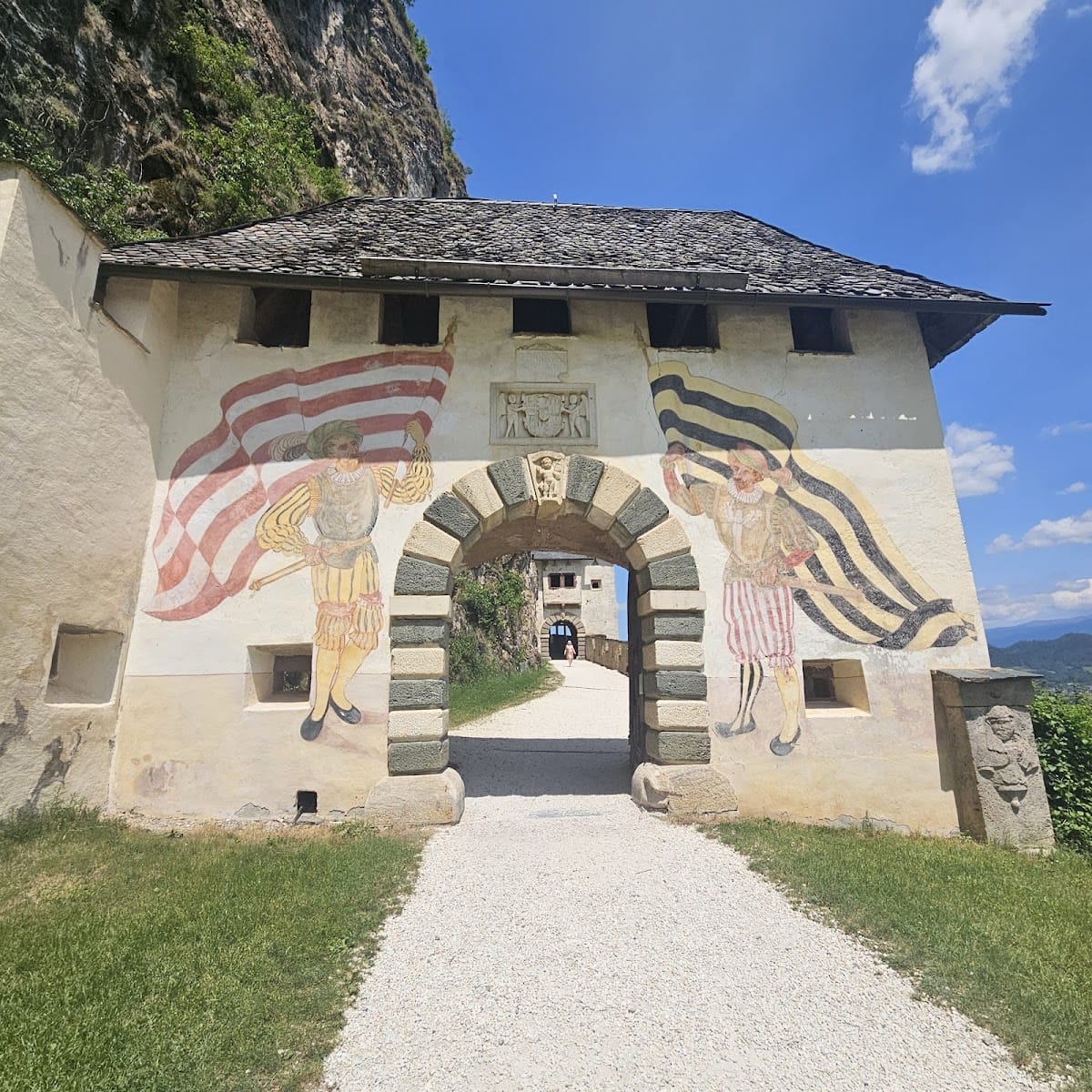
The first gate, the Fähnrichtor or Standard-Bearers’ Gate, was completed in 1580. Two larger-than-life sixteenth-century standard-bearers carry flags associated with the Khevenhüller family and Carinthia. Above the passage is a relief of Christ with a flag and a lamb, while the right front corner bears a grey-stone relief of Margarete Maultasch. A cannon stood beside the passage, and the gate’s exterior frescoes have been restored.
Defensive gates along the ascent
The Wächtertor or Watchmen’s Gate, dated 1577, is pressed against a steep rock wall on one side and overlooks a precipice on the other. Its defenses include a machicolation, a projecting structure with openings through which defenders could attack people below, as well as loopholes in the upper annex, iron-covered window shutters, and a small rock plateau for throwing stone blocks. A religious inscription marks the entrance.
The Nautor or Ship’s-Bow Gate dates to 1583 and projects over the precipice in a plan resembling a ship’s bow. Its narrow approach and close position beside the rock limited the space available for an attacker to ram the entrance. The Engelstor or Angel’s Gate is an older entrance rebuilt in 1577 between a ravine and an overhanging rock face. It has a drawbridge, a marble keystone with an angel relief, and a basement beneath the portal. A nearby platform served military exercises and storage.
The Löwentor or Lion Gate, dated 1577, takes its name from the lion painted on its iron-clad doors. Its drawbridge mechanism was placed on the upper floor of the adjoining guard structure. A cross, an inscription panel, and a marble relief of Jesus decorate the gate. The Manntor or Men’s Gate has a short barrel-vaulted passage. Its actual door stood at the rear and opened toward an attacking force, while loopholes, a ceiling opening for dropping projectiles or liquids, and a cannon position allowed the passage to be defended from several directions. An inscription dates the gate to 1579, while another description gives 1578. A relief of Archduke Charles of Inner Austria, now placed above the tenth gate, originally belonged here.
Inner gates and the main castle entrance
The Khevenhüllertor or Khevenhüller Gate is the most elaborate entrance. Its round-arched opening has a rusticated green-schist frame, three storeys, battlements, corbels, and firing projections. A lion’s head and the Khevenhüller arms, dated 1580, appear on the keystone. Above the entrance, a marble high relief shows Georg von Khevenhüller in full armor. The gate bears the date 1582, while the portrait relief is dated 1589.
Georg von Khevenhüller donated the Landschaftstor or Estates’ Gate to the Carinthian estates, the territory’s representative political bodies. Built of red sandstone over a ravine, it contained a drawbridge that rotated around a central axis. When raised, the bridge confronted an intruder with a deep drop. Diamond rustication, the arms of Carinthia, and a foundation inscription decorate the gate, which is dated 1570.
The Reisertor or Reiser Gate has an inscription stone showing a winged hourglass and a pair of scales, dated approximately 1575 to 1580. The Waffentor or Weapons Gate carries a relief of Archduke Charles of Inner Austria and an inscription panel dated 1576. A commemorative panel for Archduke Maximilian is installed here, although it was intended for the guardhouse at the sixth gate. The entrance also helped control the lower seventh and eighth gates. The Mauertor or Wall Gate has walls built from chlorite schist.
The Brückentor or Bridge Gate stands before the outer castle courtyard and retains a drawbridge. Its upper floor contains the chain winch used to operate the bridge. The Kirchentor or Church Gate, dated 1579, is attached to the bastion of a watchtower. A branch leads from it toward the castle church, and a subterranean passage formerly ran from the gate toward the inner courtyard.
The Kulmertor or Kulmer Gate was erected in 1576 and named after the Kulmer family, who served as castle administrators. A beam bridge with pouring openings, a barrier beam, and a portcullis formerly crossed the deep ditch outside it. Within the long vaulted passage, the road turns ninety degrees left and continues into the elongated zwinger, a defended space between successive walls or gates, before reaching the main castle. The rusticated portal is made of red sandstone. An inscription panel and a Roman relief of a sacrificial attendant are embedded in the northwestern outer wall.
The upper castle and religious buildings
The Hochburg and courtyard
The Hochburg, or upper castle, forms an independent defensive body that incorporates older elements. Its core encloses a courtyard partly planted with chestnut trees. The surrounding buildings contain museum displays relating to the Khevenhüller family, including paintings, historical documents, weapons, armor, and prehistoric objects. A statue identified with Margarete Maultasch is displayed in the basement exhibition rooms, although its attribution remains questionable.
A forge outside the castle is used to restore and produce historical armor and weapons. Beside it is a cistern approximately 20 metres deep for collecting rainwater. Two rainwater reservoirs also served the castle, and a freight cableway was later built to assist with food supply. One displayed group of armor rises more than 2.5 metres high. It is associated with a legend in which an armored castle resident frightened Ottoman attackers by claiming to be the smallest of his companions.
Castle chapel
The castle chapel opens onto the inner courtyard and is dedicated to Saint Nicholas, a Christian saint associated with charity and protection. A painting of the patron saint hangs above the round-arched portal. Inside, the Baroque altar depicts the Holy Family, and portraits of the Apostles occupy the vaulted ceiling.
Castle church and crypt
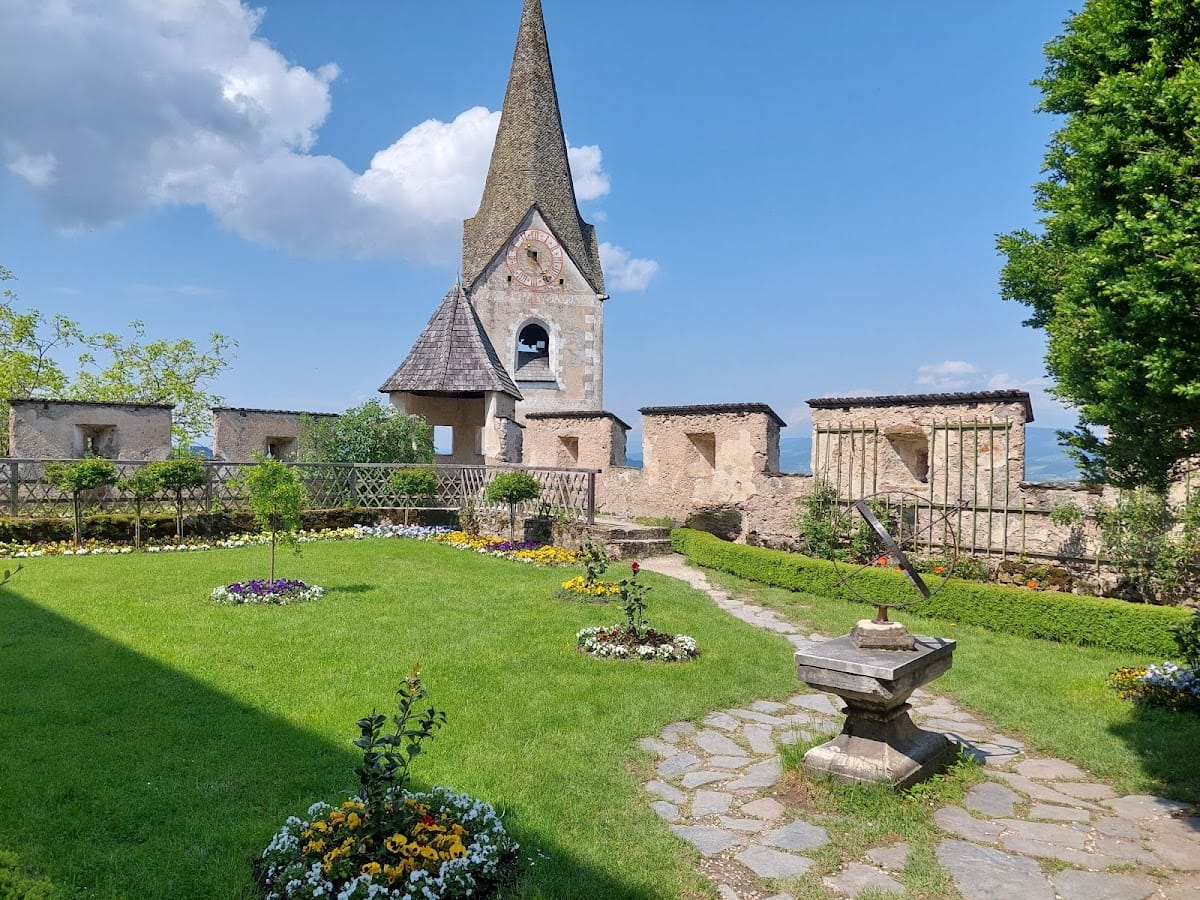
The castle church lies below the main castle beside the narrow path branching from the Church Gate. It served the surrounding population. Its Italian portal displays busts of the twelve Apostles, with Christ in the upper section, while the Baroque high altar depicts Saint John Nepomuk, a fourteenth-century Bohemian martyr.
The castle church has contained the crypt of the Khevenhüller-Metsch princely family since 1607. It was established after the Catholic parish of Villach refused burial in the main parish church to the Protestant Franz Freiherr von Khevenhüller. Maximilian Fürst zu Khevenhüller-Metsch, who died in 2010, was the most recently mentioned burial there.