Hochdorf Chieftain’s Grave: A Hallstatt Elite Burial in Germany
Site at a Glance
- Popularity
- High
- Country
- Germany
- Primary era
- Iron Age
- Eras represented
- Iron Age
- Civilizations
- Hallstatt culture
- Site type
- Burial
- Remains
- Burial Mound
On this page18 sections
History
The Hochdorf Chieftain’s Grave is a burial mound near Eberdingen, Germany, created around 530 BCE for a high-status man of the Hallstatt culture, an early Iron Age culture of central Europe. The wealth of his burial suggests that he was a leader among the Celtic elite. The grave formed part of a wider group of elite burials in the north-Alpine region.
Hallstatt elite networks
The mound was deliberately placed with an unobstructed view east toward Hohenasperg, about 10 kilometres away. Hohenasperg was a fortified Hallstatt settlement and probable elite center; the grave is not thought to have been the man’s home. The nearby Hirschlanden Warrior, a stone statue wearing a hat and neck ring and carrying a dagger at the belt, provides a visual comparison for the Hochdorf man’s possible appearance.
Genetic research published in 2024 found a close maternal-line relationship between the Hochdorf man and the person in the central burial at Grafenbühl, an elite burial site associated with Hohenasperg. The relationship was interpreted as most likely that of uncle and nephew, and as possible evidence of dynastic succession among western Hallstatt elites. Genetic links also connect two people buried at Hochdorf with individuals interred at Magdalenenberg, another Hallstatt burial mound. Dental and isotope analyses, which compare chemical patterns in human remains with those of different regions, indicate that the Hochdorf man grew up locally and spent most of his life in the area.
Discovery and excavation
In 1977, stones brought to the surface by ploughing drew the attention of Renate Leibfried, a teacher and amateur archaeologist. Archaeologists excavated the mound in 1978–79 under Jörg Biel of the Baden-Württemberg State Office for Monument Preservation. The burial had not been plundered before the excavation, allowing the grave furnishings to be examined together in their original arrangement.
Remains
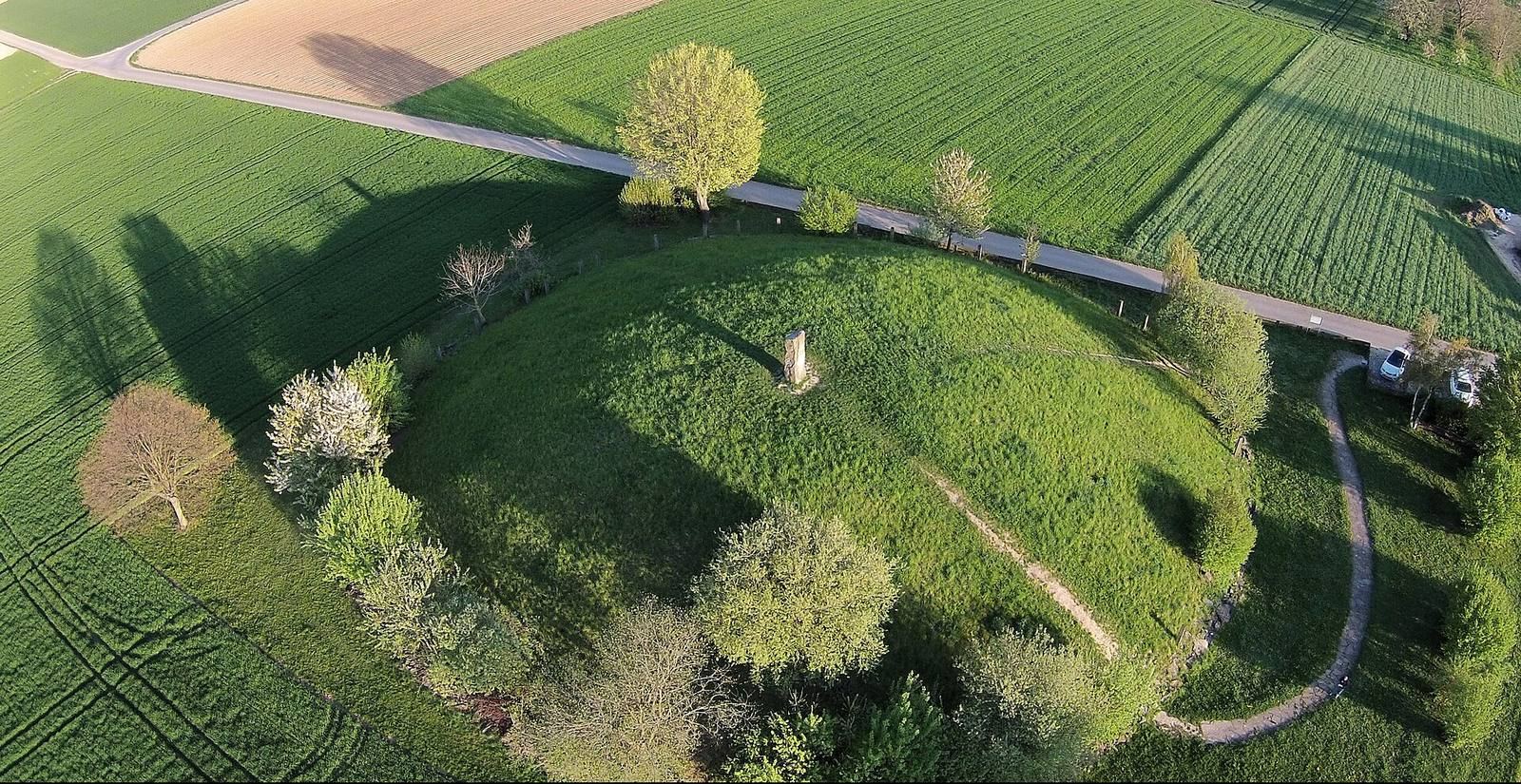
The burial lies beneath a mound about 60 metres across, originally estimated to have stood between 6 and 10 metres high. At its center, a shaft about 11 metres square held an oak-timber burial chamber. The mound and chamber have been reconstructed, and the chamber’s layered construction and exceptionally rich contents reveal how the burial was arranged.
Mound and graves
Mound and central chamber
The central chamber had two enclosing timber structures. The inner measured 4.7 metres square, while the outer was about 7.4 by 7.5 metres. Roughly 50 tonnes of stones filled the space between them, probably as protection against grave robbers. The chamber roof eventually collapsed, crushing and burying its contents. The chamber’s diagonals have been interpreted as aligned with a major lunar standstill, a recurring cycle in which the Moon reaches its farthest north and south rising and setting positions. This cycle repeats about every 18.6 years.
Additional burials
Two other graves were made as the mound was built. Southwest of the central grave, one held a man with brooches of the same type as those in the main burial. Another lay beneath the mound’s stone circle. Its stone-lined chamber contained a man with bronze ornaments and a pottery vessel holding the cremated remains of a second man. A separate, substantially later burial was placed at the mound’s edge.
The deceased and personal equipment
The man and his clothing
The buried man was estimated to have been about 50 years old and roughly 1.8 metres tall. The collapsing chamber fragmented his skeleton, and his right forearm was found beneath the bronze seat. His bones show arthritis, sinus inflammation and wear along the spine; his teeth were heavily worn. Flowers associated with late summer or early autumn suggest that the burial may have taken place in early autumn. Salt preservation of the body has also been proposed.
A conical hat made from birch bark was among his clothing. He wore a gold neck ring during his life, while other gold items were made for burial by a single smith. These included a bracelet, a belt fitting and shoe fittings, as well as a dagger about 42 centimetres long, with an iron blade, bronze sheath and gold sheeting. The gold sheets on the shoes indicate that they had been put on the wrong feet. The neck ring contained 144 grams of gold, and the gold objects together weighed 600 grams. The metal may have been obtained by panning deposits in the Rhine and Aare rivers.
Tools and weapons
Two bronze fasteners held the man’s burial cloths. A pouch on his chest contained a finely sawn comb, a razor, an iron nail clipper, three fishhooks and a small iron knife. Its leather fastening was reinforced with bronze and decorated with five amber beads. Near his head lay a quiver made from black poplar rootwood with 14 arrows, 13 tipped with iron and one with bronze, alongside a knife in a carved wooden sheath.
Furniture and feast equipment
Bronze seat
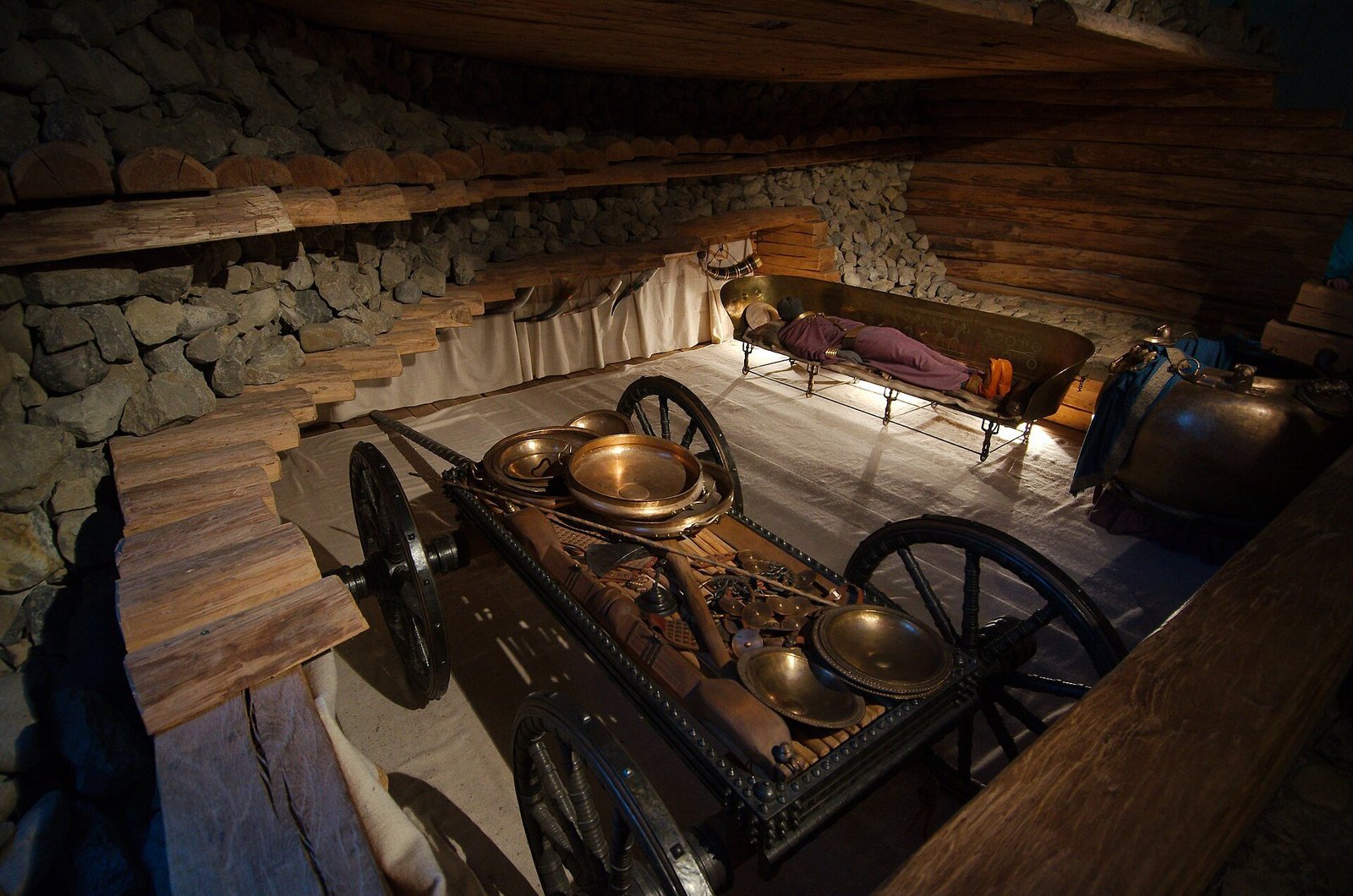
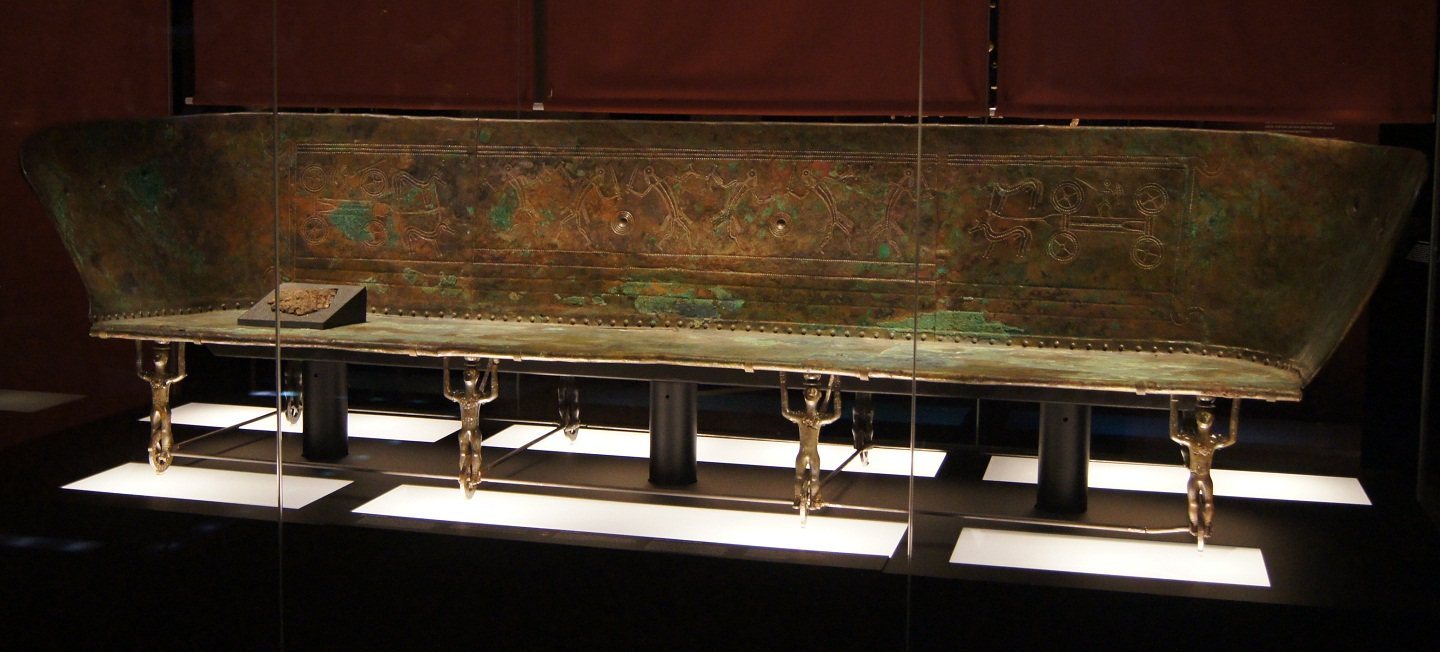
The man was laid on a bronze seat or couch 2.75 metres long, supported by eight female figures, each associated with a wheel. Punched decoration on its back shows three pairs of armed figures facing one another, while wheeled vehicles appear at the sides. Similarities have been noted with figural decoration on bucket-shaped metal vessels from northern Italy and the southeastern Alpine region. Wear and an archaic style suggest that the seat may already have been old when it was placed in the grave.
The seat had a low sitting surface, about 35 centimetres above the ground, and rings at its ends. These features have prompted suggestions that it could be moved, possibly with people seated on it, and that it may have served as a seat for several people. Its layers included fibrous material from the inner bark of plants, woven cloth, badger pelts, textiles made from badger hair, wool and linen.
Wagon and harness
A nearly complete four-wheeled wooden wagon stood on the east side of the grave. Made from elm and ash, it carried tableware and was extensively covered with iron sheet. Its exterior, wheels and pole had more than 1,300 pieces of iron cladding, most decorated with punched patterns. The equipment included a maple double yoke banded with bronze and fitted with facing bronze horse figures. Leather harness straps had bronze fittings, while the leather headgear was decorated with bronze discs. Iron bits had wooden cheekpieces, and a wooden driving goad ended in a bronze handle and iron tip. The wagon may have displayed or transported the deceased during the funeral procession, but this remains an interpretation.
Dining service, drinking horns and cauldron
The wagon held a dining service of three handled bronze bowls and nine bronze plates, sufficient for nine people. Made locally with inspiration from Etruscan-Italic models, the pieces show wear and repairs from use during the man’s lifetime. A multi-part set of butchering and sacrificial tools accompanied them.
Eight drinking horns made from aurochs, an extinct wild cattle species, hung on the chamber’s south wall. Delicate bronze handles and wall hooks held them, and gold sheet covered their rims. A larger ninth horn, made of iron and decorated with small bull heads, lay above the man’s head. It could hold about 5.5 litres.
A large bronze cauldron stood at the foot of the burial in the chamber’s northwest corner. Assembled from reused parts, it could hold about 500 litres and was buried around three-quarters full of mead. Residue remained inside, and pollen in the honey indicates a late-summer harvest. Three lions decorated the rim: two came from a Greek workshop around 540 BCE, while the third was made locally in a different style. A gold bowl used for ladling and drinking was inside the cauldron.
Textiles
Textiles served as wall hangings, seat coverings and cloths wrapped around the deceased and the cauldron. This unusually well-preserved group is exceptional for the Iron Age in Central Europe. Most pieces were made of sheep’s wool, with hemp and linen also used. The fabrics include plain and diagonal weaves, intricate diamond and other patterns, and woven borders. Many were blue or yellow; others were dyed red with colorant from Mediterranean scale insects. Three cloths, in red, purple and blue, covered the cauldron. Each carried an ancient geometric swastika pattern.
Museum and nearby settlement remains
Reconstructed burial chamber
The original skeleton is displayed at the Keltenmuseum Hochdorf/Enz, while the other original grave finds are held at the Württemberg State Museum in Stuttgart. At the Keltenmuseum, a replica of the chamber, furnished with objects made using Iron Age techniques, stands beneath a metal arch representing the mound.
Village foundations and reconstructions
Foundations of a Celtic village were found during construction of the Keltenmuseum, which began in 1989, and were incorporated into the building. A nearby open-air museum includes reconstructed buildings based on remains found at the site. It also demonstrates Iron Age crafts, including iron production in a bloomery furnace, which makes iron by heating ore without fully melting it.