Thapathali Durbar: A Thapa and Rana Palace Complex in Kathmandu
Site at a Glance
- Popularity
- High
- Country
- Nepal
- Primary era
- Modern
- Eras represented
- Modern
- Civilizations
- Unclassified
- Site type
- Domestic
- Remains
- Palace
On this page8 sections
History
Thapathali Durbar was a palace complex in central Kathmandu, Nepal, established as the official residence of the Thapa family. The name Thapathali means “abode of the Thapas.” Its history became closely connected with Nepal’s ruling families.
Thapa beginnings and Rana expansion
Kaji Nain Singh Thapa of the Bagale Thapa family began construction. A Kaji was a court and administrative official. His brother Bhimsen Thapa, a prominent Nepali statesman, also built structures at the complex. Nain Singh was Jung Bahadur Rana’s grandfather. Jung, a nineteenth-century prime minister who established Rana political rule, later took possession of the palace, and Rana rulers held it after him. Many buildings were added between the 1840s and 1900. Jung commissioned numerous additions, with Ranasur Bista supervising construction. A treaty between Nepal and Tibet was concluded at the durbar in Chaitra, a month in the Nepali calendar, 1912 of that calendar.
The hospital
After visiting London in 1850, Jung Bahadur established an Ayurvedic hospital at Thapathali. Ayurveda is a traditional South Asian system of medicine. The family controlled the hospital, while members of the public received treatment without charge. It closed after a military revolt in Nepal in 1886. Dev Shumsher and his family later took over the site, and his children became its owners.
From Jagat Jung to Singha Mahal
In 1885, a palace was built for Jung Bahadur’s son Jagat Jung. Jagat moved elsewhere the following year, and his son Juddhapratap Jung inherited the Thapathali palace. Shumsher Ranas murdered Juddhapratap in 1887. Chandra Shumsher then took possession of the palace, occupied it until 1904, and had it restored. Chandra had intended the complex for his son Singha Shumsher. After his father’s death, Singha inherited it, named it Singha Mahal, and began living there permanently. Previously, he had lived with his father at Singha Durbar, another palace complex in Kathmandu.
Later ownership
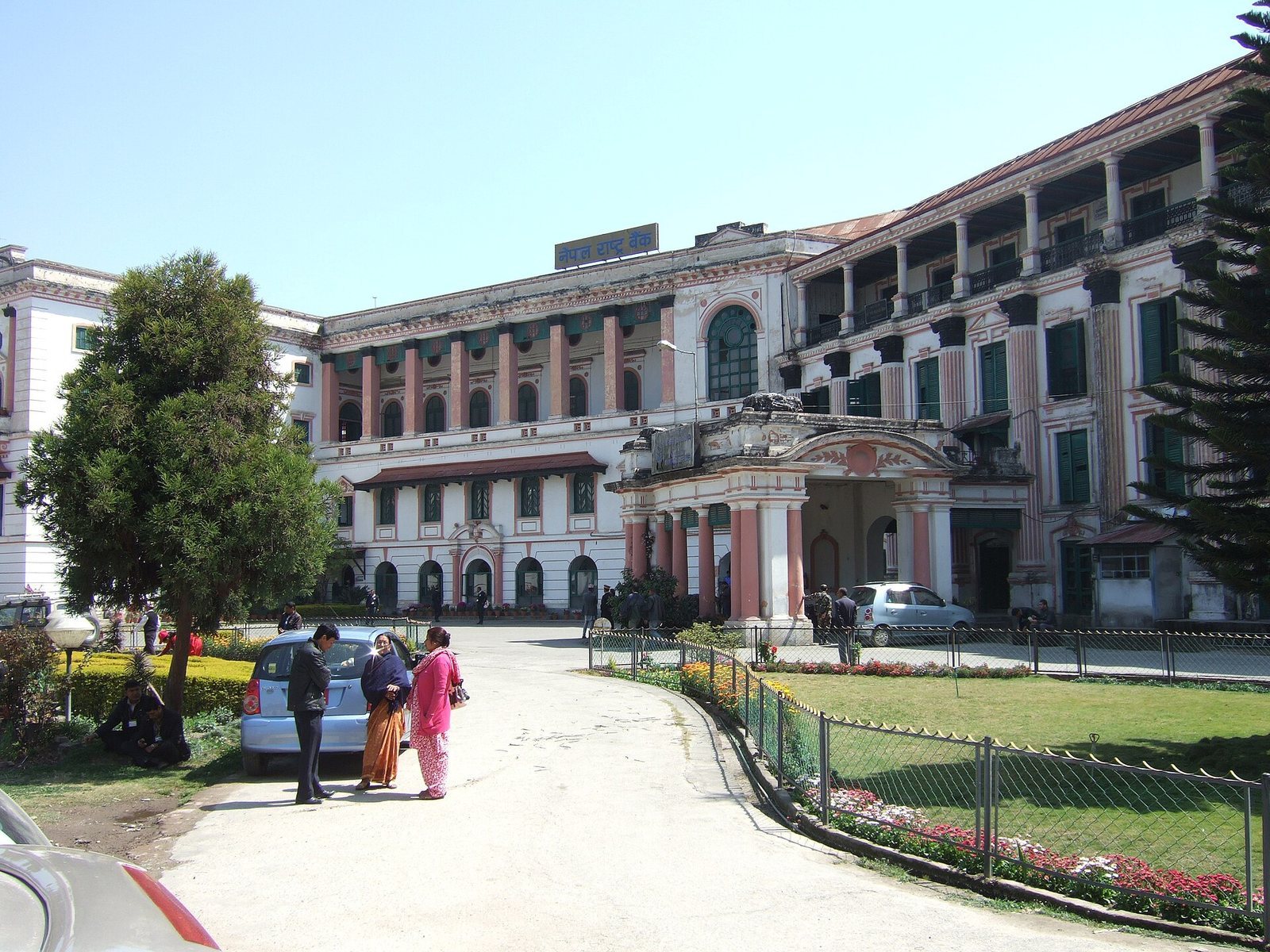
After democracy was established in Nepal, Jung Bahadur’s descendants claimed Singha Mahal, but Singha Shumsher refused to return it. During the Panchayat period, Nepal’s partyless political system under the monarchy, Singha sold the complex to Nepal Rastra Bank for nine lakh, or 900,000 in the South Asian numbering system.
Remains
The complex stood north of the Bagmati River and covered 80 ropani, a local area unit, or about 40,697.6 square metres. Its grounds contained numerous buildings, courtyards, gardens, and temples, constructed with brick and mortar. The architecture combined Mughal design, developed under the Mughal Empire in South Asia, with European styles and Nepali influences.
Singha Mahal
Singha Mahal was a palace within the complex, and Nepal Rastra Bank now occupies the site. An earthquake in the twentieth century damaged the palace, which Singha Shumsher restored. The 2015 Nepal earthquake caused further damage. After the old building became dilapidated, a new building was constructed in its place.
Kalmochan Temple
Kalmochan Temple, also called Janga Hiranya Hemnarayan Mandir, stood at Kalmochan Ghat, just beyond the palace walls but within the wider complex. Jung Bahadur built it in the mid-nineteenth century and dedicated it to Vishnu, a major Hindu deity associated with preservation and also known as Narayan. Its name refers to Jung’s wives Hiranya Garbha and Hem. The temple’s design combined Mughal and Nepali art with Kathmandu Gothic, a form of Gothic influence adapted to the Kathmandu setting. Jung is said to have built it in search of inner peace after involvement in many killings. One tradition holds that soldiers he killed were buried beneath the temple and would attain moksha, or spiritual release from the cycle of rebirth in Hindu traditions. Another connects the burials with people killed in the Kot Parva, the 1846 political massacre at Kathmandu’s Kot courtyard. The 2011 Sikkim earthquake damaged the walls and roof, leaving a large structural crack in the eastern wall and cracks along the roof edges. The 2015 Nepal earthquake reduced the temple to rubble, and the wider Kalmochan Ghat area was left dilapidated.