Hiyoshi Taisha: The Head Shrine of Japan’s Hiyoshi Tradition


Site at a Glance
- Rating
- 4.3
- Popularity
- Medium
- Country
- Japan
- Primary era
- Early Modern
- External website
- Open
- Eras represented
- Classical, Medieval, Early Modern
- Civilizations
- Tokugawa, Toyotomi regime
- Site type
- Religious
- Remains
- Sanctuary
On this page24 sections
History
Hiyoshi Taisha is a Shinto shrine in Otsu, Japan, at the eastern foot of Mount Hiei near Lake Biwa. Its origin is difficult to establish, but its traditions reach back to the worship of Oyamakui, a mountain deity associated with Mount Hiei, agriculture, and local protective power. The shrine later became the head shrine of approximately 3,800 Hiyoshi, Hie, and Sanno shrines throughout Japan. Its surviving principal buildings represent the Hiyoshi-zukuri style, a form shaped by the long interaction of Shinto worship and Tendai Buddhism.
Early Mountain Worship
The earliest written reference to Oyamakui appears in the eighth-century Kojiki, which places the deity on Mount Hiei, particularly near the sacred rock close to the summit of Hachioji-yama. A foundation tradition dates the deity’s movement from the mountain summit to the present area to the seventh year of Emperor Sujin, traditionally 90 or 91 BC. This chronology is uncertain, however, and does not establish a secure date for the shrine’s foundation.
Another tradition connects the shrine with Emperor Tenji’s transfer of the capital to Otsu in 668. According to this account, the deity of Miwa in Yamato Province, regarded as a protector of the imperial dynasty, was brought to what became the western sanctuary, while the original local sanctuary became the eastern sanctuary. Contemporary evidence does not securely support this transfer under Tenji, and another tradition attributes it to Saicho. The Great Hiei deity was later identified with the Miwa deity, Ōkuninushi, while the Lesser Hiei deity was associated with Oyamakui. An alternative interpretation holds that both deities began as forms of a local Hie deity, later divided between the greater and lesser peaks of Mount Hiei.
Enryaku-ji and the Formation of Sanno Belief
In 788, Saicho founded the Buddhist complex that became Enryaku-ji on Mount Hiei. Hiyoshi Taisha subsequently served as its guardian shrine. After the capital moved to Heian-kyo in 794, the shrine was also regarded as protecting the capital’s vulnerable northeast direction from evil and calamity. Hiyoshi Taisha and Enryaku-ji developed as an integrated religious center in which Sanno belief, or “mountain king” worship, combined the sacred mountains of the Hiei region with Tendai Buddhist and Shinto traditions.
Enryaku-ji’s influence over the shrine’s rites increased during the late ninth century. In 887, the Tendai monk Enchin petitioned the imperial court for two annual ordination places at Enryaku-ji for the Great Hiei and Lesser Hiei deities. This is the first surviving documentary confirmation of the two deities together. Around the same period, Shoshinshi became the third member of a central triad. The triad was later associated with the West Shrine, East Shrine, and Usa Shrine and interpreted through Tendai teachings concerning the unity of three contemplations and three bodies.
Shoshinshi became an independent shrine during a rebuilding of the Great Shrine in the time of the monk Sōō, who lived from 831 to 918. By the late ninth century, the Hiyoshi triad was established, and the wider Sanno Seven Shrines had formed by 1115 at the latest. The larger complex eventually included the Sanno Twenty-One Shrines and traditionally counted groups of 108 subsidiary shrines within and outside the precincts.
The East Shrine deity was linked with the mountain, land, and agriculture and was treated as a local tutelary deity. Medieval traditions variously identified the Lesser Hiei deity with Oyamakui, Kuninotokotachi, or Sanno. The shrine priestly Hōribe clan is thought to have encouraged the identification with Kuninotokotachi in resistance to Enryaku-ji’s growing authority. The Hiyoshi Shrine Priest Oral Tradition Record, once treated as an early record of these traditions, was later shown to be a forgery produced around the end of the Edo period or the beginning of the Meiji period.
Imperial Patronage and Medieval Power
Hiyoshi Taisha was listed as a major imperial shrine in the Engishiki of 927. Imperial patronage continued during the Heian period. Emperor Murakami ordered imperial messengers to visit guardian deities in 965, and Emperor Go-Suzaku added Hie Taisha to the group of Twenty-Two Shrines in 1039. The Great Hiei and Lesser Hiei deities received the first rank of kami status in 880 and 1183 respectively.
As Enryaku-ji expanded, a temple complex was established behind Hachioji-yama by the middle of the Heian period, while residential temple buildings lined the approach to the shrine. Tendai missionaries helped spread Sanno belief throughout Japan, contributing to the establishment or incorporation of numerous branch shrines. Medieval Sanno Shinto combined worship of Sanno Gongen, the Buddhist-era title for the Hiyoshi deities, with Tendai teachings that understood local kami as manifestations of Buddhist figures.
From the late Heian period, Enryaku-ji’s warrior-monks repeatedly carried the shrine’s mikoshi, or portable shrine, to Kyoto to press political demands. The first recorded protest took place in 1095 after a conflict involving the governor Minamoto no Yoshitsuna and monks from Mount Hiei. After the death of Fujiwara no Moromichi was interpreted as divine punishment for stopping a mikoshi, the objects became associated with fear as well as veneration. Such processions and protests took place more than forty times over more than 370 years, extending from the Heian period into the Muromachi period.
The Yotenki, whose prototype formed in the early thirteenth century, and the Sanka Yoryakki, compiled between the late thirteenth and fourteenth centuries, preserved important theological and origin traditions associated with the shrine. Some buildings were destroyed by fire in 1259, but the complex continued to flourish during the medieval period. Traditions then counted 108 subsidiary shrines inside the precincts and another 108 outside them.
Destruction and Momoyama Reconstruction
The shrine declined during the late Muromachi period as political disorder weakened the Muromachi government. It was burned during the Shiga Tokusei uprising of 1493, after which the surviving ritual organization centered mainly on the Sanno Twenty-One Shrines.
In 1571, Oda Nobunaga attacked and burned Enryaku-ji after its monks supported his opponents, Asai Nagamasa and Asakura Yoshikage. Hiyoshi Taisha was completely destroyed in the same campaign. Four members of the Hōribe priestly family escaped with assistance from Nagahara Shigetora. The priest Yukimaru of the Shōgenji family worked to preserve knowledge of the seven principal shrines, their subsidiary shrines, their deities, and the arrangement of the complex.
Reconstruction began after Nobunaga’s death, following an interval of about ten years. Most of the surviving shrine buildings were rebuilt between 1586 and 1597, during the height of Momoyama-period architecture. Yukimaru also reorganized the rites. The Sanno Festival resumed in 1582, initially using a sacred sakaki tree instead of the mikoshi. Toyotomi Hideyoshi and Tokugawa Ieyasu supported reconstruction and Sanno belief, while the Hiyoshi Three Bridges and other structures were built or renewed. Elements of Yoshida Shinto entered the ritual system, and by the end of the Keicho era the festival liturgies had been revised in the Yoshida Shinto style.
Separation from Buddhism
During the later seventeenth century, Enryaku-ji increasingly controlled both ritual authority and the shrine’s administration. In 1684, several shrine priests secretly removed and burned the Buddhist images that served as sacred objects of the Sanno Seven Shrines. They attempted to exclude monks and promote a more exclusively Shinto identity. After an investigation in Edo, seven priests were exiled or expelled, associated families were reorganized, and the shrine priesthood retained authority only to conduct rituals. The Buddhist images and related objects were later restored.
Before the Meiji period, Hiyoshi Taisha transmitted overlapping traditions that included Sanno Ichijitsu Shinto, Yoshida Shinto, and the Miwa lineage of Ryobu Shinto. This mixture, together with resentment of Enryaku-ji’s control, contributed to the violence that accompanied the nineteenth-century separation of Shinto and Buddhism.
In 1868, the Meiji government ordered the separation of Shinto and Buddhism. Priests led by Kinoshita Shigekuni, joined by about forty other priests and local villagers, destroyed or burned Buddhist statues, ritual implements, scriptures, and other objects at Hiyoshi Taisha. All seven principal shrines were affected, and more than 1,000 objects, possibly several thousand, were destroyed or removed. Kinoshita was temporarily detained after the destruction exceeded the government’s stated policy.
This violence became an early and widely recognized episode in Haibutsu Kishaku, the movement to suppress Buddhism and destroy or remove Buddhist images, scriptures, and ritual objects. Hiyoshi Taisha separated from Enryaku-ji, adopted the name Hie Jinja, excluded Buddhist clergy from its reconstituted festival, and changed shrine names regarded as Buddhist in character.
Modern Reorganization and Continuing Rituals
The Meiji reorganization altered the shrine’s deity system and the rank of the East and West Shrines. The East Shrine was temporarily made principal, and the deities of the two shrines were exchanged. The earlier arrangement was restored in 1942. The modern Sanno Festival was also reconstructed, including a rite representing Oyamakui and Tamayorihime as a divine couple whose union produces Kamo Wakeikazuchi.
The West Shrine became a Kanpei Taisha, or imperial shrine of the first rank, in 1871, and the East Shrine received the same designation in 1928. After the prewar shrine-rank system was abolished, Hiyoshi Taisha became a shrine on the Association of Shinto Shrines’ special list in 1948. Research published in 1989 established that the Hiyoshi Shrine Priest Oral Tradition Record was a modern forgery, although the document had strongly influenced the Meiji-era reorganization of the shrine’s deities and rituals.
The precincts cover approximately 400,000 square meters and are designated a National Historic Site. Hiyoshi Taisha became a Historic Landscape Special Preservation District in 2006 and a component of the Japan Heritage designation “Lake Biwa and Its Waterfront Landscapes: Water Heritage of Prayer and Daily Life” in 2015. The Sanno Festival, held from April 12 to 15, remains the principal annual festival. Its rites include mikoshi processions, sacred sakaki observances, food and tea offerings, and ceremonies connected with Karasaki. Enryaku-ji monks now participate in the festival. Other continuing observances include the New Year’s Great Opening of the Doors ceremony, the Sanno Raihaikō derived from a Tendai Lotus Sutra lecture held at the West Shrine in 1025, and the summer Mitarashi purification festival at Karasaki Shrine.
Remains
Hiyoshi Taisha is organized around the West Shrine and East Shrine, with the seven principal shrines, the Sanno Twenty-One Shrines, subsidiary shrines, bridges, mountain sanctuaries, and sacred natural features extending through the precincts and into the surrounding landscape. The principal buildings rebuilt in the late sixteenth century preserve the Hiyoshi-zukuri form, while the arrangement links mountain sanctuaries near Hachioji-yama with corresponding shrines at the foothills.
Principal Shrine Buildings
West Shrine
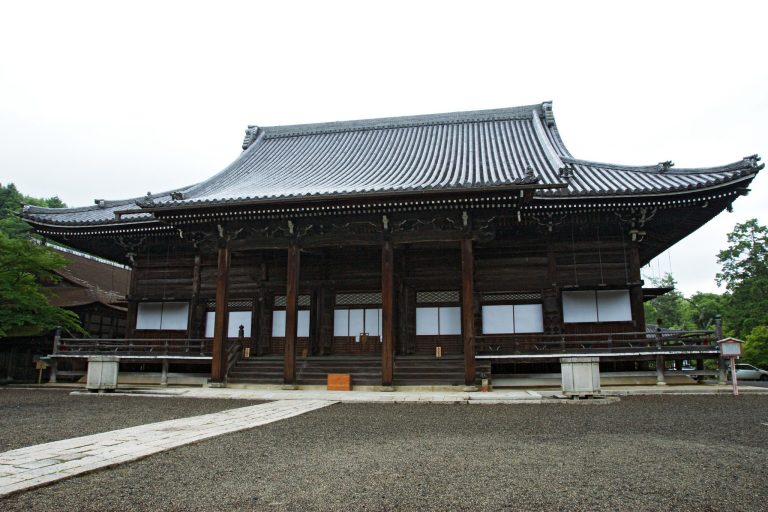
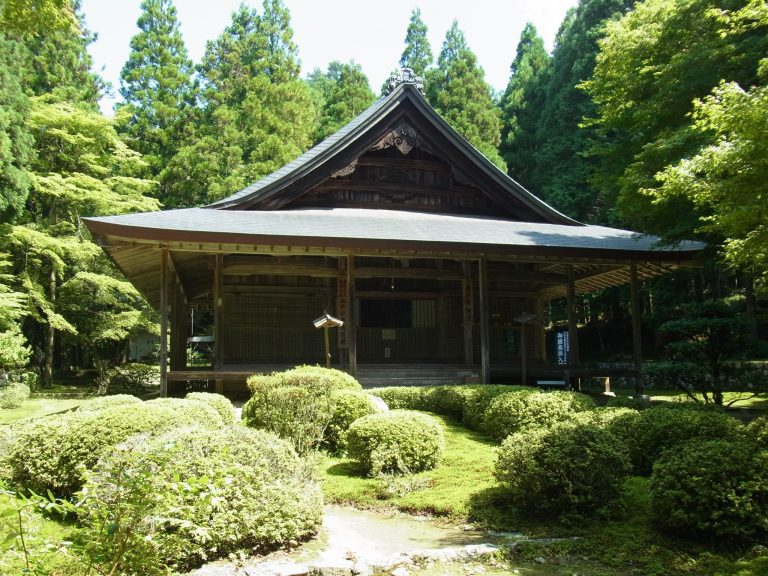
The West Shrine main hall, or Nishi Hongu honden, is a National Treasure dedicated in the modern shrine system to Great Hiei, identified with Ōkuninushi. It is one of the Sanno Seven Shrines and exemplifies Hiyoshi-zukuri. The form has a roof resembling a hipped-gabled roof, with extended eaves on three sides. Its rear roof edge appears cut off and turns upward, while the entrance runs parallel to the ridge beneath a separate projecting canopy. The central inner space measures three bays wide by two bays deep, and the surrounding galleries bring the building to approximately 11 by 6 meters. The raised floor creates a small space with a bench below it. The ceiling above the altar is latticed, the central room has a boarded ceiling, and the surrounding galleries are open.
East Shrine
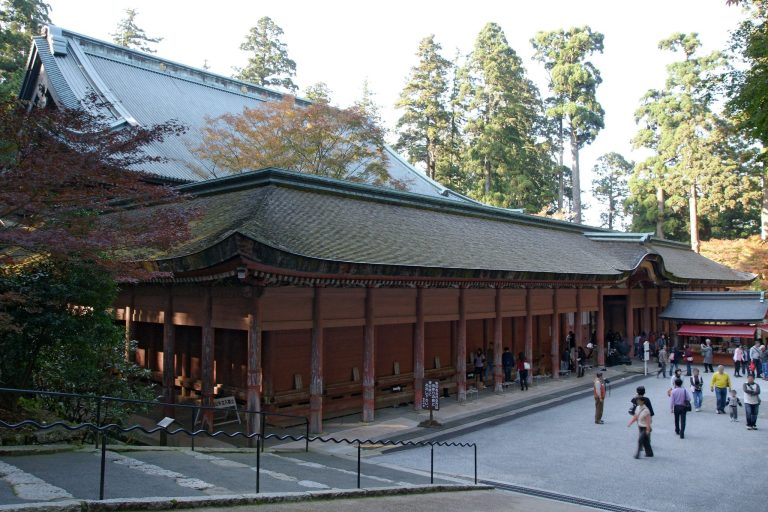
The East Shrine main hall, or Higashi Hongu honden, is also a National Treasure. It is dedicated to Oyamakui and was rebuilt in 1595. Tradition regarded the shrine as founded in 668. Between 1868 and 1928, when Ōkuninushi temporarily replaced Oyamakui as its deity, the building was called the Omiwa Shrine main hall. It formerly stood northwest of its present position and resembles the West Shrine main hall. The East Shrine worship hall was rebuilt in 1596, and the main hall, worship hall, and gate form one of the complex’s principal architectural groupings.
Usa Shrine
The Usa Shrine main hall is a National Important Cultural Property. Founded during the Ninna era, from 885 to 889, it was rebuilt in 1598 and uses the Hiyoshi-zukuri form. It belongs to the Sanno Seven Shrines, and its worship hall was rebuilt in the same year.
Mountain and Foothill Sanctuaries
Ushio Shrine
Ushio Shrine stands on the upper part of Hachioji-yama and is dedicated to the rough spirit of Oyamakui. Its main hall, a National Important Cultural Property, was rebuilt in 1595. The worship hall was also rebuilt that year and connects directly to the main hall. It uses kake-zukuri, a construction method in which a building projects over a steep slope on supporting posts.
Juge Shrine
Juge Shrine is a National Important Cultural Property dedicated to Tamayorihime. Founded in 1109 and rebuilt in 1595, it serves as the foothill sanctuary of Sannomiya Shrine. A sacred spring and well lie directly beneath its main hall. The main hall and worship hall are aligned at right angles to the corresponding arrangement of the East Shrine. Formerly called Juzenji Shrine, it was originally dedicated to Juzenji. Its worship hall was rebuilt in 1595.
Shirayama Shrine
Shirayama Shrine’s main hall is a National Important Cultural Property rebuilt in 1598. Its worship hall was rebuilt in 1601.
Sannomiya Shrine
Sannomiya Shrine stands near the summit of Hachioji-yama. Its main hall and connected worship hall were rebuilt in 1599, and both use kake-zukuri construction. Together with Ushio Shrine, it forms part of the mountain sanctuary group associated with the sacred rock called Kanada-iwa.
Secondary Shrines and Religious Landscape
The precinct contains numerous shrines associated with particular deities and ritual functions. Omonoi Shrine, dedicated to Ohtoshi, stands behind the East Shrine main hall and belongs to the middle group of shrines. Shinomonoi Shrine is another middle shrine and is dedicated to Amachikarumizuhime. Hayao Shrine, dedicated to Susanoo, stands south of the entrance, opposite an approach leading toward Gubo-ji and the Rokkaku Jizo-do.
Ujigami Shrine is dedicated to Kamo Takerikuma and Kotono-tate Ushimaro, regarded as the founder of the shrine priestly family. Usa Wakamiya is dedicated to Shitateruhime, while Ushimiko Shrine, inside the Ushio worship hall, is dedicated to the rough spirit of Yamazue no Okami. Yashihashira Shrine is dedicated to five male and three female deities.
Omiya Kamadono Shrine, Ninomya Kamadono Shrine, and Usa Kamadono Shrine are kitchen or hearth shrines dedicated to Okitsuhiko and Okitsuhime. Other shrines include Kehi Shrine, dedicated to Emperor Chuai; Tsurugiya Shrine, dedicated to Ninigi; Juge Wakamiya, dedicated to Tamayorihiko; and Iwadaki Shrine, dedicated to Ichikishimahime and Tagitsuhime. Kohakusan Shrine is dedicated to Ōkuninushi, Yasaka Shrine to Susanoo, Kitano Shrine to Sugawara no Michizane, Ebisu Shrine to Kotoshironushi, Inari Shrine to Ukanomitama, Uchimiko Shrine to Sarutahiko, and Suga Shrine to the miraculous spirit of Susanoo.
Farther into the mountains, beyond Hachioji-yama, Okusosha occupies the site of a former Buddhist temple. It is dedicated to the heavenly and earthly deities and houses an image of Saicho. Tradition also identifies the site as the place where Saicho’s father, Mitsu no Oba, prayed for his son’s birth. Ujinaga Shrine commemorates a member of the Hōribe family regarded as an ancestor of the Shōgenji branch. Shokaku-in Inari Daigongen is dedicated to Dakiniten, Sosha enshrines the Sanno Twenty-One Shrines, and Goshi-sha combines the Ko-yasu and Kodate shrines.
Hashiri-i Honden Shrine is dedicated to the four purification deities Seoritsuhime, Hayakitsuhime, Ibukidonushi, and Hayasasurahime. Ubuya Shrine, between the former Enryaku-ji residential temple Shikan-in and the Taishotoko, is dedicated to Kamo Wakeikazuchi. Ryugo-in Shrine, beside it, is dedicated to the monk Goin. Nezumi Shrine, south of Shikan-in, is dedicated to Ōkuninushi and is traditionally understood to confine the supernatural rat associated with the monk Raigo, whose transformation into an iron rat was linked to attacks on Enryaku-ji.
Hachioji-yama and Sacred Natural Features
Hachioji-yama, also called Ko-Hiei-yama, Hie-yama, Habo-yama, or Ushio-yama, is the principal sacred mountain associated with Hiyoshi Taisha. Near its summit, Kanada-iwa is regarded as the sacred rock associated with the manifestation of the deities of Ushio and Sannomiya. Their mountain sanctuaries stand on opposite sides of the rock.
The summit rock represents an ancient iwakura, a natural stone believed to receive or house a deity. A spring at the foot of the mountain, beneath the former Juzenji Shrine, formed another early sacred focus. The religious landscape therefore connects worship at a mountain rock with worship at a spring in the foothills. Ushio and Sannomiya function as mountain shrines near Kanada-iwa, while the East Shrine and Juge Shrine serve as their corresponding foothill sanctuaries.
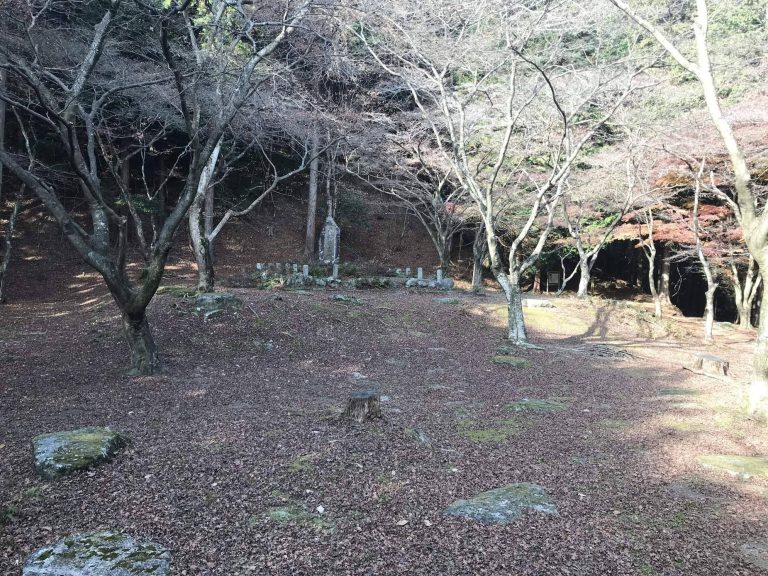
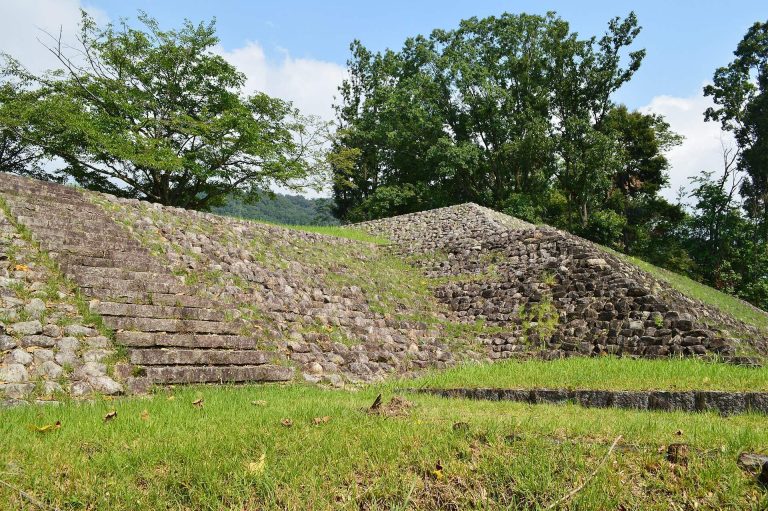
A dense group of circular tombs from the late Kofun period occupies the eastern foothills of Hachioji-yama. These tombs are associated with ancestral worship. The original site of the East Shrine may have been farther inland near the Kotani River, while the present East Shrine stands on land levelled in an area containing many of the tombs.
Bridges, Gardens, and Associated Sites
Historic Bridges
Three historic bridges form part of the complex: Ninomiya Bridge, Omiya Bridge, and Hashiri-i Bridge. Omiya Bridge has been selected as one of Japan’s One Hundred Notable Bridges. Toshogu Bridge, formerly a National Treasure stone bridge, was washed away by a flood on June 29, 1935, and its designation was cancelled.
Hiyoshi Toshogu
Hiyoshi Toshogu stands south of Cable Sakamoto Station. Its main hall, worship hall, and connecting stone chamber were remodeled in 1634 in the Gongen-zukuri form, with the three parts linked by an intermediary chamber. The complex includes the main hall, stone chamber, worship hall, transparent fence, and Chinese-style gate. This arrangement predates and is regarded as a prototype for the form later used at Nikko Toshogu.
Karasaki Shrine
Karasaki Shrine is located at Karasaki in Otsu rather than within the main mountain precinct. Dedicated to Onamabetsu, it is associated with the Karasaki rites and with the sacred tree beneath which the Great Hiei deity was traditionally said to make a ritual procession.
Old Chikurin-in Garden and Gubo-ji
The Old Chikurin-in Garden, formerly associated with an Enryaku-ji residential temple, lies north of the precinct entrance. Gubo-ji, associated with the Tendai monk Ryo-gen, also stands near the entrance area. Both belong to the wider religious landscape surrounding Hiyoshi Taisha.