Rinnō-ji: A Sōtō Zen Temple and Date Family Temple in Sendai


Site at a Glance
- Rating
- 4.4
- Popularity
- Low
- Country
- Japan
- Primary era
- Early Modern
- External website
- Open
- Eras represented
- Early Modern, Modern
- Civilizations
- Japanese, Tokugawa
- Site type
- Religious
- Remains
- Monastery
On this page9 sections
History
Rinnō-ji is a Sōtō Zen Buddhist temple in Sendai, Japan, founded in 1441 by the Date clan during the Muromachi period. Sōtō is a major school of Japanese Zen Buddhism that places seated meditation at the center of religious practice. The temple bears the mountain title Kongōhōzan and became the Date family’s temple, later developing into a major Sōtō monastic center in Ōshū, the historical region corresponding broadly to much of present-day Tōhoku.
Foundation and relocation
Rinnō-ji began in Yanagawa, in Date District, Fukushima, under Date Mochimune, the eleventh-generation lord of the Date family. Tai’an Bonshu served as its founding abbot. The foundation was undertaken at the request of Rantei Myōgyoku Zenni, the wife of the ninth-generation Date lord Masamune. Her family connections reached the Ashikaga shogunate, the military government that ruled much of Japan during the Muromachi period. Ashikaga Yoshinori petitioned Emperor Go-Hanazono, who granted the temple a handwritten plaque naming it Kongōhōzan Rinnō Zen-ji.
As the Date clan moved its political seat, the temple moved with it. Rinnō-ji passed through Nishiyama, Yonezawa, Aizu, and Iwadeyama before arriving at its present location in Sendai in 1602. This final relocation followed Date Masamune’s establishment of Sendai. In total, the temple changed location six times. Under Date family protection, it retained its position for more than three centuries and was known as the “Zen Cave of the Eastern Sea.”
Fire and twentieth-century revival
The Meiji Restoration transformed Japan’s political order and ended the temple’s protection by the Date family. In 1876, a wildfire that began in Kitayama destroyed the temple buildings, while the Niōmon gate remained standing. The complex then declined for more than twenty years.
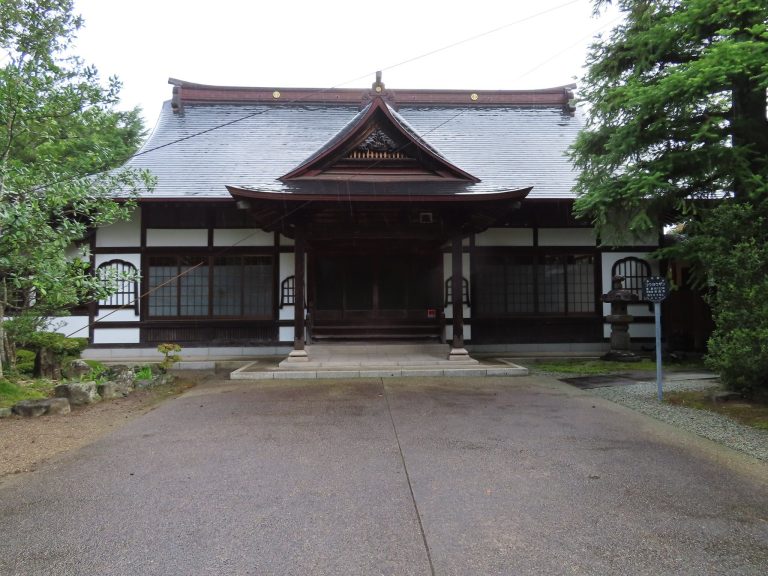
In 1903, Eihei-ji and Sōji-ji, the two head temples of the Sōtō school, appointed Fukutei Mugai as abbot to direct Rinnō-ji’s revival. After more than a decade of work, he completed the present main hall and priests’ quarters in 1915 and greatly expanded the garden. His successor, Gohō, continued the restoration and improvement of the complex. A temple bell, memorial tablet hall, meditation hall, and founder’s hall were completed in succession, re-establishing the group of seven principal temple buildings. The garden was also extended with the teahouse Hanjaku-an.
Later development and religious life
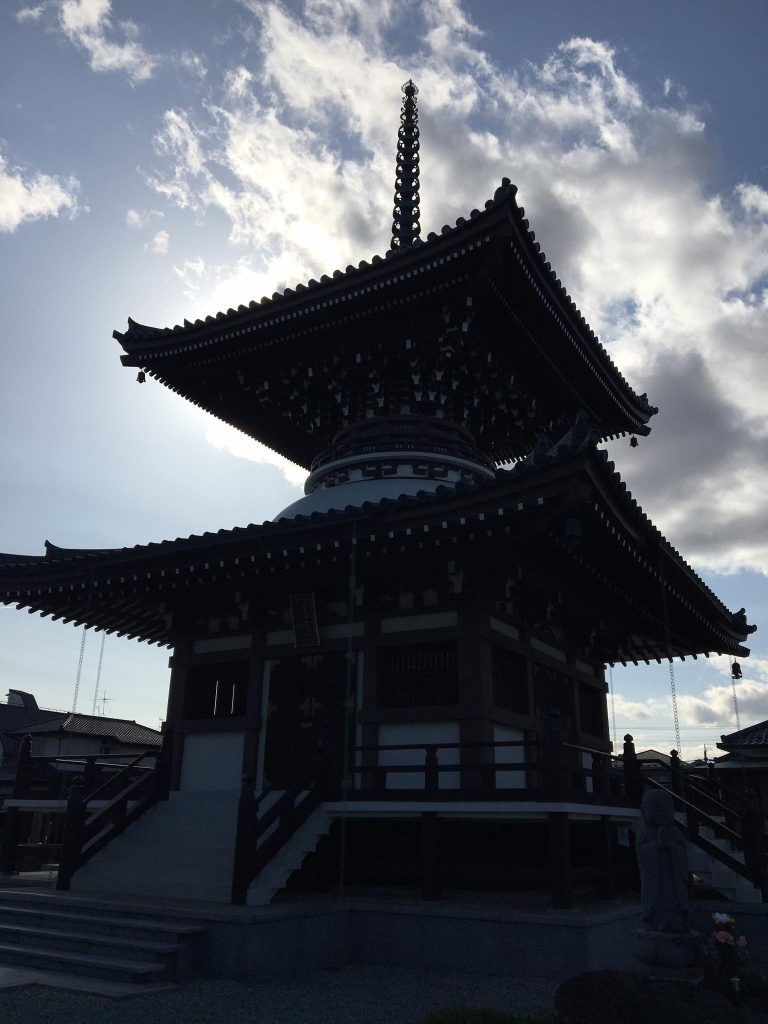
In 1981, during the abbacy of Dōkan, a three-story pagoda was erected to commemorate the five-hundredth memorial anniversary of Rinnō-ji’s founding abbot. A pagoda is a tower-like Buddhist structure associated with relics, memorial observance, or worship. Its addition formed part of the effort to recover the complex’s former appearance.
In 2004, an urban-planning road was constructed beneath the temple, requiring the complete removal of the cedar-lined approach. The present abbot and numerous volunteers replanted the approach with a forest intended to reflect the area’s native vegetation. More than 30,000 trees have since been planted across the approach and temple grounds. Rinnō-ji remains formally affiliated with the Sōtō school and continues to offer organized religious practice through Saturday-evening seated meditation and intensive morning-and-evening sessions held in early December, with public participation permitted.
Remains
Temple buildings
Gate and principal buildings
The complex includes the Niōmon, a gate associated with the two guardian figures known as Niō, together with the main hall, priests’ quarters, temple bell, memorial tablet hall, seated-meditation hall, and founder’s hall. The Niōmon is a Sendai City-designated tangible cultural property. The other principal buildings were reconstructed after the nineteenth-century fire, with their renewed forms reproducing the original forms. The main hall and priests’ quarters belong to Fukutei Mugai’s rebuilding campaign and were completed in 1915.
Pagoda and associated features
A three-story pagoda stands within the temple complex. Built in 1981, it commemorates the five-hundredth memorial anniversary of the founding abbot. Rinnō-ji is also associated with a seated statue of Shaka Nyorai, which is designated by Sendai City. Shaka Nyorai is the Japanese Buddhist name for the historical Buddha.
Garden and planted grounds
The temple garden extends behind the main hall and combines a pond with a rock garden. Water lilies grow in the pond, Japanese koi carp inhabit it, and irises bloom around its edges in June. The garden reached approximately its present scale during Fukutei Mugai’s later years and was developed further under Gohō. It is regarded as one of the leading gardens in the Tōhoku region. The rebuilt approach and temple grounds now contain more than 30,000 plantings and are enclosed by a developing forest of native vegetation.