Hinooka Kofun: A Decorated Keyhole Burial Mound in Japan
Site at a Glance
- Rating
- 4
- Popularity
- Very Low
- Country
- Japan
- Primary era
- Medieval
- Eras represented
- Medieval
- Civilizations
- Yamato
- Site type
- Burial
- Remains
- Burial Mound
On this page6 sections
History
Hinooka Kofun is a decorated Japanese burial mound in Ukiha, Fukuoka, Japan, built around the beginning of the sixth century during the late Kofun period. A kofun was a mounded tomb constructed mainly between the third and seventh centuries for members of the ruling and elite classes. Hinooka Kofun formed part of the Wakamiya Kofun Cluster with Tsukioka Kofun and Tsukado Kofun, and was the last tomb for a chief built within that group. Its painted chamber makes it an important early example of a mural-type decorated kofun and a representative monument for understanding funerary decoration during the Kofun period.
Construction and Burial Tradition
The mound followed Tsukioka Kofun and Tsukado Kofun in the development of the Wakamiya cluster. Its construction around the start of the sixth century belongs to the later phase of the kofun tradition, when large tombs continued to express the status of chiefly and elite figures. The chamber’s paintings and the associated military and equestrian imagery connected the burial with the symbolic world of the period’s ruling class.
Excavation and Preservation
Excavation in 1887 revealed the decorated stone chamber, and fragments of horse equipment were collected from the mound. Shogoro Tsuboi reported the findings in 1889. The chamber was repaired to some extent after the excavation and then sealed. A prefectural report documented the site in 1925, and Hinooka Kofun became a National Historic Site of Japan on 7 February 1928.
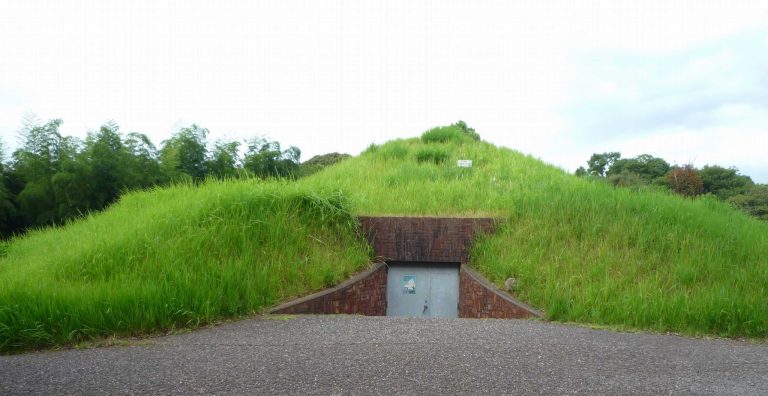
A concrete protective shelter was installed over the stone chamber in 1964. Between 1987 and 1989, the Yoshii Town Board of Education surveyed the mound, measured the chamber, and dug test trenches around it. The results were reported in 1989 and 1990. The stone chamber is now preserved within the shelter, with access restricted to scheduled viewings.
Remains
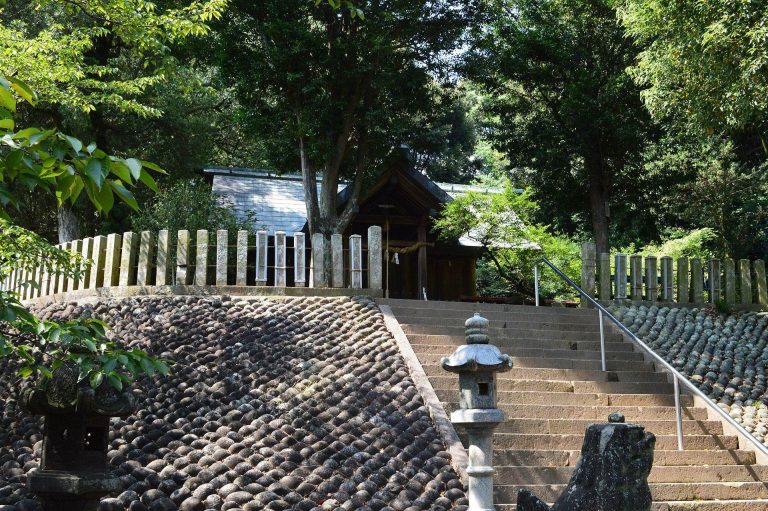
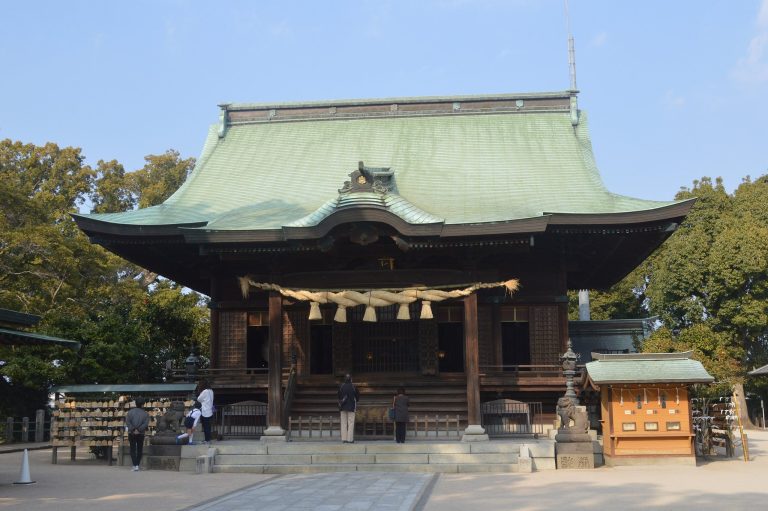
Hinooka Kofun is a keyhole-shaped mound, or zenpō-kōen-fun, formed by a circular rear section joined to a roughly square front section. It measures 74 metres in total length and stands about five metres high. The main axis runs from east to west, with the square front facing west and the circular rear section extending eastward. The rear section is approximately 40 metres in diameter. The mound occupies elevated ground on the south bank of the Chikugo River, within the precincts of Wakamiya Hachiman Shrine, and a single moat once surrounded it.
Burial Chamber
The burial facility is a single-chamber stone structure entered horizontally, built in the double-winged form. It originally opened toward the southwest. The passage is now blocked, while the collapse of the ceiling has produced the opening visible today. The surviving chamber measures 5.1 metres in total length and consists of a burial room with an entrance passage. The burial room is four metres long, 2.1 metres wide at the rear wall, up to 2.8 metres wide, and about 2.3 metres high.
Split andesite forms the chamber walls. The burial room has a rounded, bulging plan, and its side walls lean slightly inward. A large monolith more than 2.2 metres wide and 1.9 metres high forms the rear wall. Set almost vertically, it acts as a mirror stone and is capped by two or three courses of split stones. A stone shelf was also installed inside the chamber. The structure is preserved beneath the concrete protective shelter.
Painted Decoration and Finds
Paint covers almost the entire wall surface of the chamber. Six large concentric-circle designs appear on the rear wall in red, white, and green pigments, accompanied by fern-scroll and continuous-triangle motifs. The side walls carry further geometric patterns, including circles and triangles, alongside images of shields, quivers, swords, and other weapons and military equipment. Fish, boats, horses, and beasts are also represented, with different colours used across the painted motifs.
Fragments of horse equipment and haniwa, clay funerary objects commonly placed around or on Japanese burial mounds, were recovered from the mound. Related finds are displayed at the Ukiha City Yoshii History and Folklore Museum.