Hermitage of Nuestra Señora de Olatz: A Historic Shrine and Assembly Place in Spain


Site at a Glance
- Rating
- 4.5
- Popularity
- Very Low
- Country
- Spain
- Primary era
- Medieval
- Eras represented
- Medieval, Early Modern
- Civilizations
- Crown of Castile
- Site type
- Religious
- Remains
- Chapel
On this page7 sections
History
The hermitage of Nuestra Señora de Olatz is a Catholic place of worship in Azpeitia, Spain, dedicated to the Virgin of Olatz. Also known historically as Olas or Olaz, it stands in the Izarraitz district, a short distance from the Sanctuary of Loyola, and is regarded as the oldest hermitage in Azpeitia. The temple is dated to the thirteenth century, while its foundation is placed in the fourteenth century. It may have existed before Azpeitia was founded in 1310, although its precise construction date remains uncertain.
Assemblies and parish life
From the mid-fifteenth century until the beginning of the eighteenth century, the hermitage hosted the Particular Assemblies of Guipúzcoa. These were regional political and administrative gatherings held at designated meeting places before the modern provincial system. The first official reference to meetings at Olatz dates to 15 October 1460, when an assembly at Uzarraga asked Henry IV of Castile to authorize future gatherings at Santa María of Olatz or Santa Cruz of Azkoitia.
The shrine appeared again in the testament of Sancha Yáñez de Loyola, sixth lady of the House of Loyola, dated 11 December 1464. She requested that two masses be celebrated at Santa María of Olas. The assembly of 1688 met at Santa María of Olatz and at the Hermitage of Saint Augustine in Azpeitia on 12, 14, and 28 July and on 3, 11, 12, 14, and 15 August. The building also had parish functions and continues to serve as a place of worship.
Seroras and successive repairs
The hermitage was served by seroras, women who acted as religious representatives or custodians of local shrines and lived in an associated residence. Its patrons were the lords of the House of Loyola and the mayor of Azpeitia on behalf of the town. María de Hurreeta, also called Urreta, became serora in 1511 after providing a dowry of 10,000 maravedís. Sancha de Echenagusya entered the hermitage in 1526, during a period when the building was enlarged.
After María de Hurreeta died in 1529, María de Herrasti succeeded her with a dowry of 10,000 maravedís. When Herrasti died in 1561, Ysabel de Larraaz took the office, bringing two fully furnished beds and 50 ducats. Ana de Azame succeeded her in 1564 with 62 gold ducats, clothing, and two fully furnished beds. In 1668, Magdalena de Eleizalde appointed María de Arregui Guerrenzuri, who was followed by Catalina de Echeberría after Arregui Guerrenzuri’s death in 1683.
The first recorded improvement ordered by the authorities took place on 5 February 1597. In 1684 and 1685, Catalina Echeberría contributed 100 ducats toward the complete restoration of the house of the Virgin of Olatz. A severe storm damaged the hermitage in 1711. On 27 December, responsibility for repairs was assigned to its patrons, but by 26 August 1712 the damage was so extensive that the building was described as close to disappearing. The seror Lázaro Lainzera prepared plans to adapt it, with the work financed through the dowries of Katalina Etxeberria, a former serora, and Ana María Erkizia, the incumbent serora.
In 1776, the architect Francisco de Ibero took charge of the hermitage’s administration. Later, Joxepa Sorazabal entered as seror with a contribution of 50 ducats. Further repairs were then authorized with her contribution and donations gathered from devotees. By 1863, parish and local authorities considered the hermitage unsuitable for worship, with only parts of the temple still standing. They agreed that necessary works should be paid for from parish property because of the strong devotion to the Virgin among residents of Azpeitia and neighboring communities.
That same year, the priest Tomás Agirre Zabalaga and other residents requested a commemorative emblem in front of the hermitage on the old Harzubi–Loyola road. A design was also submitted for a tower, with the municipality agreeing that the parish representative would meet any remaining cost after local contributions. The building was re-roofed by the municipality of Azpeitia in 2001. It was declared an Archaeological Presumption Area on 23 September 1997 under Official Gazette of the Basque Country no. 195.
Devotion to the Virgin of Olatz
The hermitage is closely associated with the pilgrimage tradition of Ignatius of Loyola, the sixteenth-century Basque nobleman and religious founder who established the Society of Jesus. He reportedly showed particular devotion to the Virgin of Olatz and walked daily along the old road between Azpeitia and Loyola, passing the hermitage. During convalescence from his wounds, when he could not make the journey, he is said to have sung the Salve from a distance. Memorial plaques on the old road recall this devotion.
The Virgin of Olatz was canonically crowned on 21 September 1952 and chosen as patron of the people of Azpeitia. Religious practices included Wednesday visits by the faithful, Saturday rosary prayers, and evening Mass until 1974. An annual novena and Mass were also associated with the anniversary of the coronation on 18 December.
Local customs placed newborn children under the Virgin’s protection. Women hoping to have families offered children’s clothing as petitions, after which the clothing was given to people in need. When prayers were fulfilled, the women attended a thanksgiving Mass and presented their newborn children. In 1993, nearly 30 mothers carried out this rite.
Since the beginning of the twentieth century, the Community of Catechist Ladies of the Dolores Sopeña Congregation has cared for the hermitage. Dolores Rodríguez Sopeña was a Spanish Catholic religious founder whose work led to the congregation. The nearby Casita de Olatz became the first formation house of the catechists and was presented to Sopeña on the Friday of Sorrows in 1905. It served as a residence for the catechists and for Sopeña. Before 1912, a footbridge connected it with the hermitage, which served as its chapel. The Casita was demolished and rebuilt behind the hermitage in 1912, when the novitiate building was erected.
Remains
The hermitage is an east-facing rectangular building constructed with roughly dressed stone walls and ashlar corner blocks. Its hipped roof slopes down on all four sides, while a bell gable topped by a cross and a weather vane rises above the building. A lean-to portico shelters the entrance. The surviving structure combines a simple rectangular plan with a carefully shaped stone doorway and interior elements associated with continued religious use.
Hermitage building
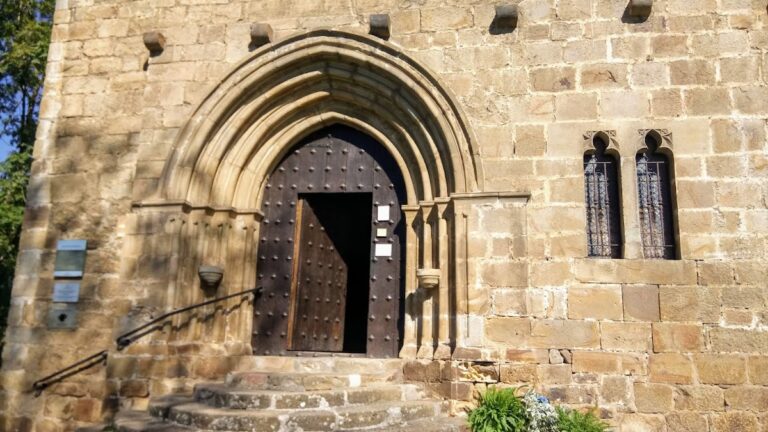
The main doorway is semicircular and framed by three fluted archivolts, moulded bands that follow the curve of the arch. Plain capitals and robust fluted columns flank the opening, with the columns carrying matching capitals. A holy-water stoup stands to the left of the entrance, while two continuous stone benches are built against the walls on either side of the entrance area.
The end wall contains five exterior windows, one blind window, and a loophole or light opening. Inside, a barrel vault, a continuous curved ceiling, covers the space, and a U-shaped wooden choir occupies part of the interior. Wooden benches serve worshippers, and the building formerly contained as many as three altars. On the stone at the front stands a 1.1-metre-high statue of Our Lady of Olatz, with a statue of Saint Stephen in a semicircular-arched niche to its right.
The polychrome wooden statue of the Virgin is Gothic in style. She holds a sacred lotus flower and supports the seated Christ Child on her left knee. The child makes a blessing gesture. The figure’s body and drapery follow Gothic sculptural conventions, while the limbs and narrow shoulders retain some Romanesque features. A white-marble plaque on the rear wall bears the coat of arms of Guipúzcoa and text in Spanish and Basque recalling the hermitage’s role as a meeting place of the Particular Assemblies of Guipúzcoa.
Associated residences and memorial spaces
The serora’s house beside the hermitage contained two beds, a complete kitchen with utensils, a table for kneading bread, a vegetable garden, and an apple orchard with ten or twelve trees. The nearby private cemetery, situated between the hermitage and the Casita de Olatz, contains the tomb of Dolores Rodríguez Sopeña and the niches of many catechists.
The Casita de Olatz is a modest two-storey building behind the hermitage. Dolores Sopeña’s former room survives with part of its original furniture. A framed display of her private notes from 1913 remains in the room, preserving a material connection between the building, the congregation, and the religious community that has cared for the hermitage since the early twentieth century.
Nearby sites