Ekain Cave: A Paleolithic Cave-Art Site in Spain
Site at a Glance
- Popularity
- High
- Country
- Spain
- Primary era
- Stone Age
- Eras represented
- Stone Age
- Civilizations
- Unclassified
- Site type
- Religious
- Remains
- Sanctuary
On this page19 sections
History
Ekain Cave is a limestone cave in the municipality of Deba, Gipuzkoa, Spain. Its paintings date to the Magdalenian, an Upper Paleolithic period especially associated with elaborate European cave art, and its deposits preserve evidence of human occupation across several prehistoric periods. The paintings have been interpreted as part of a deep cave sanctuary, although that interpretation does not establish a particular form of organized religion.
Prehistoric occupation
The cave’s archaeological layers show use at different times, alongside evidence of cave bears. Level X contains Châtelperronian material, from a culture associated with the transition between the Middle and Upper Paleolithic, dating to more than 30,600 years ago. Level IX yielded numerous cave-bear remains and an artifact resembling Aurignacian material. The Aurignacian was an Upper Paleolithic period. Level VIII contained a small quantity of stone tools and no cave-bear remains.
Magdalenian occupation is represented in levels VII and VI. Bones from level VII date to about 15,400–16,510 years BP, meaning years before 1950. Animal remains and other evidence suggest that people used the cave in summer, especially to hunt young deer and hinds. The age profile of the animals has been taken to indicate that people did not occupy it during winter. Level VI, dated to about 12,050 years ago, points to temporary visits focused on hunting Iberian ibex, which lived nearby on Mount Izarraitz. The upper layers belong to the Azilian, a later western European archaeological culture.
Magdalenian art and interpretation
The cave’s paintings are attributed to the Magdalenian. They lie deep within the cave, beyond the reach of sunlight, and may have been made when the cave was uninhabited. Researchers have interpreted the arrangement of the images as evidence that Ekain functioned as a sanctuary focused on horses. The paintings do not simply reflect the animals people hunted: horses and bison appear frequently in the art but rarely among the excavated animal remains, while some more commonly hunted species receive less attention in the images.
Discovery and archaeological study
Rafael Rezabal and Andoni Albizuri, members of the Antxieta cultural society in Azpeitia, found the cave entrance on 1 June 1969. A week later, they cleared stones from a narrow passage and reached the decorated galleries. Jesús Altuna and José Miguel de Barandiarán visited the cave on 10 June. Altuna and Barandiarán took part in the initial excavations, and Barandiarán directed the first three campaigns.
The Aranzadi Society of Sciences carried out six excavation campaigns between 1969 and 1975, with financial support from the Gipuzkoa provincial government. There was no campaign in 1970 after permission was refused amid a dispute over authority to excavate. A temporary closure of the cave allowed work at the entrance to proceed, and excavations resumed in 1971. Barandiarán and Altuna published a preliminary study in 1969; further studies of the paintings and archaeological evidence appeared in 1978, followed by a comprehensive publication in 1984.
Protection and presentation
At Altuna’s urging, the cave was closed to the public soon after its discovery to protect the paintings. The decision met resistance from local authorities, higher authorities and members of the public. The original cave was kept without tourist infrastructure such as installed lighting, ramps or stairs. A stone quarry nearby threatened it through blasting, truck traffic and vibration. After Altuna appealed to the Basque government in 1991, the quarry closed the following year.
Ekain became a Spanish Asset of Cultural Interest in 1984. In 2008, it joined the UNESCO World Heritage property called “Cave of Altamira and Paleolithic Cave Art of Northern Spain,” as one of 17 decorated caves added to the property. The regional cultural authority also oversees a buffer zone around Ekain. Monitoring inside the cave tracks environmental conditions, drainage, airborne particles and other factors that could affect its preservation.
To make the site’s art accessible without opening the original cave, the nearby Ekainberri facility was developed as a replica and cultural center. Jesús Altuna promoted the project and arranged for Renaud Sanson to lead the replica work after meeting him in 1994. The municipality of Zestoa commissioned it in 1997. The project took about a decade, and construction of the replica was nearly complete by 2014. It reproduces selected parts of the cave rather than its entire network, using digital recordings to recreate painted panels and rock surfaces.
Remains
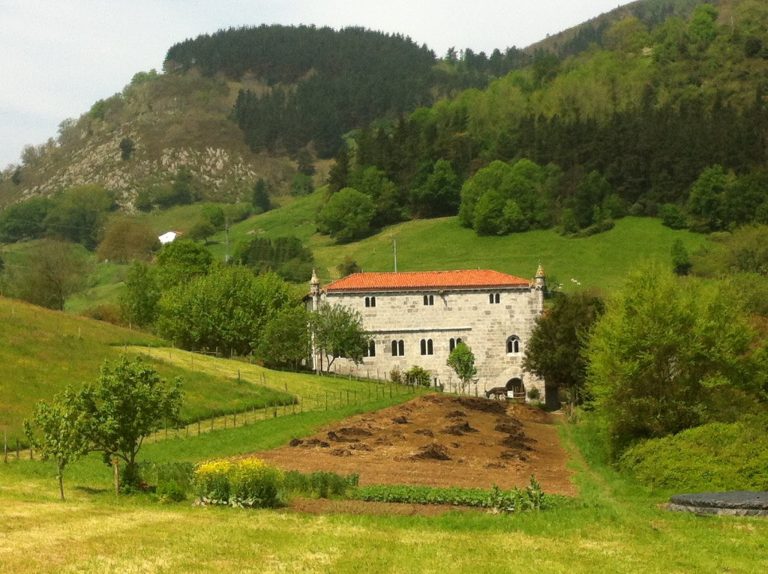
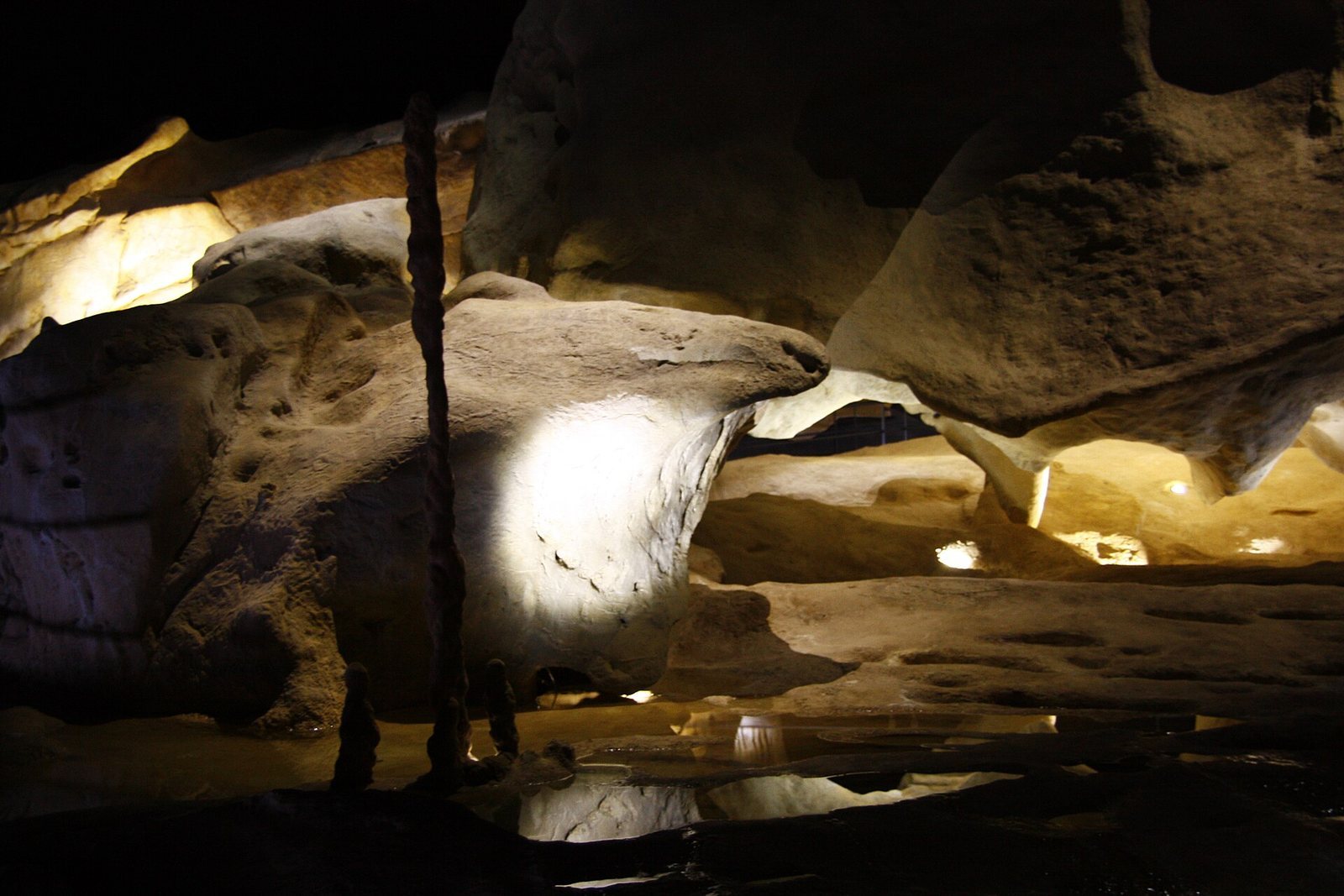
Ekain is a natural limestone cave on the eastern side of Ekain hill, with its entrance facing east toward the meeting of the Goltzibar and Beliosoerreka streams. Together, those streams form the Sastarrain stream, which flows into the Urola. The narrow entrance is arched, about 1.20 metres high and 2.30 metres wide at its base. Just inside it, a vestibule leads to a short, level-floored gallery on the left. A stone-blocked passage opened in 1969 connects this entrance area to the deeper cave.
Passages and chambers
Beyond the opened passage, the cave narrows into a winding gallery. It runs northwest for about five metres, turns southwest for roughly 15 metres, then continues northwest for just over 30 metres. The first painted station lies about 12 metres beyond the second turn. The passage reaches a chamber with a larger chamber to the left; a narrowing between them bears two painted stations. Just beyond the narrowing, a side gallery about 17 metres long branches off at a right angle. The main passage continues into a long chamber, with a small painted chamber to the right and a broad gallery beyond it that contains many of the cave’s paintings.
Excavated entrance deposits
Vestibule
Excavation of the vestibule reached bedrock 4.65 metres below the surface. A limestone block about 3.30 metres long, 1.70 metres wide and one metre high occupied much of its northern side. It lay in the uppermost deposit and also appeared in a lower deposit of compact earth and limestone stones. Level III included dark hearth soil, bone fragments, deer molars and flint tools, among them a retouched blade, backed points and a side scraper. Level IV yielded further stone tools and, in later excavation areas, a bone spear point and a harpoon base.
Level V contained dark soil, bone fragments, flint and limestone, with excavated sublevels yielding hearths, animal remains, ochre and limonite, an iron-oxide mineral. Level VI, about 45 centimetres thick, produced numerous stone tools and a bone spear fragment with a simple beveled base. Iberian ibex and red deer dominated its animal remains, alongside other species. Finds also included a human bone fragment, fish vertebrae, quartz crystals and ochre. Level VII contained charcoal, shellfish remains, flint and other materials. At its base, beneath the large entrance block, a circular hearth about 90 centimetres across had a partly stone-paved base. A limestone slab lay beside it.
Short left-hand gallery
The short gallery branching left from the vestibule contained four layers of deposits. Finds included shells, animal bones, charcoal, ochre, quartz and a wide range of stone tools, as well as a worked bone point with incised lines. One deposit held a stone circle slightly more than 60 centimetres across, apparently the base of a hearth, surrounded by charcoal and dark soil. A later excavation recovered 1,018 flint flakes and a nearly complete wolf skeleton, alongside remains of deer, ibex and other animals.
Painted galleries and chambers
Entrance gallery and horse head
The entrance gallery has a narrow, slightly sloping floor formed by stalagmitic deposits. Its first recorded black painted stroke is about six metres from the gallery’s beginning. Farther inside, about 50 metres from the cave entrance, is Ekain’s largest painted horse head. The head faces right and is rendered as a flat wash of manganese-based pigment, with a darker outline around the muzzle and lighter areas at the temples and start of the mane. The eye and ears are clearly marked. From this location, a stone block in the adjoining chamber resembles a horse’s head.
Main painted chamber
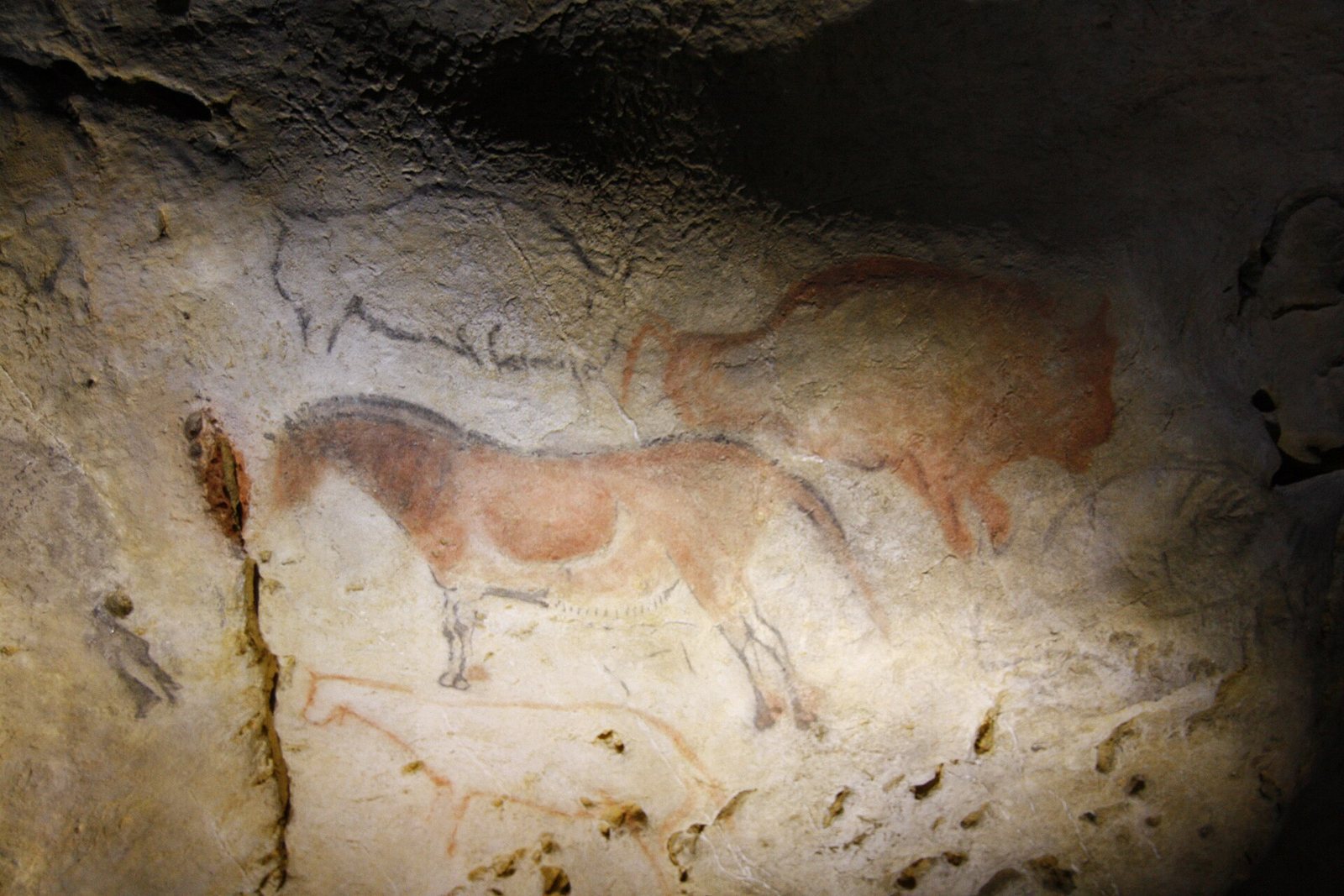
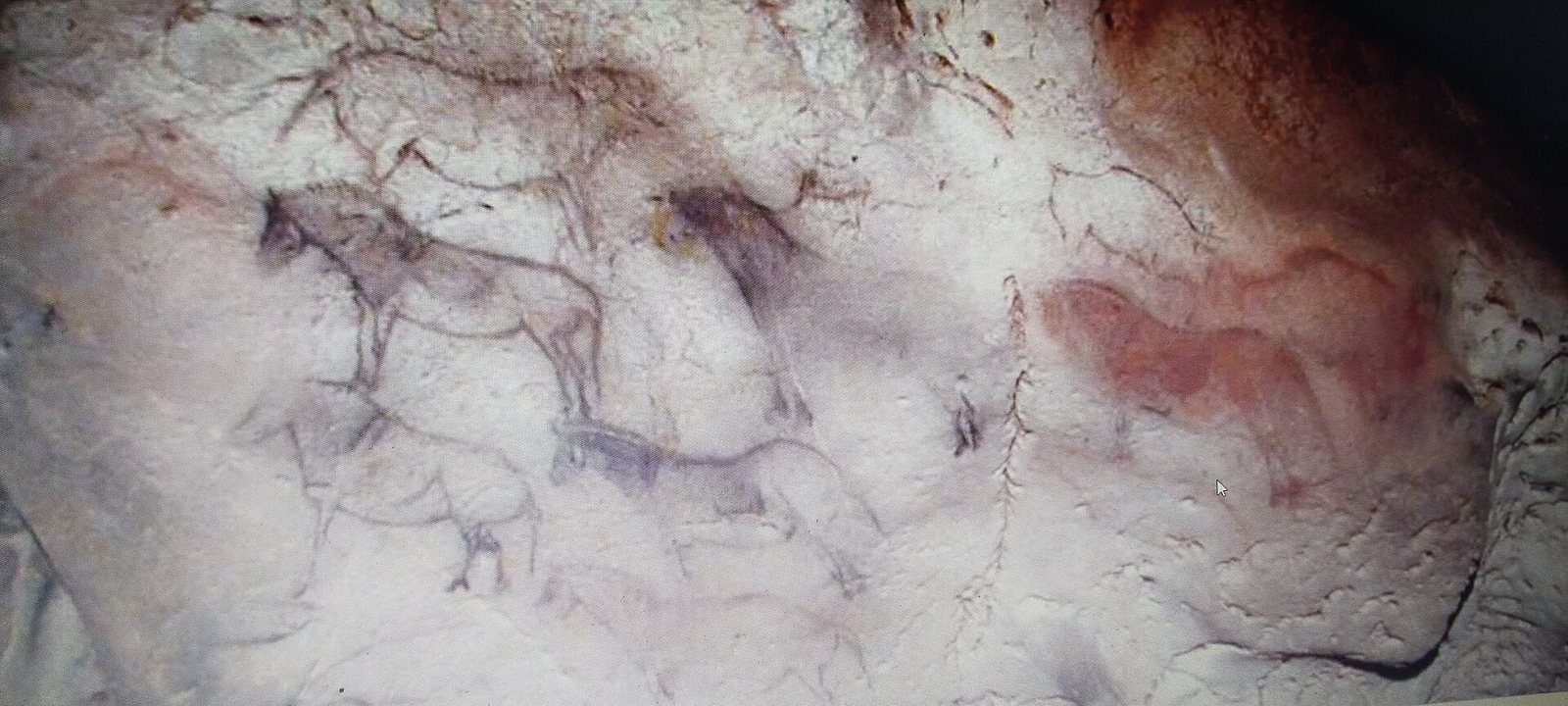
A chamber with a floor shaped by small mineral basins contains figures on both sides, mostly horses, with one bison on each wall. The large panel on the right wall has 18 figures, including 11 horses. Fifteen face left toward a niche with bear paintings. The figures do not overlap, and the artists used black outlines, internal shading, combinations of black and red paint, and engraving. Eight horses on the left wall face toward the same niche. In the bison images, a natural rock ledge forms the line of the back and tail, while paint completes the rest of each animal.
Bear niche and side gallery
A raised platform beneath a low ceiling holds two concealed bear paintings in black manganese-based pigment. A separate dead-end gallery, about 15 metres long and two metres wide, contains engraved deer, four goats and a salmon, as well as evidence of cave-bear use. One deer is shown with its antlers, neck, back and haunches; the other is represented by its head and neck. The black salmon silhouette measures 55 centimetres and includes details such as its fins and lateral line. A small goat opposite is painted in black, lying down and looking left.
Largest chamber and horse-shaped block
The cave’s largest chamber contains a natural stone block resembling a horse. A painted horse and bison appear low on the block and on the wall behind it. The block’s resemblance to a horse has been proposed as one reason the cave was selected as a horse sanctuary.
Figure inventory and pigments
About 70 figures have been identified in the cave, including 64 paintings and the remainder engravings; the total depends partly on how associated strokes are counted. Horses make up about 58 percent of the figures, and three groups contain more than five figures each. One inventory lists 33 horses, ten bison, four goats, two deer, two bears and two fish. Many images combine colors. Black pigment came from charcoal or a manganese-based pigment, while red was made from limonite.
Several horses are shown with upright manes, marks on the neck, lighter undersides or stripes on the limbs and neck. Some also have distinct light and dark areas on the body. Thirteen horses are nearly complete, ten in a single color and three using more than one color. The two fish images represent a rare subject in cave painting.
Portable objects
Engraved sandstone plaque
An engraved sandstone plaque was recovered in seven pieces from level VI and is dated to about 12,000 years ago. Its three figures include a deeply engraved Iberian ibex, shown with its head, horns, neck, chest and forelegs, and a cross-shaped mark on its back. A finer engraving depicts a deer’s head, neck and antler. A third, less certain figure may be a horse; its muzzle, mane and the beginning of its back are visible.
Carved bird figure
A carved bone object representing a bird was recovered in 2008 and assigned to the Middle Magdalenian through comparison with a nearby bone. Made from a rib of an aurochs or bison, it measures 66.2 millimetres from head to tail, 19 millimetres across the wings and 3.3 millimetres thick. Its head is shown in profile, while the body and wings face forward. Incised lines decorate both sides. The posture may represent a diving bird, perhaps a kingfisher, but the identification remains uncertain.