Hamada Castle: The Edo-Period Administrative Headquarters of Hamada Domain
Site at a Glance
- Country
- Japan
- Primary era
- Early Modern
- Eras represented
- Early Modern, Modern
- Civilizations
- Tokugawa
- Site type
- Military
- Remains
- Castle
On this page12 sections
History
Hamada Castle is a hilltop castle in central Hamada, Japan, built by the Furuta house between 1620 and 1623 during the Edo period, the era of Tokugawa rule. It served as the administrative headquarters of Hamada Domain, a feudal territorial administration. Furuta Shigeharu received Hamada in 1619 for his service in the Osaka Campaign, with the domain assessed at 54,000 koku, a measure of rice yield used to assess income. Construction began the following year, and the castle and surrounding town were completed in 1623.
Foundation and changing lordships
The second Furuta lord lost his position in 1648 after a family dispute known as the Furuta Disturbance. The following year, the Matsudaira (Matsui) house took control of Hamada, assessed at 50,000 koku, and ruled for five generations. In 1759, its fifth lord was transferred to Koga in Shimousa Province, and a lord of the Honda house arrived with an assessment of 50,000 koku. In 1769, the third Honda lord moved to Okazaki in Mikawa Province, and Matsudaira (Matsui) Yasufuku returned to Hamada with an assessment of 55,400 koku.
In 1836, illicit trade with Qing China and Korea came to light during the rule of the third Matsudaira (Matsui) lord. The affair, known as the Takeshima Incident, led to his retirement and the transfer of the fourth lord to Tanakura in Mutsu Province. Matsudaira (Ochi) Nariatsu then came to Hamada from Tatebayashi in Kozuke Province, with an assessment of 61,000 koku. Apart from the Furuta, Hamada’s ruling houses came from hereditary Tokugawa vassal families or families related to the Tokugawa. Hamada was regarded as a frontline position on the San’in side facing Choshu Domain, ruled by the Mori clan. The succession of these houses may have reflected shogunal concern about the Mori.
Capture and abolition
During the Second Choshu Expedition in 1866, a shogunal military campaign against Choshu Domain, Choshu forces advanced under the military leader Omura Masujiro and captured Hamada Castle. The domain lord, Matsudaira Takeakira, fled without fighting. As domain soldiers withdrew, they set fire to the castle and town, and the castle buildings burned. The castle was abolished that year.
Remains
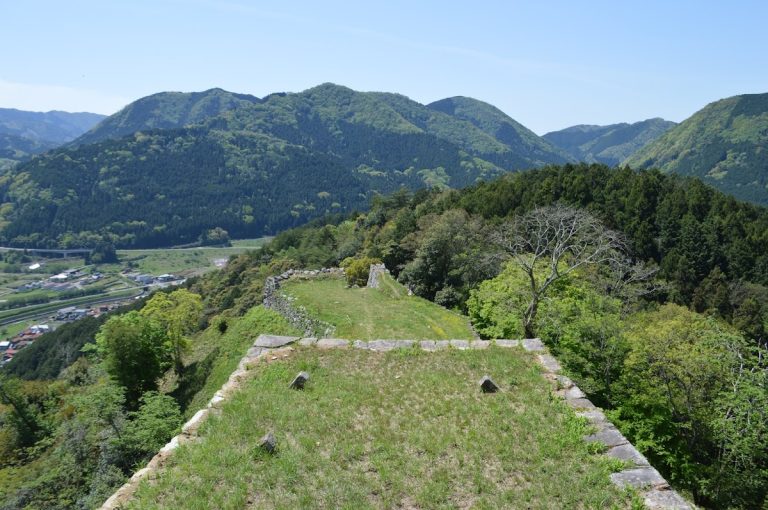
The castle occupied an isolated hill about 68 m high, also known as Kameyama. Its summit was levelled for the main enclosure, the principal fortified precinct. Matsubara Bay lay to the north, the Asai River to the east, and the Hamada River to the south and west; these waterways provided natural defenses. The layout included enclosures on the hill, precincts at its foot, and a detached area on a low hill to the south.
Castle layout
Main enclosure and tower
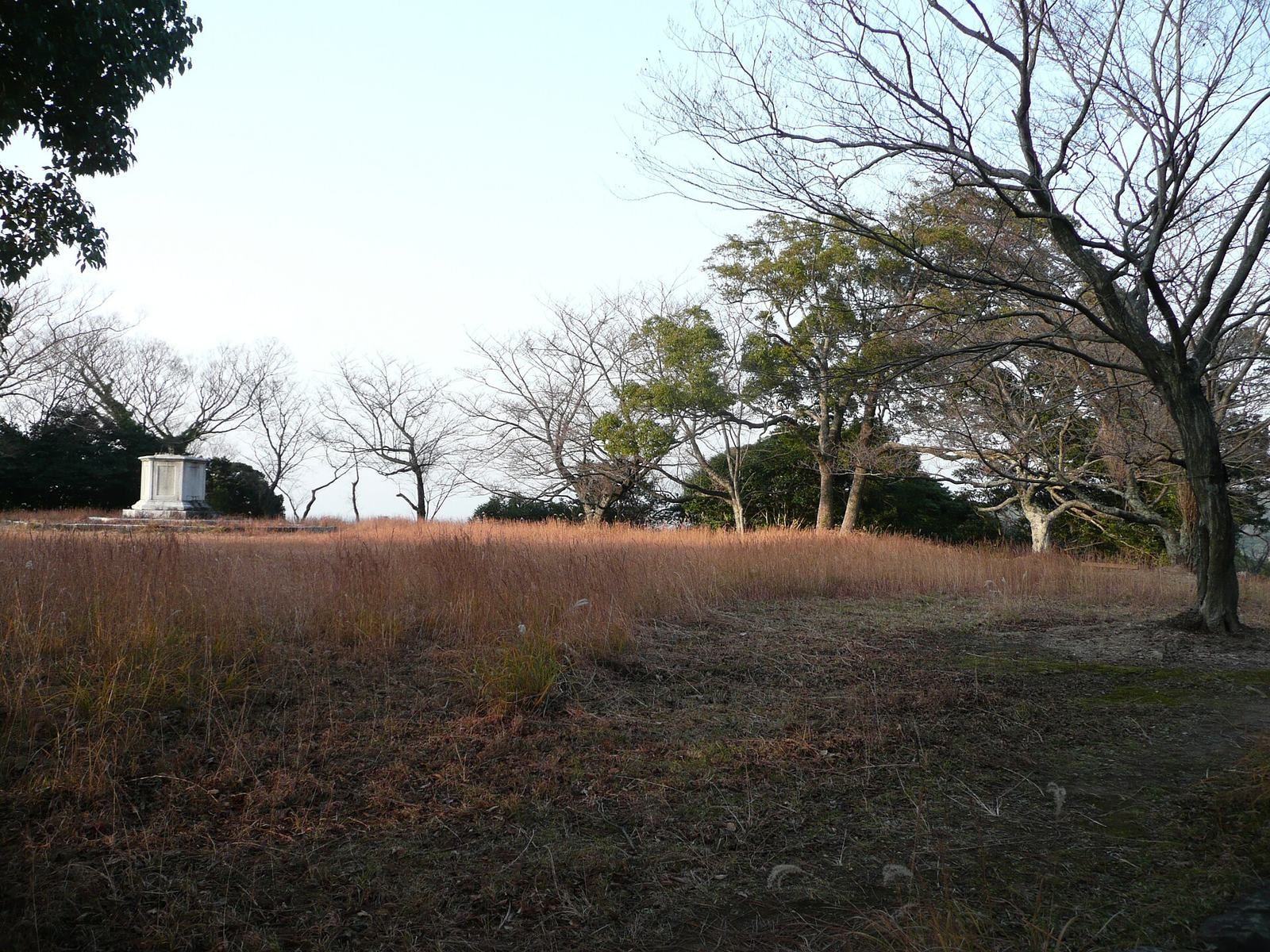
The main enclosure measured about 60 m from north to south and 50 m from east to west, covering roughly 0.3 hectares. A three-tiered tower stood at its northwest corner. At the southeast were the main gate and a six-bay longhouse, while an ammunition storehouse stood near the center. A wall enclosed the precinct. The tower was a free-standing, watchtower-style keep, the castle’s principal defensive tower, with three tiers and four floors. Its height is estimated at about 14 m. The upper floor measured about 9.1 m square, the middle floor about 12.7 m square, and the lowest floor about 9.1 m north to south by 16.4 m east to west.
Southern and western enclosures
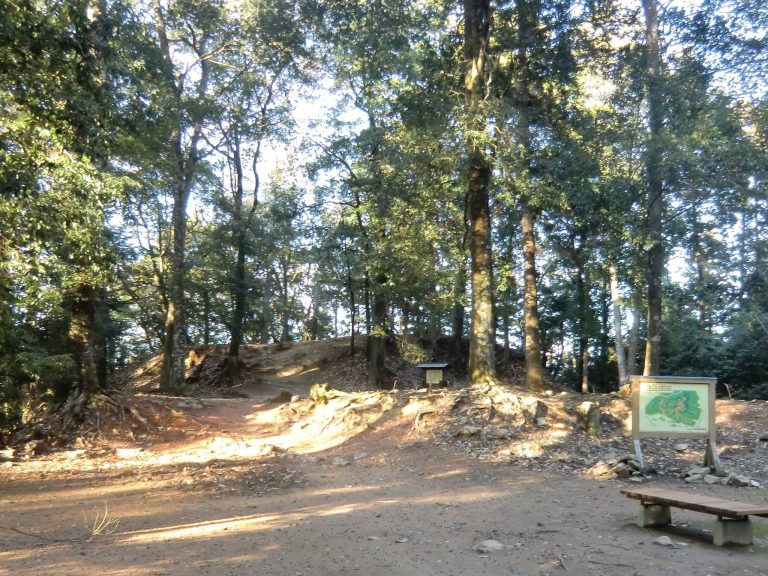
A narrow second enclosure lay south of the main enclosure, with a third enclosure farther south. A separate western bailey, an enclosed area within the castle, was also known as the Thousand-Person Muster Ground beside the Main Enclosure. It measured about 24.2 m from east to west and 23.9 m from north to south. A path ran along its northern side, while a separate southern path connected it to the second enclosure. Another detached bailey occupied a low, isolated hill south of the castle. Commonly called the Sunset Enclosure, this area is now covered by brush and woodland.
Lower precincts and castle town
At the foot of the hill, the lower second enclosure contained a gunpowder storehouse, a guard post for the main enclosure, a time-signal post, and a middle gate. The lower third enclosure held the residence, administrative offices, an official rice storehouse, and the main gate. Samurai residences were arranged around the castle, while merchant dwellings lay south of the Hamada River.
Surviving fabric and commemorative features
Stone defenses
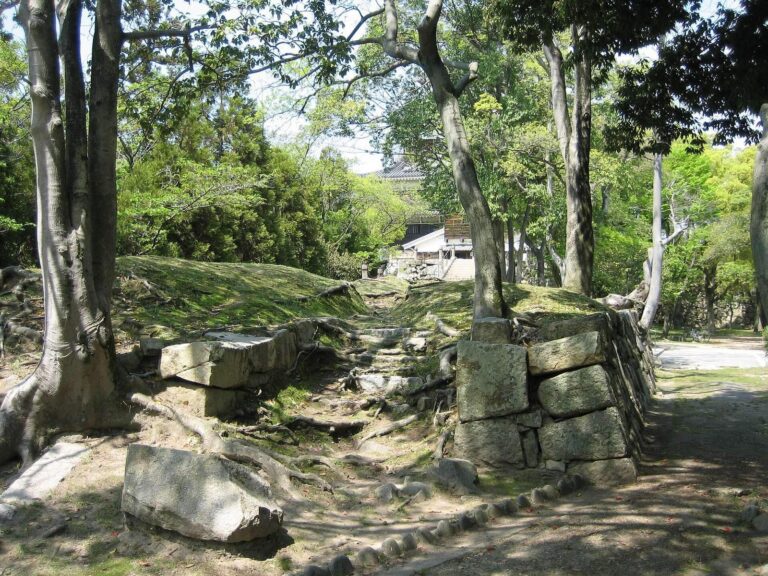
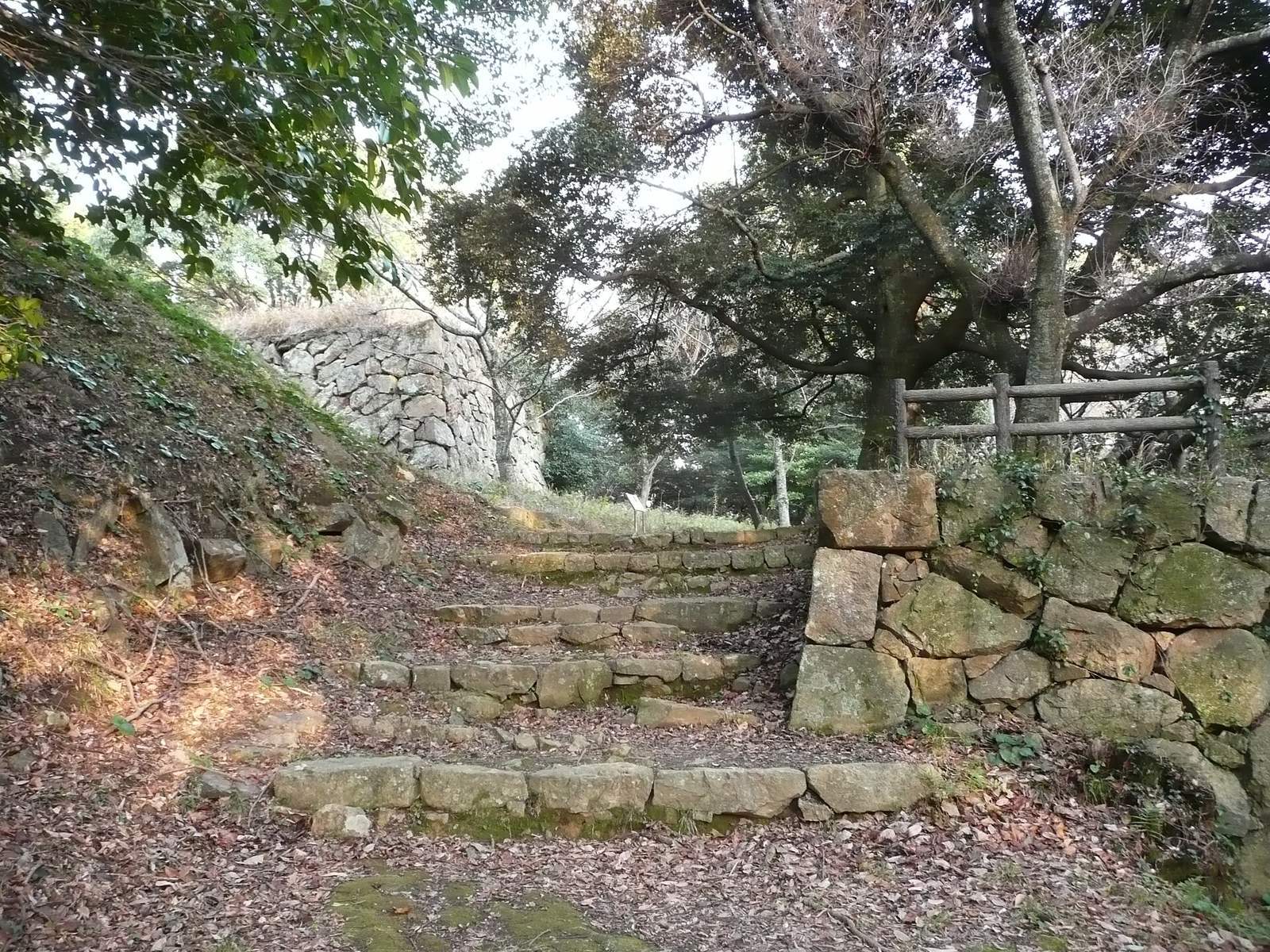
Stone walls and earthen ramparts survive at the site. Stepped stonework extends from the main enclosure toward the third enclosure. Other surviving stonework is found in the main enclosure and around the second gate of the second enclosure.
Relocated gate and domain memorial
A gate near the castle approach at the foot of the hill originally belonged to a samurai residence in Tsuwano Domain and later served as the main gate of the Hamada Prefectural Office. It was moved to its present position in 1967. A memorial inscription by novelist Shiba Ryotaro at the entrance commemorates Hamada Domain.
Hamada Gokoku Shrine
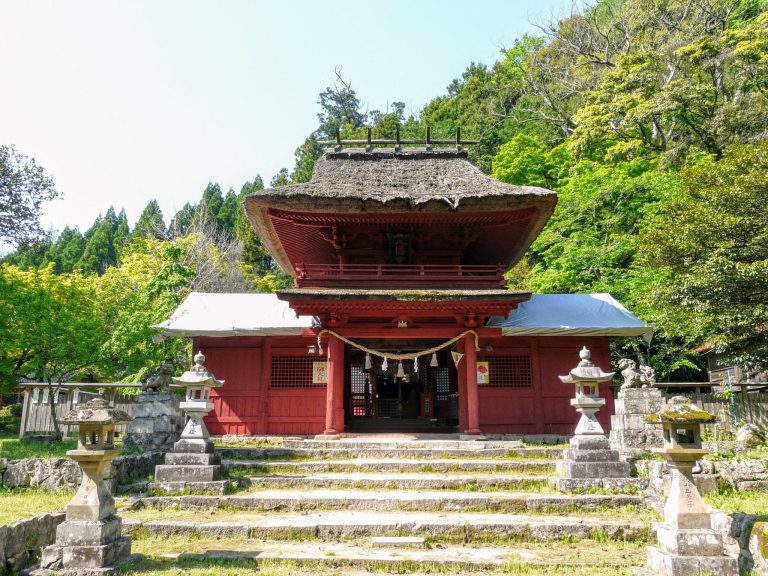
Hamada Gokoku Shrine stands within the castle ruins and is dedicated to the war dead. It is classified as a Beppyo shrine, a special category for shrines regarded as particularly notable, and is regarded as a branch of Yasukuni Shrine, which also commemorates the war dead.