Santa Cristina, Turin: A Baroque Catholic Church
Site at a Glance
- Country
- Italy
- Primary era
- Early Modern
- Eras represented
- Early Modern, Modern
- Civilizations
- Duchy of Savoy, Holy Roman Empire, Kingdom of Sardinia
- Site type
- Religious
- Remains
- Church
On this page12 sections
History
Santa Cristina is a Catholic church in Turin, Italy, dedicated to Christina of Bolsena and shaped by the ornate Baroque style that flourished in seventeenth- and eighteenth-century Europe. Its development formed part of Turin’s expansion south beyond the earlier city walls into a district known as Borgo Nuovo. The new quarter included Via Nuova, now Via Roma, and Piazza San Carlo, where the neighboring church of San Carlo, begun in 1619 without a façade, was planned as Santa Cristina’s companion.
Planning and construction
A plan for Santa Cristina dates to 1620 and is attributed to Carlo di Castellamonte. In 1639, Maria Cristina of France, a French princess and regent of Savoy, acquired the land and promoted the church as a memorial to her recently deceased eldest son, Francesco Giacinto, a Savoyard prince. Carlo began the work; after his death in 1640, his son Amedeo continued it. Construction halted in 1641, leaving the church unfinished at the front.
Completion and the Carmelite convent
In 1666, Giacomo Casella and his brother-in-law Giovanni Andrea completed frescoes on the church’s interior vault. Maria Cristina, who remained devoted to the church, was buried there in 1674. She had also intended a convent beside its eastern side. Discalced Carmelite nuns, members of a reformed branch of the order with stricter observance, later occupied the convent. Blessed Maria degli Angeli Fontanella, a Carmelite nun venerated as blessed in the Catholic Church, lived there.
The façade was completed between 1715 and 1718 under Victor Amadeus II of Savoy, to a design by Filippo Juvarra. It was Juvarra’s first work in Turin. Sculptures commissioned from Pierre Legros in 1715 were replaced by works made in 1717 by Carlo Antonio Tantardini and Giuseppe Salvatore Caresana.
Suppression and renewed worship
In 1802, Napoleonic secularization turned the church into a commercial exchange and suppressed the convent and its order in Turin. After Napoleon’s rule, during the return of traditional monarchies known as the Restoration, Victor Emmanuel I ordered the church reconsecrated. It received new marble embellishments and a new altar by Ferdinando Bonsignore. The church also became known as the church of the servants: its well-attended Sunday Mass in the early afternoon suited domestic workers from nearby aristocratic households, who had part of the day free but were expected back by 4 p.m.
Alterations in the modern period
During Fascist rule in Italy, from 1922 to 1943, rebuilding along Via Roma cost the church some of its windows. The adjoining convent was demolished for new buildings connecting the church with the small square behind it, and the apse was almost entirely rebuilt. Further interior changes followed in the nineteenth century and after the Second World War bombardments. In 1960, the main altar and all the side chapels were extensively renovated. On 26 February 2017, a piece of the rear marble cornice fell onto the Dora Riparia fountain statue in Piazza C.L.N.; no one was injured, and damage was limited.
Remains
Setting and façade
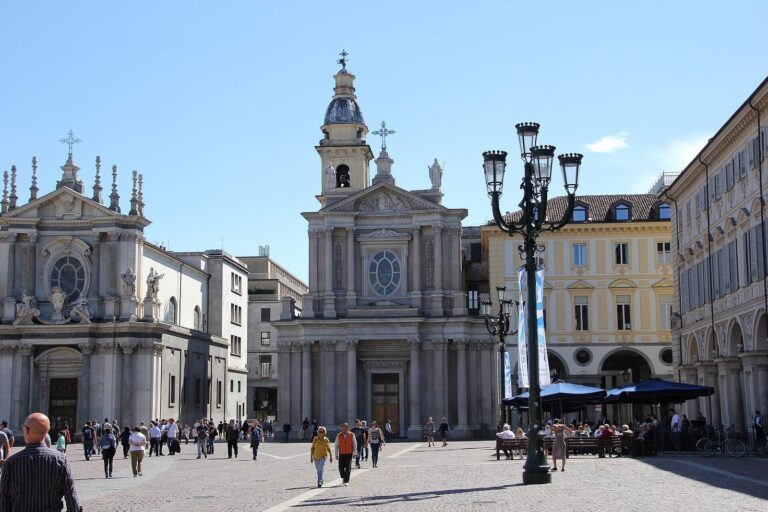
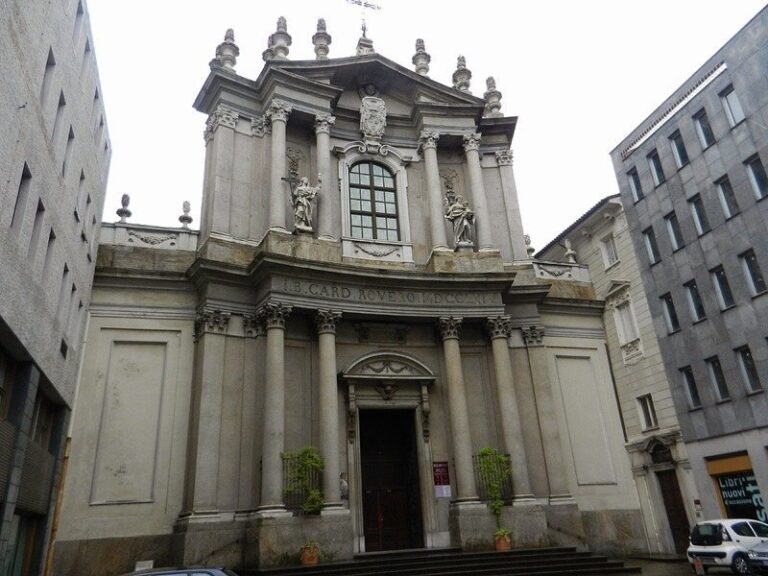
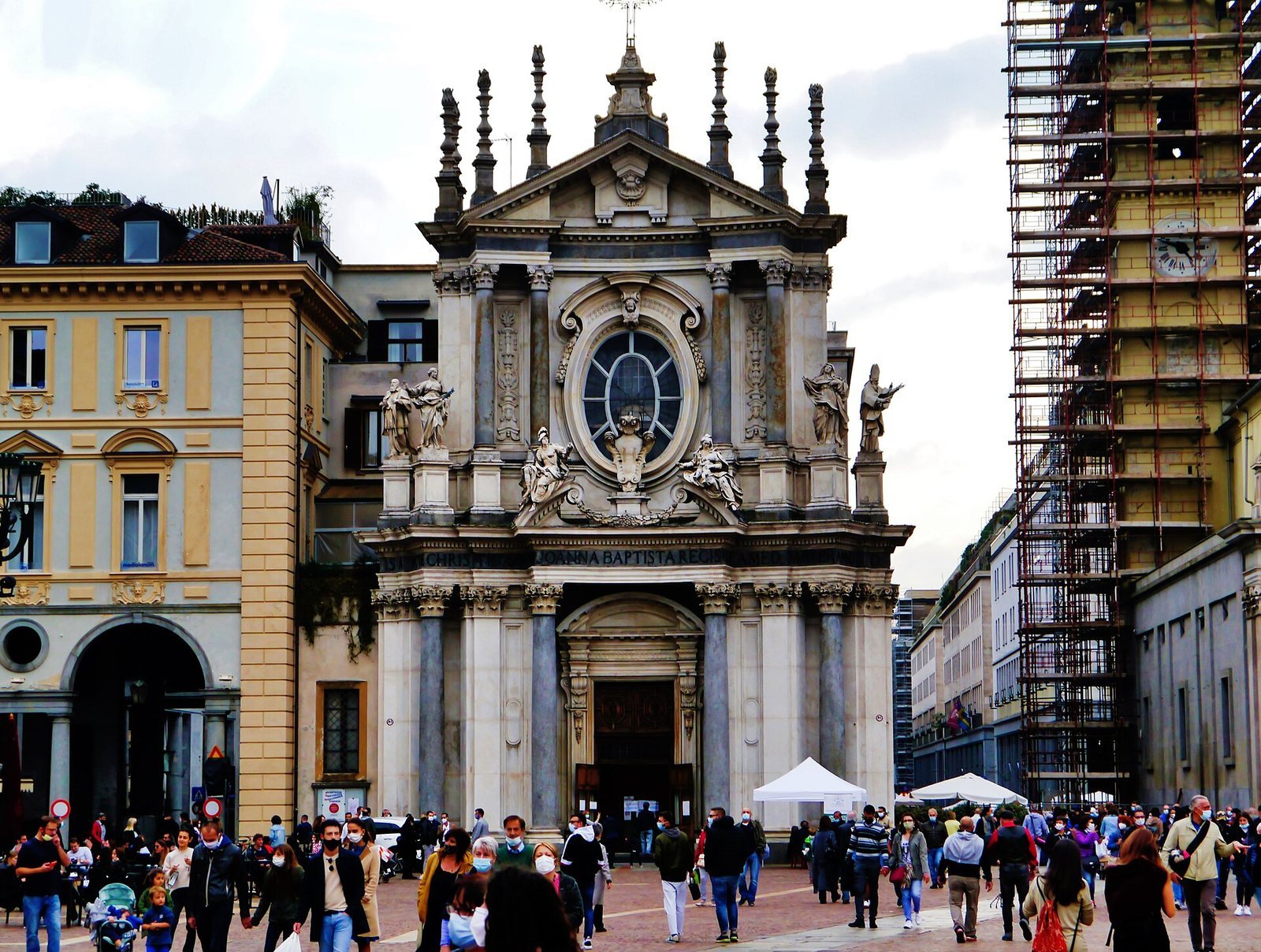
Santa Cristina faces Piazza San Carlo, and together with San Carlo across Via Roma it marks the southern side of the square. Piazza C.L.N. lies behind the church, where a fountain statue representing the Dora Riparia is attached to its rear. Juvarra’s Baroque façade has two levels and a curved central section. A large double-door entrance sits off centre, with an oval window above and closely spaced columns and flat supports across the front. Sculptures show Saints Christina and Teresa, alongside figures representing virtues. The paired arrangement of Santa Cristina and San Carlo has been compared with Rome’s Santa Maria dei Miracoli, dated 1681, and Santa Maria in Montesanto, dated 1679, which face Piazza del Popolo.
Interior
Nave and ceiling
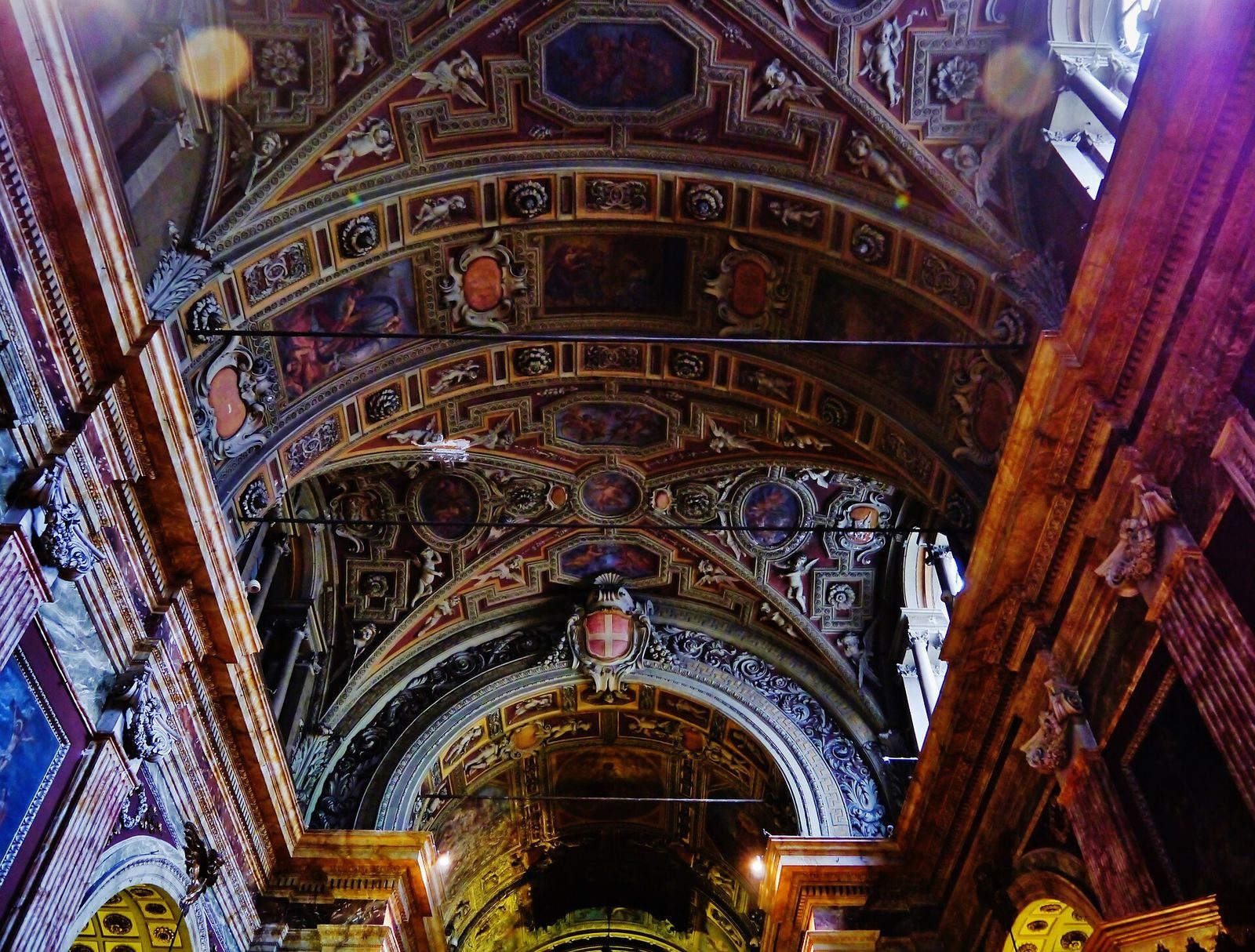
The church has a single nave with rich eighteenth-century Baroque decoration. Above the entrance, a choir gallery holds five eighteenth-century panels depicting episodes from the life of Saint Michael. The curved, barrel-shaped ceiling is adorned with floral and angelic plasterwork by Pietro Somasso, as well as nine painted panels by Antonio Mari showing events from Christina of Bolsena’s martyrdom.
Presbytery and altar
A rounded arch marks the entrance to the presbytery, the clergy’s area around the main altar. The Savoy coat of arms occupies the arch’s central stone, and an eighteenth-century marble railing encloses the space. Its altar, made from colored marble by Ferdinando Bonsignore in the nineteenth century, stands before an organ built in 1748 by Neapolitan organ maker Liborio Grisante. Above the organ is a seventeenth-century painting of Christina’s martyrdom.
Side altars and paintings
The altar on the right is dedicated to the Sacred Heart of Mary and includes a painting of the Madonna of the Rosary, two reliquaries (containers for sacred relics), and two pewter angels. Christina, the church’s titular saint, is venerated on the left, where an altar dedicated to Saint Joseph holds an altarpiece by Ferdinando Cavalleri showing Joseph as patron of Turin, along with two reliquaries and two pewter angels. Beside it hangs Antonio Domenico Triva’s Rest on the Flight into Egypt, in which Joseph offers a pomegranate to the infant Jesus on Mary’s lap.
Pulpit and devotional paintings
A late-Baroque pulpit in gilded wood stands among the church’s furnishings. Fourteen oval paintings by Luigi Morgari depict the Stations of the Cross, devotional scenes from Jesus’s route to crucifixion.