Tsuwano Castle: A Mountain Fortress in Japan


Site at a Glance
- Rating
- 4.5
- Popularity
- Low
- Country
- Japan
- Primary era
- Early Modern
- Eras represented
- Medieval, Early Modern
- Civilizations
- Tokugawa
- Site type
- Military
- Remains
- Castle
On this page12 sections
History
Foundation and Yoshimi Rule
Tsuwano Castle is a mountain fortress in Japan, founded by the Yoshimi clan in the late thirteenth century during the late Kamakura period and completed by 1324. It stood in former Iwami Province near the border with Nagato Province, on routes linking Yamaguchi and Hamada and crossing the Chugoku Mountains toward Aki Province and the Seto Inland Sea. The fortress was established to defend the region against possible invasion, including attacks from the sea, and was initially known as Sanbonmatsu Castle or Ipponmatsu Castle.
Yoshimi Yoriyuki founded the castle, and the Yoshimi clan retained it for many generations. The family claimed descent from Minamoto no Noriyori, a twelfth-century Minamoto commander and younger brother of Minamoto no Yoritomo. During the Muromachi period, an era dominated by powerful regional military houses, the Yoshimi became closely aligned with the Ōuchi clan, which ruled Nagato and Suō Provinces. Yoshimi Masayori, who married a daughter of Ōuchi Yoshioki, supported the Ōuchi against the Amago clan and other rivals.
Conflict in the Sixteenth Century
In 1551, the castle endured a siege lasting more than four months after Sue Harukata invaded Iwami during a conflict surrounding the Ōuchi clan. The Yoshimi later submitted to the Mōri clan after Mōri Motonari defeated Sue’s forces at the Battle of Itsukushima in 1552. These events brought the fortress into the wider struggles of the Sengoku period, a prolonged era of warfare among competing regional warlords.
Tokugawa Reorganization
The political order changed after the Battle of Sekigahara in 1600, the victory that enabled Tokugawa Ieyasu to establish the shogunate that ruled Japan during the Edo period. The shogunate confiscated much of the Mōri clan’s territory, including Iwami Province. The Yoshimi lost their Tsuwano estates and were compelled to relocate to Hagi.
Sakazaki Naomori, a general serving Tokugawa Ieyasu, then received a fief centered on Tsuwano. Its assessed yield was initially 30,000 koku, a traditional measure of agricultural production, and later rose to 43,468 koku. Naomori laid the foundations of Tsuwano Domain, built the castle town, surveyed the land, and extensively renovated the fortress. A domain was the territory governed by a major lord, or daimyo, under the Tokugawa shogunate.
In 1616, Sakazaki Naomori was killed or committed seppuku, a formal suicide associated with samurai, after plotting to abduct Senhime, the daughter of Tokugawa Ieyasu. The Sakazaki clan was consequently destroyed, and the shogunate transferred Tsuwano to the Kamei clan. The Kamei ruled the castle and domain for eleven generations until the Meiji Restoration, the political transformation that began in 1868 and ended the Tokugawa shogunate.
Edo Administration and Destruction
During the Edo period, Tsuwano Castle served as the political center of Tsuwano Domain. Because the approach to the summit was steep, the domain’s administrative offices and the daimyo residence stood at the foot of the mountain rather than in the upper fortified complex. Tsuwano remained an autonomous fief from 1617 until 1869.
Lightning caused the castle’s main tower to burn in 1686. The tower was never rebuilt, partly because the lord’s residence was located below the mountain instead of within the summit complex. After the Meiji Restoration, Kamei Koremi, the last daimyo of Tsuwano, ordered the castle’s destruction before new government regulations were issued. The fortress was dismantled in 1871.
The ruins received protection as a National Historic Site of Japan in 1942. In 2006, Tsuwano Castle was included in the Japan Castle Foundation’s list of the country’s Top 100 Castles. The former daimyo-residence site at the mountain’s base is now occupied by Tsuwano High School.
Remains
Mountain Layout and Summit Defenses
Tsuwano Castle occupied a mountain overlooking the castle town, with the Tsuwano River to the west. The original Muromachi-period fortress extended along a ridge running roughly two kilometres from north to south. Sakazaki Naomori later concentrated the principal fortified area within about 300 metres around the central peak and added an extension toward a smaller western peak. This arrangement created a plan resembling the letter T.
Enclosures and Stone Walls
The castle was arranged in three courtyards, or enclosed defensive areas. The summit complex included stone walls, compound gates, numerous yagura turrets, moats, and other defensive works. A yagura was a smaller tower or fortified watch structure used for observation and defense. Naomori’s rebuilding produced stone walls approximately 15 metres high. These walls, together with surviving stone foundations, form the principal remains of the upper castle.
Central Tower Foundation
A tenshu, the principal tower of a Japanese castle, stood in the central enclosure on a foundation measuring approximately 20 metres square. It was probably three storeys high. The tower itself no longer survives, while its foundation remains part of the summit ruins.
Foot of the Mountain and Town Remains
Relocated Gate
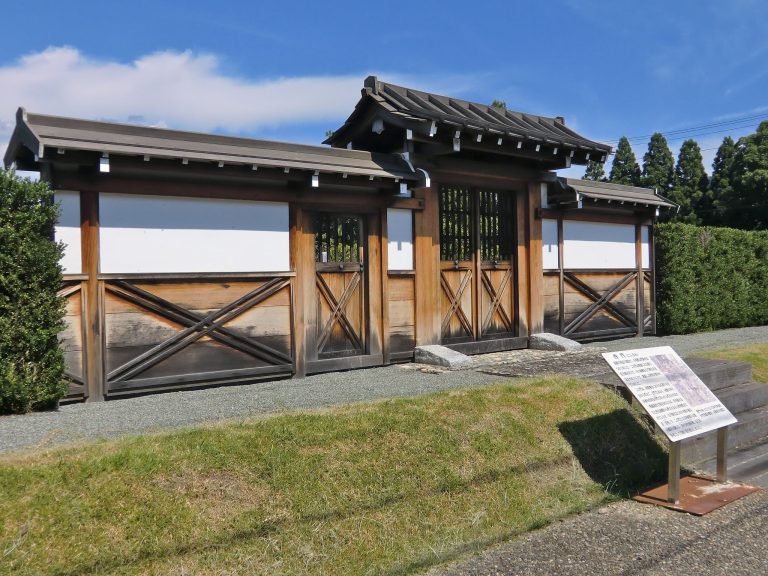
One castle gate survived because it was moved to Hamada. There it served as the entrance to a local government office, preserving part of the fortress’s former defensive architecture outside the mountain complex.
Watchtowers and Samurai Area
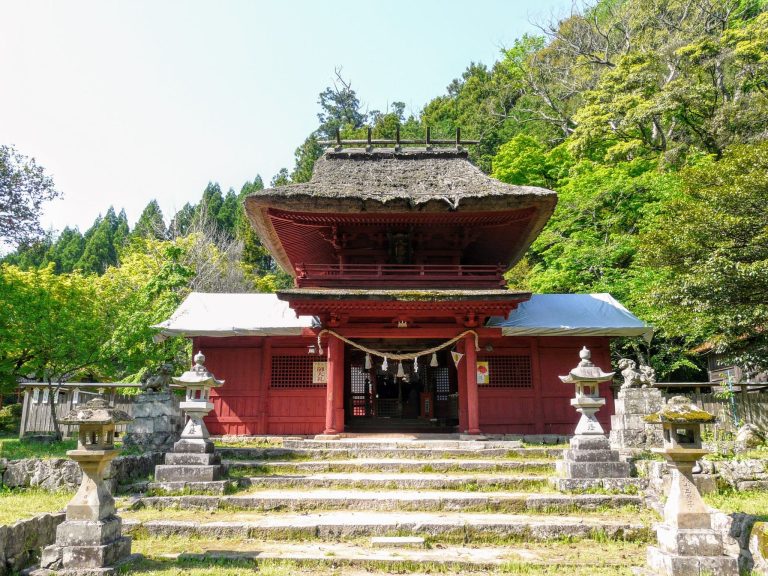
Two yagura at the foot of the mountain are described as dating from the middle of the nineteenth century. Samurai residences also survive or are documented in the town area near the former fortress. The administrative buildings and the daimyo residence formerly stood at the mountain’s base, where the residence site is now occupied by Tsuwano High School. Taikodani Inari Shrine is also located on the same mountain.