Shiroishi Castle: A Hilltop Castle and Regional Seat in Japan
Site at a Glance
- Country
- Japan
- Primary era
- Early Modern
- Eras represented
- Early Modern
- Civilizations
- Tokugawa
- Site type
- Military
- Remains
- Castle
On this page12 sections
History
Shiroishi Castle, also known as Masuoka Castle, is a hilltop castle in the Shiroishi Basin of Japan. Its founding date and builder are uncertain, although a tradition traces its beginnings to the late eleventh century. The castle later commanded routes across the region and served as a center of political and military activity.
Origins and the Shiroishi Clan
According to tradition, a member of the influential Fujiwara family established a residence in the Katta district after distinguishing himself in the Gosannen War, an eleventh-century conflict in northeastern Japan. The Karita clan later made the castle its residence and became known as the Shiroishi clan. The family eventually came under the authority of the Date clan.
A record from 1545 names Shiroishi Castle as the seat of Shiroishi Munetsuna, a local lord serving under the Date. In 1546, during a conflict between Date Tanemune and his son Harumune, Harumune took refuge there. After the dispute was mediated in 1548, Munetsuna gained greater standing among the Date retainers.
Changing Lords in the Late Sixteenth Century
In 1586, Munetsuna’s grandson Munazane received 33 villages in another district and moved his residence from Shiroishi to Miyamori Castle. Following Toyotomi Hideyoshi’s 1590 campaign to unify Japan, the Shiroishi family lost its lands. The following year it received a fief assessed at 15,000 koku, a measure of rice yield used to express income, and relocated to Mizusawa.
In 1591, the Katta district became part of Gamō Ujisato’s Aizu domain, and a Gamō retainer took charge of the castle. The Gamō carried out major modernization and rebuilding, though the sequence is uncertain. Some work may have been adapted later under Uesugi control to strengthen the castle against the Date. A tradition says the castle was dismantled when the retainer moved to Sukagawa in 1595. After the Gamō were transferred to Utsunomiya in 1598, Uesugi Kagekatsu took control of Aizu and placed Shiroishi under one of his retainers.
The Katakura Family’s Castle
In 1600, during Tokugawa Ieyasu’s campaign against Kagekatsu, Date Masamune attacked Shiroishi. The defender surrendered, returning the Katta district to Date control. Masamune’s uncle, Ishikawa Akimitsu, initially administered the castle. In December 1602, Masamune gave it to his close retainer Katakura Kagetsuna, who moved there from Watari with a fief assessed at 18,000 koku. The Katakura family governed the area from Shiroishi for generations.
The castle stood beside important routes through northeastern Japan. The Ōshū Highway ran north to Sendai and south toward Fukushima and Edo; roads also connected Shiroishi westward to Yonezawa and eastward to Sōma. Although a 1615 Tokugawa shogunate edict restricted each province to one castle, Shiroishi was permitted to remain in use alongside Sendai Castle. It continued in use until the Meiji era, and Katakura family records list about 30 major repairs.
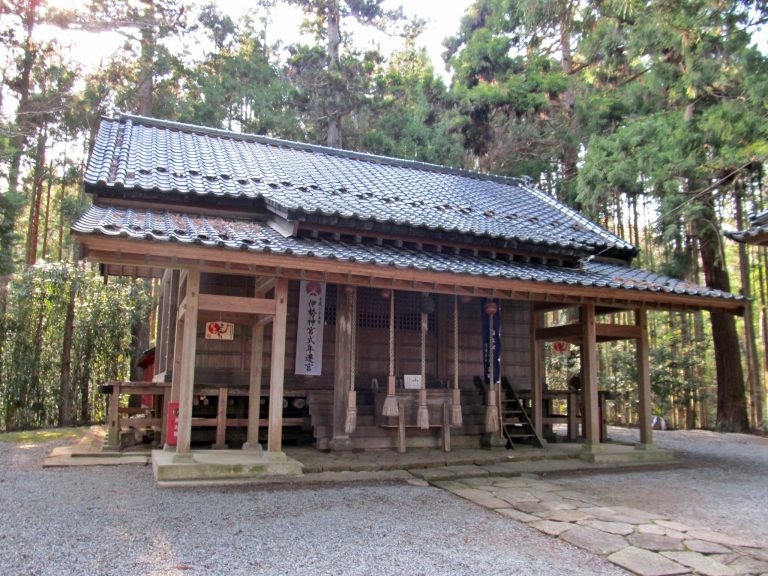
A tradition links strange lights, laughter, and sightings of an unknown woman to repairs begun after Kagetsuna took charge. In the tale, a fox possessing an old woman complained that foxes had been treated with respect under the Uesugi but poorly under the new lord. The fox warned that the domain would be secure if they were honored. A shrine was built overlooking the castle to appease them. Inari shrines are associated with a deity linked to rice and prosperity, and foxes are traditionally regarded as the deity’s messengers. The shrine was later incorporated into Manzō Inari Shrine in 1909.
A fire destroyed the castle in 1819. Katakura Munekage rebuilt it in 1823.
War, Political Change, and Demolition
During the Boshin War, the 1868–69 conflict between supporters of the Tokugawa shogunate and forces backing the new imperial government, representatives of northeastern domains met at Shiroishi in 1868. Their meeting led to the formation of the Ōuetsu Reppan Dōmei, an alliance of northeastern domains. The castle became the alliance’s headquarters, housed a council office, and hosted Prince Kitashirakawa Yoshihisa.
After the Sendai domain surrendered to the new government, the castle was handed over. In 1869, former Morioka lord Nanbu Toshiyuki was assigned the new Shiroishi domain, but soon left in hopes of regaining his former lands. A regional oversight office under government official Bōjō Toshiaki then operated at the castle until its abolition in 1870. The site was subsequently entrusted to an office concerned with the settlement and development of former Katakura retainers. It later passed under the Army Ministry and Finance Ministry, was sold to private owners in 1874, and had its buildings demolished by 1875. The former castle grounds became Masuoka Park in 1900.
Remains
Setting and Layout
The castle occupies the northern end of an isolated hill in the Shiroishi Basin, between the Ōu Mountains and the Abukuma Highlands. It stands about 76 metres above sea level and roughly 20 metres above the town. The Shiroishi River flows east about one kilometre to the north. Maps from different periods indicate that the castle expanded during the Edo period. Its final layout included six enclosures and five baileys, fortified subdivisions of the castle. The main, second, middle, and western enclosures occupied the hilltop. The marsh, southern, southeast, belt, and stable baileys lay on the middle slopes, while the third enclosure and outer bailey occupied lower ground.
Surviving and Reconstructed Structures
Main Enclosure and Earthworks
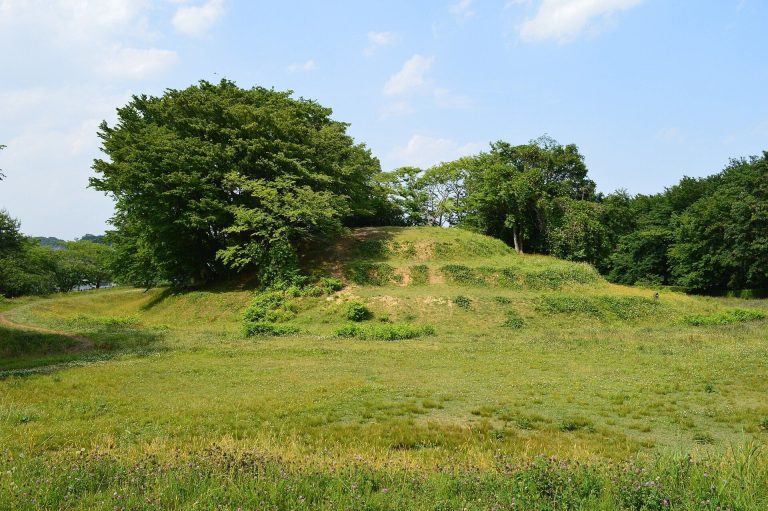
Stone ramparts survive in the main enclosure, and the castle’s earthworks retain their original form. Together with the arrangement of the enclosures and baileys, these features preserve elements of the castle’s defensive layout.
Three-Story Tower
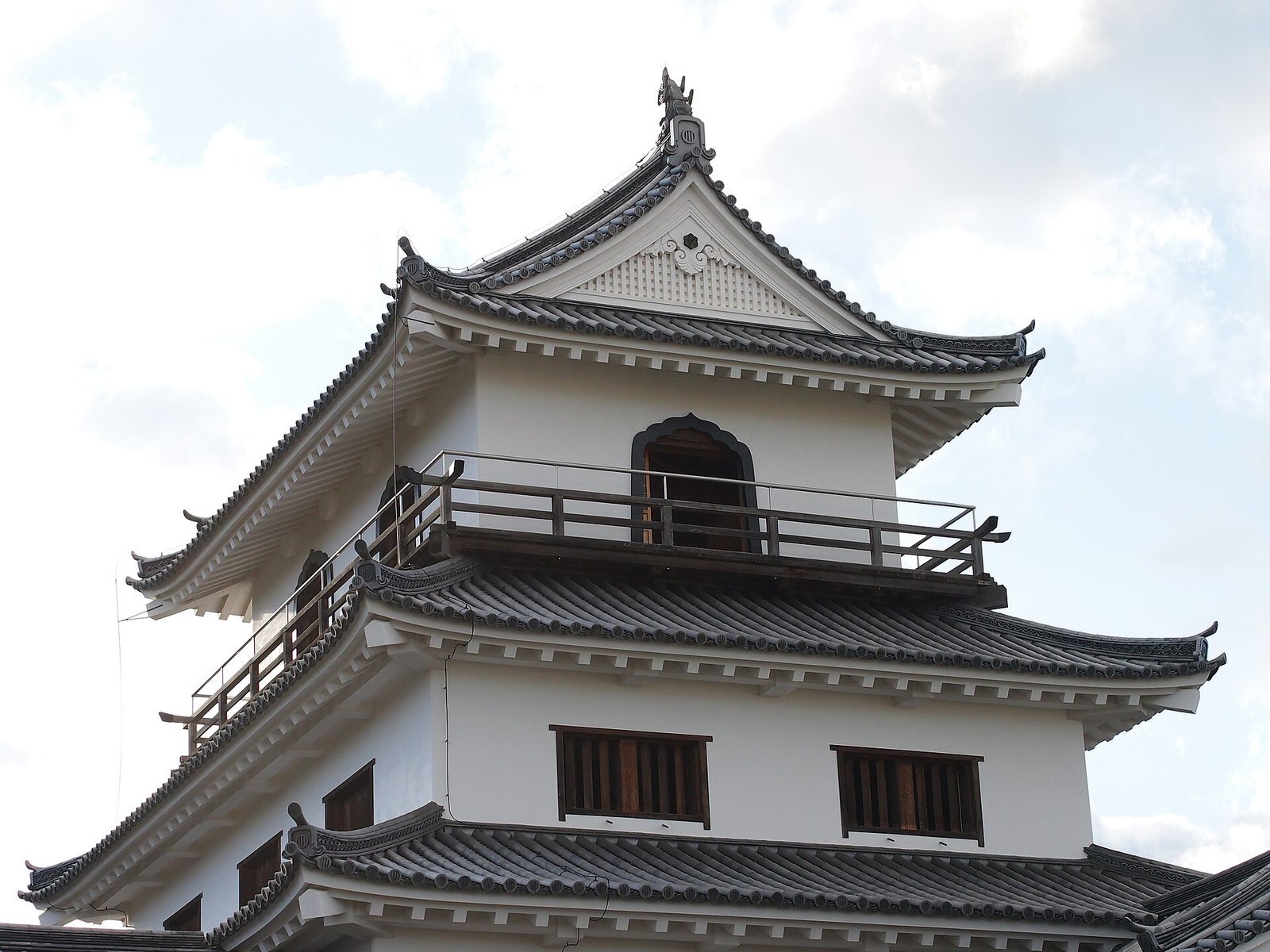
A large tower in the main enclosure served in place of a keep. It had a tiered form with three tiers and three stories. Seventeenth-century maps depict it with either two or three stories, but it is understood to have had three stories from the beginning. The reconstructed tower follows the form of the castle rebuilt in 1823.
Relocated Gates and Storehouse
Several gates were moved from the castle and now serve at temples. The stable entrance gate became the gate of Enmeiji Temple, and the east gate was moved to Toshinji Temple for the same use. A gate possibly from the upper residence stands at Kōryūji Temple in Natori. A gate possibly from the women’s quarters and the gunpowder store were relocated to private residences in Shiroishi.
Reconstruction and Earthquake Damage
Renewed interest in Katakura Kagetsuna, encouraged by the television drama Dokuganryū Masamune, helped build support for reconstruction. The city adopted reconstruction of the three-story tower as a policy in 1988, followed by research, document collection, and archaeological investigation. Work began in 1992. By 1995, the tower, first and second main gates, and an earthen wall had been rebuilt in wood using traditional materials and techniques. The reconstruction included the tower and part of the main enclosure. The 2011 Great East Japan Earthquake damaged the rebuilt castle, including collapsing sections of wall; repairs followed from May to September 2012. Earthquakes off Fukushima in 2021 and March 2022 caused further damage, including more than 400 cracks in the tower’s walls, and led to additional repairs.