Haj-Nehaj: A Venetian Fortress in Montenegro


Site at a Glance
- Rating
- 4.8
- Popularity
- Low
- Country
- Montenegro
- Primary era
- Early Modern
- Eras represented
- Medieval, Early Modern, Modern
- Civilizations
- Habsburg, Serbian, Venetian
- Site type
- Military
- Remains
- Fort
On this page9 sections
History
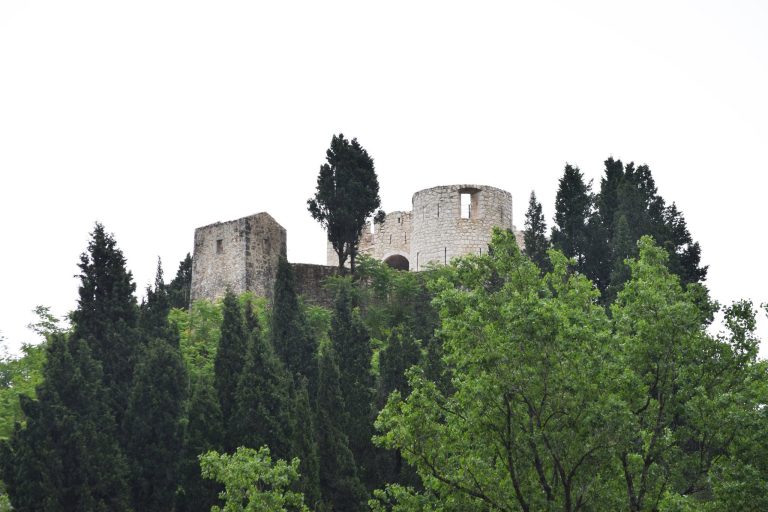
Haj-Nehaj is a fortress in Montenegro near Sutomore, built by the Venetian Republic during the period when Venice fortified important routes and ports along the Adriatic. Its oldest known mention dates from 1542, when it was called Fortezza de Spizi, or the Spič fortress. The older name Nehaj appears as Nechagia on a 1550 engraving of Bar. The fortress may have originated in the late fifteenth century, but that earlier date remains a historical supposition rather than a certainty.
Venetian and Ottoman control
Haj-Nehaj occupied a position between Bar and the Paštrovići area. A Venetian report from 1555 listed a garrison of two soldiers and one artilleryman, while a report from 1558 stated that the fortress could accommodate as many as 900 people in an emergency. Its defences were intended for firearms, reflecting the changing character of warfare in the region.
The Ottoman Empire captured the fortress in 1571, during its contest with Venice for control of Balkan territories and Adriatic routes. Ottoman rule continued until 13 November 1877, when the Montenegrin army took Haj-Nehaj. The following year, the Congress of Berlin, an international settlement that reorganized Balkan territories after the Russo-Turkish War, assigned the area to Austria-Hungary, the Habsburg dual monarchy established in 1867.
Ottoman restoration and later changes
During an Ottoman restoration in 1861, Mehmet Pasha converted the Church of Saint Demetrius into a gunpowder store. He also prohibited both Orthodox and Catholic burials there. The surrounding cemetery was demolished, and the bones from its graves were thrown down the cliff. After the Montenegrin takeover, the fortress fell into neglect and became partially ruined.
After the Congress of Berlin, Austro-Hungarian authorities incorporated Haj-Nehaj into their defensive line and enlarged the fortification. These later additions were subsequently left empty. The Serbian Orthodox Church continues to hold liturgies at the ruins of Saint Demetrius on Mitrovdan, the Orthodox feast of Saint Demetrius, and on Petrovdan, the feast of Saints Peter and Paul. The summer Petrovdan gathering is organized by Orthodox believers from Zagrađe and Sutomore together with the Sutomore Church Municipality.
Name and tradition
The name Haj-Nehaj is relatively recent. It combines Haj, identified with Golo Brdo above Sutomore to the west, with Nehaj, the older name of the fortress. A longstanding tradition says that women helped build the stronghold by carrying water, sand, and stones. This tradition remains neither confirmed nor disproved.
Remains
Haj-Nehaj stands on a rocky hill near Sutomore, about 10 kilometres northwest of Bar and slightly inland from the sea toward Mount Sozina. The fortress occupies ground approximately 230 to 231 metres above sea level. Its position is naturally difficult to approach from every direction except the west, where the entrance is located. The surviving complex combines firearm defences, residential buildings, a water reservoir, a gunpowder store, and the Church of Saint Demetrius.
Fortifications and buildings
Entrance and defensive works
Three construction phases can be distinguished at the entrance, with a water cistern, a built reservoir for collecting and storing water, added beside it at a later date. Round towers and numerous loopholes, narrow openings through which firearms could be used, belong to the fortress’s firearm-defence system. A carved emblem of the Venetian Republic, showing the winged lion, survives in the stone above the main entrance.
Residential buildings and gunpowder store
The higher southern part of the fortress and the area extending toward the entrance are occupied by residential buildings. These sections may be somewhat older than the northern part of the complex. At the extreme eastern end, a gunpowder store stands above the almost vertical cliffs. The Austro-Hungarian enlargement remains as part of the later fortification, although those additions were subsequently left vacant.
Church of Saint Demetrius
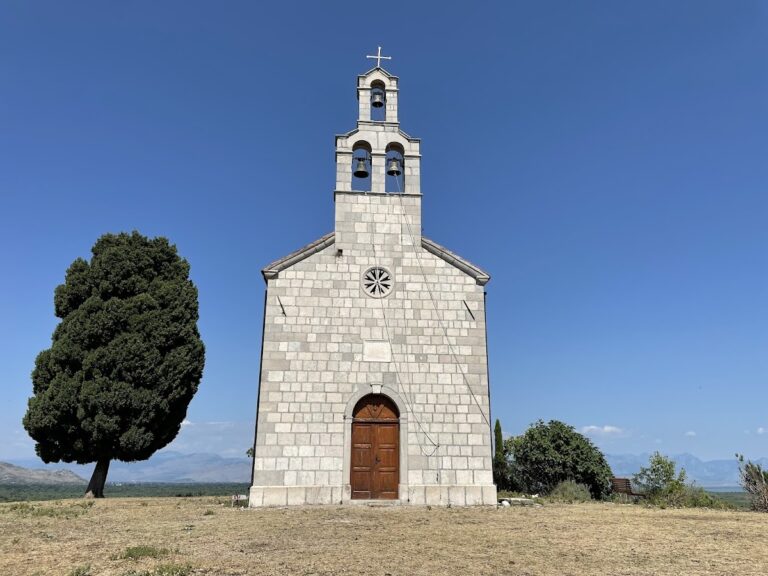
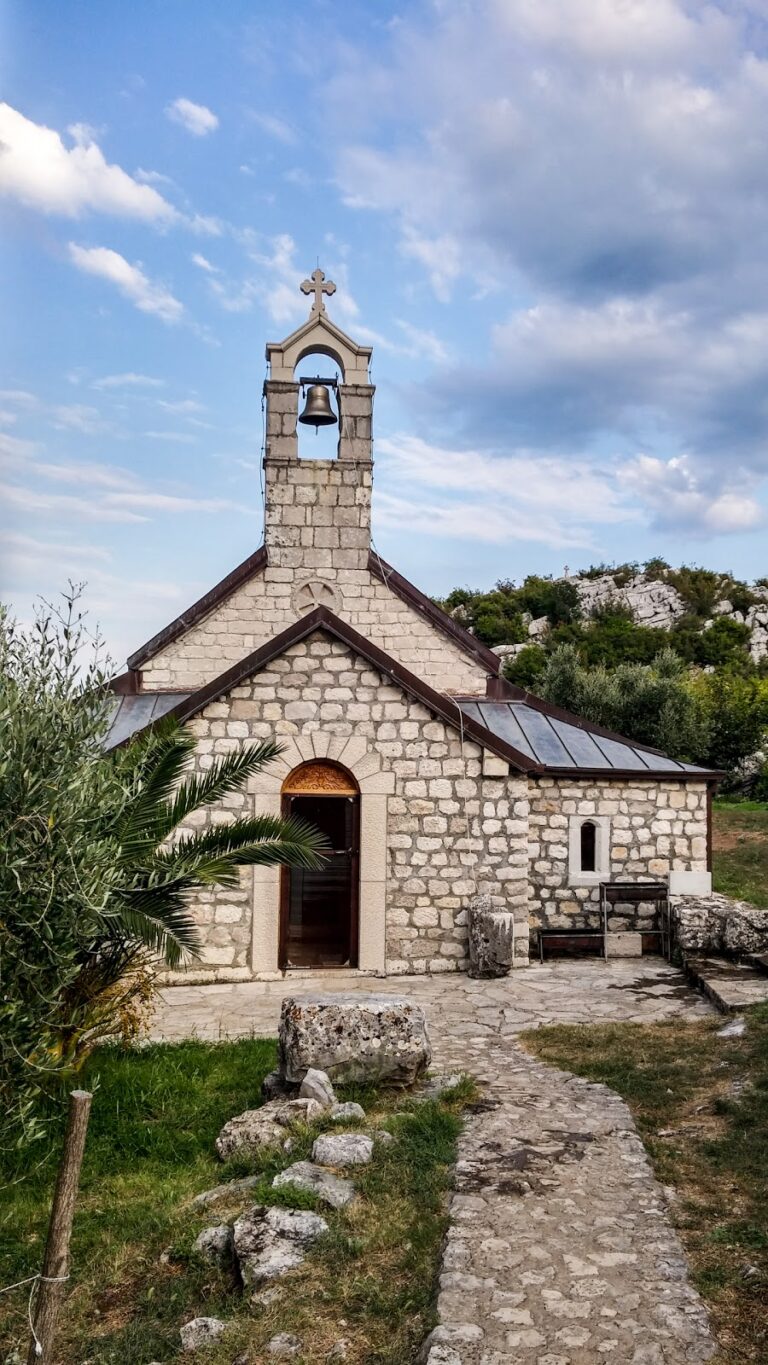
The Church of Saint Demetrius occupies the highest point of the hill within the fortress walls. It predates the fortress and may belong to the late thirteenth or early fourteenth century. The church had two altars, one Orthodox and one Catholic, allowing it for a period to serve both Christian traditions. It now survives as a ruin, where Orthodox liturgies continue on the feasts associated with Saint Demetrius and Saints Peter and Paul.