Château d’Arnay-le-Duc: A Historic Residence, Factory, and Educational Centre


Site at a Glance
- Rating
- 4.6
- Popularity
- Low
- Country
- France
- Primary era
- Early Modern
- External website
- Open
- Eras represented
- Early Modern
- Civilizations
- French
- Site type
- Domestic
- Remains
- Castle
On this page10 sections
History
Château d’Arnay-le-Duc is a historic château in France, associated with Arnay-le-Duc and known also as the Manoir de Juilly and the former Château des Princes de Condé. The present residence is described as a seventeenth-century château, with construction beginning in 1650, and its initial owner was Philibert II Verchère d’Arcelot. An earlier manor on the site was built under Francis I, the French king who reigned from 1515 to 1547 and encouraged Renaissance architecture.
The earlier manor and the Merlan family
The earlier building was attributed to Charles Merlan de Beaumont, a receiver of finances and lord of Juilly. The Merlan family occupied the manor until 1562, when Léonor Chabot-Charny acquired it as settlement for debts. In 1570, the future Henry IV passed through the château during the Battle of Arnay-le-Duc. Henry IV later ruled France from 1589 to 1610.
The Princes of Condé and later aristocratic owners
From 2 May 1634 to 1654, the château belonged to the third Prince of Condé, a member of the Bourbon dynasty’s princely branch. He carried out numerous alterations. His son, Louis II de Bourbon, known as the Grand Condé, became lord of Arnay but never visited the château. In 1655, ownership passed to Henri de Lorraine, Count of Harcourt, and in 1678 to his son Charles de Lorraine, Viscount of Marsan.
The building underwent further decline during the eighteenth century. In May 1747, it was used as a prison for Dutch soldiers. In March 1756, Louis-Charles de Lorraine, Count of Brionne, gave the already stripped and architecturally depleted residence to the town for use as a town hall, with maintenance assigned to the municipality. This civic arrangement continued until 6 January 1792.
Civic use and industrial transformation
During the municipal period, the Dames de Saint-Cyr acquired the château. They were women associated with the royal school for noble girls established at Saint-Cyr near Versailles. The residence served civic purposes and also contained a ballroom from which commoners were excluded. The Dames had acquired the lordship of Charny, including Arnay, Mont-Saint-Jean, and Pouilly, in 1779.
In 1792, the château was sold as national property and converted into a textile factory. Its ownership changed repeatedly between 1792 and 1865. Furniture and sculptures were removed and dispersed internationally, and one fireplace was exported to The Breakers, the Vanderbilt villa in the United States.
A file-manufacturing factory occupied the château from 1865 to 1957 and became Arnay’s principal employer. The Proutat-Michot-Thomeret company produced files, rasps, and tools, gained an international reputation, and received awards at universal exhibitions in Paris and London. Its files ranged from 3 to 60 centimetres in length, and the works employed as many as 400 people.
Municipal renovation and later institutional use
Industrial construction substantially changed the château’s historic fabric. Between 1958 and 1967, the municipality renovated the complex and demolished unnecessary buildings. From 1967 until 2019, the château housed the Pierre-Meunier Educational Vocational Centre as a boarding institution for 50 residents.
The educational centre left in 2019, returning the lease to the municipality. The town then sold the monument to a private owner. Since 2022, the privately owned château has housed a restaurant. It was registered as a French historic monument on 26 May 1926, under the national category that places a building under conservation controls below the highest classified level. The château is also listed in the Mérimée architectural-heritage database under reference PA00112063.
Remains
Enclosed layout and entrances
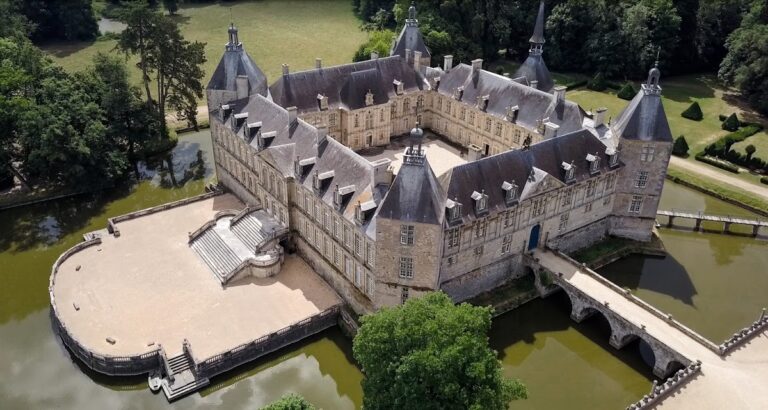
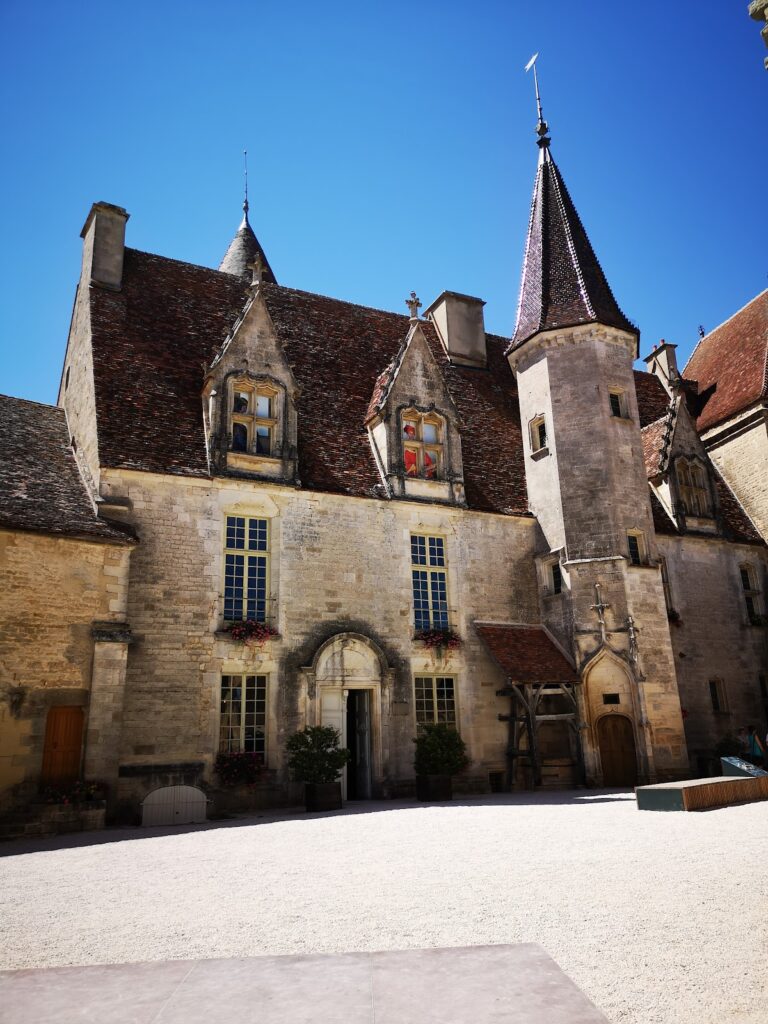
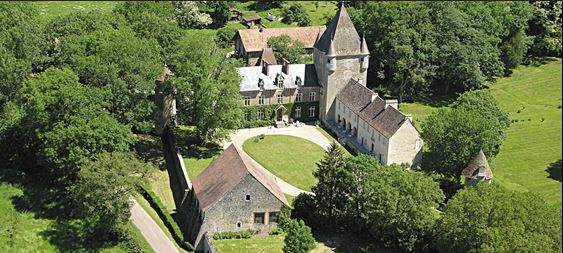
The château stands at the edge of the Morvan and Auxois regions and is completely enclosed within a residential block bounded by Rue du Château, Ruelle du Château, Rue Lucienne-et-Jean-Barnet, Rue des Ursulines, and Rue Saint-Honoré. Its buildings form a right-angled layout over two levels and a roof space. Small flat tiles cover the roofs, while the polygonal tower on the eastern façade rises to the highest point of the complex.
The western entrance opens from an exterior courtyard beside Rue du Château. A wrought-iron gate carries the initials PMT, a surviving feature associated with the Proutat-Michot-Thomeret file factory. A vehicle entrance from the departmental road leads to the renovated contemporary southern façade, which has seven windows. The northern wing contains outbuildings.
Western façade and corner tower
At the northwestern corner of what was formerly a residential building stands a round tower with a conical roof. It is positioned to the left when facing the entrance. The western façade retains mullioned windows, divided by vertical stone members, and transomed windows, which also include horizontal divisions.
Two dormer windows project from the roof. Their Corinthian pilasters are flat, engaged supports with capitals based on the Corinthian order, and their entablatures, the horizontal architectural bands above the supports, are decorated with foliate scrollwork. These elements remain part of the château’s surviving exterior fabric.
Marguerite of Burgundy Tower
The middle of the eastern façade is occupied by a polygonal tower known as the Marguerite of Burgundy Tower or Lantern Tower. It has an imperial roof and contains approximately 120 steps arranged in two flights. Its summit provides a 360-degree view.
Altered interiors and industrial fabric
The factory phase introduced industrial additions that altered the historic building. The municipal renovation of 1958 to 1967 removed some unnecessary structures. In 2011, the complex was entirely devoted to educational use, reflecting the long institutional phase that followed its industrial occupation.