Reževići Monastery: A Medieval Serbian Orthodox Monastery in Montenegro


Site at a Glance
- Rating
- 4.8
- Popularity
- Low
- Country
- Montenegro
- Primary era
- Early Modern
- Eras represented
- Medieval, Early Modern, Modern
- Civilizations
- Habsburg, Serbian, Venetian
- Site type
- Religious
- Remains
- Monastery
On this page11 sections
History
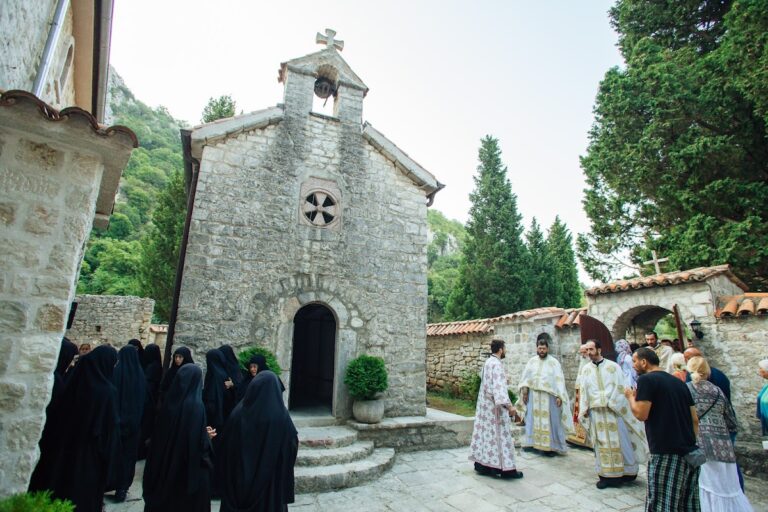
Reževići Monastery is a medieval Serbian Orthodox monastery in Montenegro, in Katun Reževići within the Budva municipality. Associated with Byzantine and Serbo-Byzantine traditions, and also classified within the Vardar style, it belongs to the Metropolitanate of Montenegro and the Littoral and remains active.
Medieval origins and local tradition
The monastery’s name comes from the Reževići clan of the Paštrovići tribe. It traditionally served as a meeting place where members of the Paštrovići community gathered to make important decisions and choose their chieftain. Stefan Štiljanović, a local Paštrovići leader, was the last chieftain elected by an assembly held at the monastery.
Local tradition attributes the foundation of the Church of the Dormition of the Mother of God to King Stefan Nemanjić, known as Stefan the First-Crowned and the first king of Serbia. The tradition places its foundation in the 1220s, with 1223 also given as a traditional date. The Church of the Archdeacon Stefan is traditionally associated with Emperor Stefan Uroš IV Dušan, the fourteenth-century Serbian ruler, and is dated by tradition to 1351.
Another tradition links the monastery’s beginnings with a roadside guesthouse and a stone column that supported a vessel of wine for thirsty travelers. One version says that Raymond IV, Count of Toulouse, drank from it during the First Crusade. Another connects the drink with Stefan the First-Crowned, who supposedly visited his cousin, the Venetian doge Dandolo, before founding the Dormition church nearby. Villages in the surrounding area maintained the vessel as an act of hospitality, while the column survived until the middle of the nineteenth century.
Records, destruction, and restoration
The monastery is mentioned on an icon painted in 1423 by the hieromonk Nikodim. The Church of the Dormition and the monastery also appear in a 1612 document concerning a land donation. During the middle of the sixteenth century, pirates from Ulcinj plundered and razed the two older churches and the guesthouse. The monastery then remained deserted for an extended period.
In 1714, the pro-abbot Maksim Kosijerevac came from Kosijerevo Monastery, restored both older churches, and organized the site as a functioning monastic foundation. Nikodim Vuković continued this work and began the larger Church of the Holy Trinity in 1770. The hieromonk Dimitrije Perazić completed it in 1814. The monastery was plundered again by a Turkish army in 1705 and 1785, with Mahmud Pasha Bushatli responsible for the latter attack. French forces occupying the Montenegrin coast looted it in 1812, and the Italian army plundered it during the Second World War.
The 1979 earthquake damaged the monastery’s buildings. In July 2016, red paint was poured over the frescoes, causing further damage to the painted decoration. The monastery’s library and treasury had already been plundered in 1785.
Remains
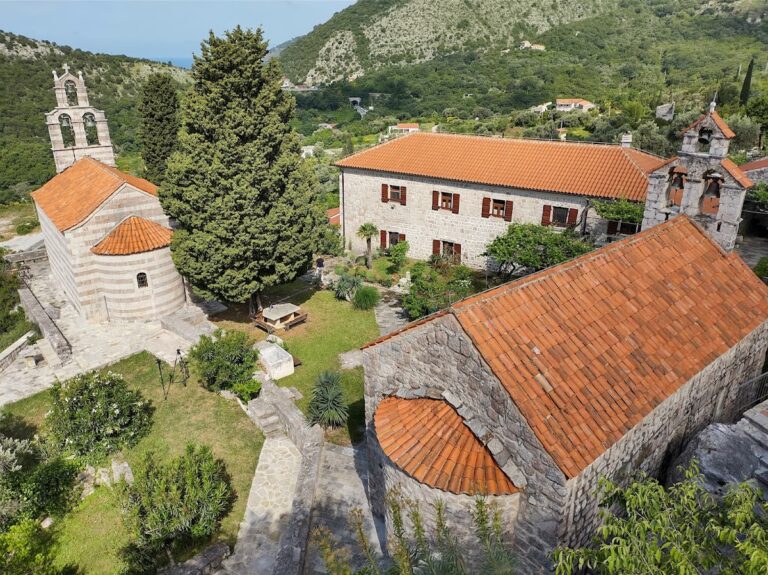
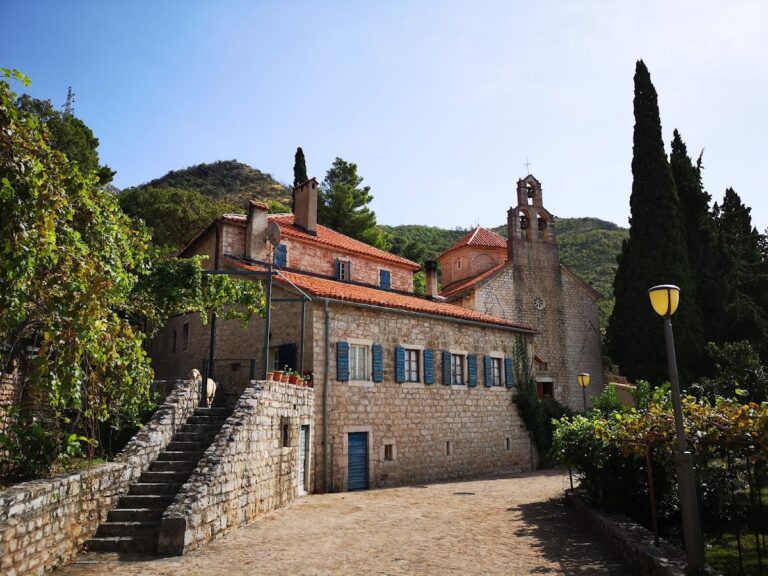
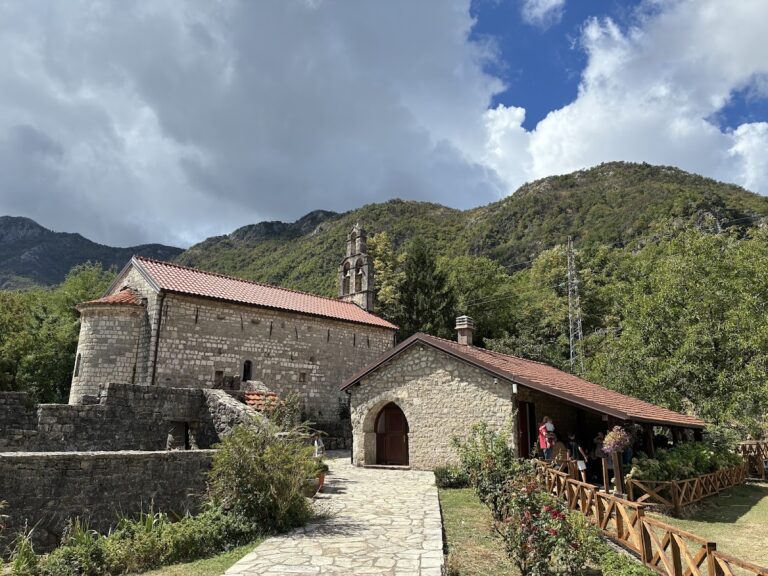
The monastery consists of three churches, the Church of the Archdeacon Stefan, the Church of the Dormition of the Mother of God, and the larger Church of the Holy Trinity. Together with the former guesthouse and the bell tower, they form an architectural complex shaped by medieval foundations, later rebuilding, and nineteenth-century additions. Its buildings follow Byzantine or Serbo-Byzantine traditions, also described through the Vardar style.
Older churches
Church of the Dormition
The old Church of the Dormition has a vaulted structure and a single-opening bell gable, a wall structure with an opening for a bell. Its interior contains frescoes from the early seventeenth century, along with surviving sections from the eighteenth century. The paintings are believed to be the work of Strahinja of Budimlje, who worked in numerous churches of the period.
A tomb inside the Dormition church served as the burial place of the monastery’s monks until the end of the nineteenth century. Its iconostasis, the decorated screen separating the sanctuary from the main body of an Eastern Orthodox church, was made by Aleksije Lazović of Bijelo Polje in the Serbo-Byzantine style. It was transferred from the neighboring Church of the Holy Trinity. Lazović also worked on the Dormition church’s icons in 1833.
Church of the Archdeacon Stefan
The Church of the Archdeacon Stefan is one of the two older churches in the complex. Its traditional date is 1351, and its foundation is associated with Emperor Dušan. The church was restored with the Dormition church in the early eighteenth century after the destruction of the older monastic buildings.
Later church and bell tower
Church of the Holy Trinity
The Church of the Holy Trinity is larger than the Dormition church and has a cruciform plan, meaning that its ground plan is arranged in the shape of a cross. Construction began in 1770 under Nikodim Vuković, and the hieromonk Dimitrije Perazić completed the building in 1814. Its iconostasis was made by the Paštrovići painter Marko Gregović.
Bell tower
A large rectangular bell tower rises to 24 meters beside the monastery churches. It ends in a pointed roof covered with stone slabs. A separate tradition dates the tower’s construction to 1839 and links its financing to money obtained by Archimandrite Dimitrije Perazić during his service in Russia from the Russian Synod.
Guesthouse tradition and surviving material
The monastery’s physical and cultural associations include the roadside guesthouse and the column that once stood before it, carrying the wine vessel maintained by nearby villages. Surviving material connected with the complex includes the frescoes, the churches’ iconostases and icons, and the 1423 icon that names the monastery.
Nearby sites