Villa Topolica (King Nikola’s Palace) in Bar: A Royal Residence and Museum
Site at a Glance
- Country
- Montenegro
- Primary era
- Modern
- Eras represented
- Modern
- Civilizations
- Unclassified
- Site type
- Domestic
- Remains
- Palace
On this page16 sections
History
Villa Topolica, commonly called King Nikola’s Palace, is a late-nineteenth-century royal villa on the Adriatic coast in Bar, Montenegro. First mentioned in 1885, it is generally dated to that year and is regarded as an important example of Montenegro’s secular architecture of the period. The familiar name is misleading: the palace did not belong to King Nikola personally. It was first known as Villa Topolica and later as the Palace of Crown Prince Danilo.
Origins and naming
The villa’s name recalled Topola in Serbia, a place associated with Karađorđević family ancestor Karađorđe. The nearby part of Bar also came to be called Topolica. Petar Karađorđević, who later became Peter I, king of Serbia from 1903 to 1921, lived in Montenegro from 1883 after marrying Zorka, a daughter of Nikola. Petar or his younger brother George is credited with choosing the villa’s name, and both brothers and other members of the family visited.
The builder remains uncertain, and the design is associated with court architect Josip Slade. A newspaper notice from January 1889 attributed the villa to George and described it as a planned home for his elderly father, Alexander Karađorđević, a former prince of Serbia. Alexander lived in Timișoara rather than moving to Bar.
Royal residence and wartime occupation
Nikola later acquired the estate for his son Danilo, heir to the Montenegrin throne. The villa became a summer residence for Danilo and his wife Jutta. Nikola, who ruled Montenegro from 1860 to 1918 and took the title of king in 1910, and Queen Milena also stayed there. Nikola’s last recorded visit was on 29 June 1914.
The estate’s royal connections extended to the sea. Nikola owned ten yachts between 1866 and 1916. One, Sibil, had been bought from novelist Jules Verne; his last yacht, Rumija, was sunk in Bar harbour by the Austro-Hungarian navy in 1915. During the First World War, Austro-Hungarian forces occupied the palace, including in 1917. After the war, the building and grounds were left in ruinous condition.
School, housing, and museum
A specialized agricultural school for southern crops began operating at the palace in 1933. A secondary agricultural school used it from 1946 until September 1949. After a new school building was constructed, the palace was converted into housing for several families and continued in that role until 1960, when it became Bar’s local-history museum. The city library also operated in the building from 1965 to 1977. The museum remains its principal use; the palace also hosts exhibitions and musical performances, while the Small Palace and winter garden have had commercial uses.
Remains
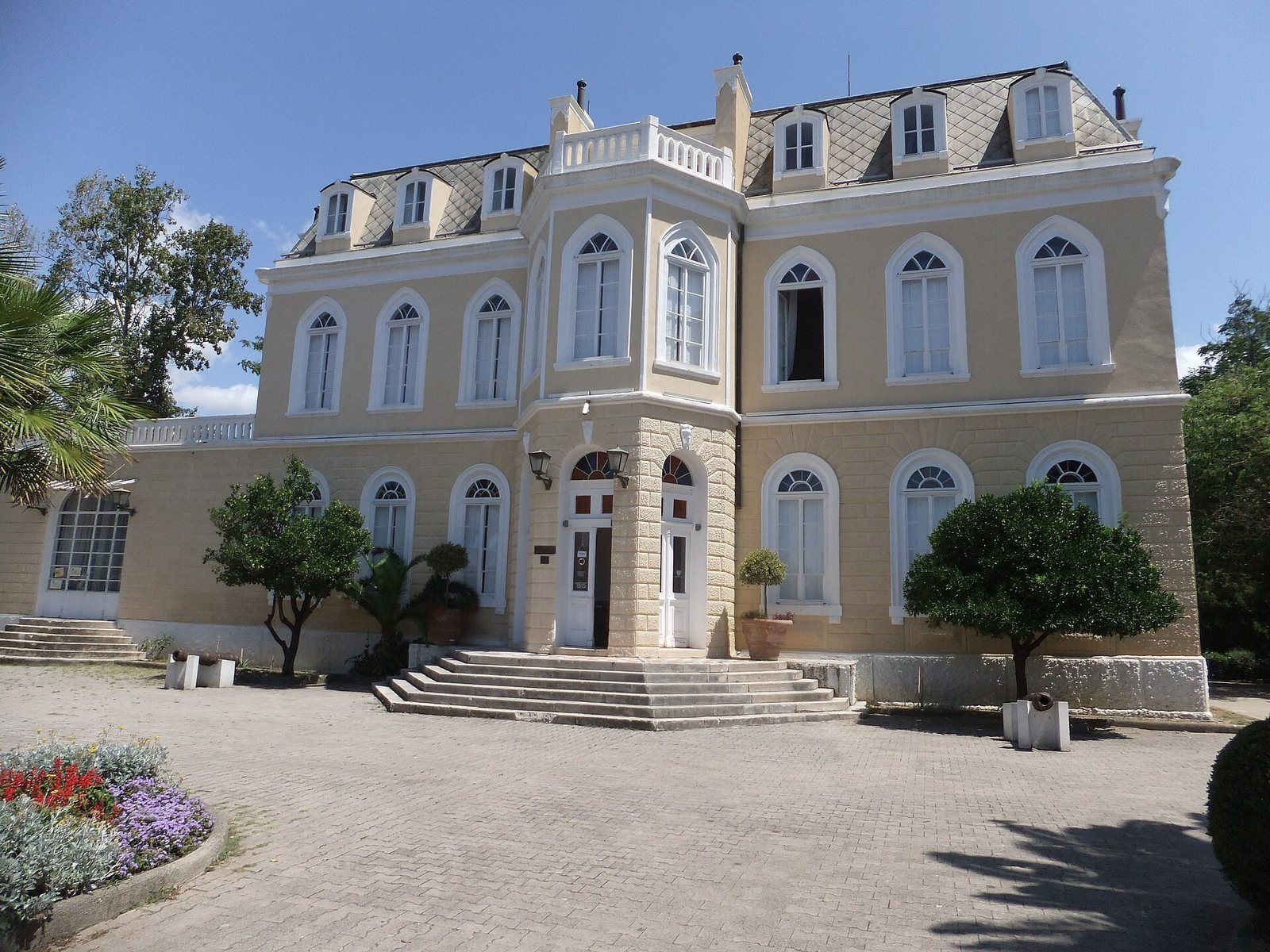
The palace complex stands beside the Adriatic waterfront and includes the Great Palace, the smaller Small Palace, two guard towers, a chapel, a winter garden, a park, and a pier. The Great Palace faces the sea, the Small Palace lies south of the park, and the winter garden adjoins the park to the east. The chapel stands between the two palaces, while the guard towers occupy the sea-facing corners of the Great Palace’s perimeter wall.
Palace buildings
The Great Palace
The principal building has a rectangular plan, with a ground floor, an upper floor, and a mansard level, an upper storey formed partly within the roof. Its brick walls are set in lime mortar, and the façades combine yellow surfaces with white ornament and woodwork. The wooden roof is covered with Eternit, or fibre-cement, sheets. A projecting horizontal band divides the façades, while shallow block-like detailing and large round-headed windows mark the ground floor. At the rear, a separate entrance and steep staircase lead toward the park. A rectangular ballroom with rounded corners was added to the west façade in 1910.
Rooms and circulation
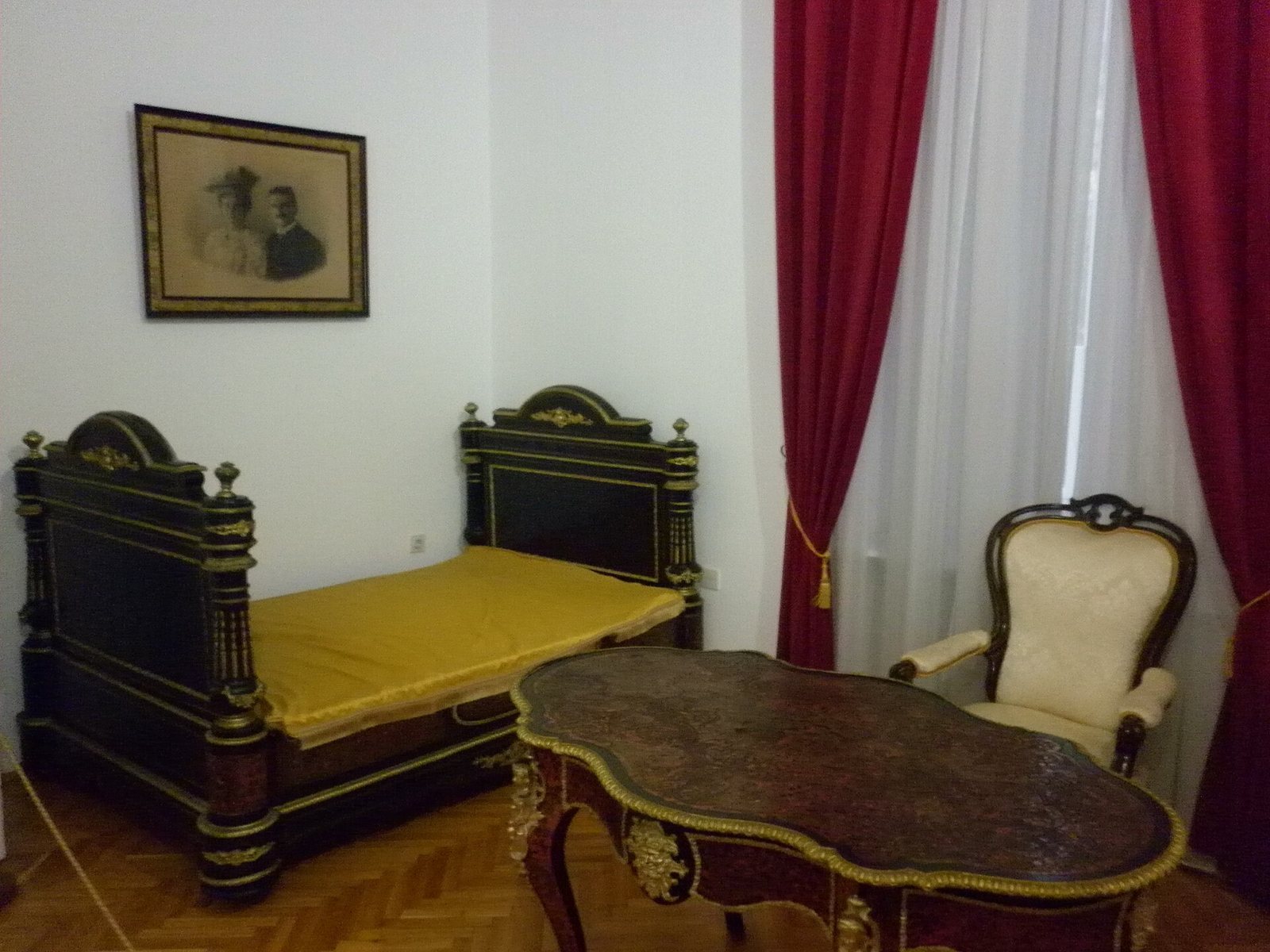
The lower floor contains a long hall with a double staircase, a living room with a fireplace, a large bathroom, and a kitchen. Rooms on the upper floor were assigned to Nikola and Milena, Danilo and Jutta, and Prince Mirko; this level also has a second bathroom. The attic contains the king’s study, a library, and a third bathroom. The front balcony overlooks the beach, while the rear balcony faces the palace park.
Cellars and tunnel
Wine cellars lie underground on both sides of the Great Palace. A tunnel linking one cellar with the guard towers may have served as a drainage channel or a concealed passage; its purpose remains uncertain.
The Small Palace
Substantially smaller than the Great Palace, this building has a rectangular plan, a ground floor, and an upper floor. Its façade faces the sea. Its design has been compared with villas built around lakes in northern Italy, and the building stands on the waterfront south of the palace park.
Guard towers
The two low towers are hexagonal, with pointed-arch windows and pyramidal roofs. Their positions at the sea-facing corners of the perimeter wall place them alongside the main palace building.
Chapel
The small, rectangular chapel stands between the palaces. Corrugated metal sheets form its walls, and its porch rests on metal columns. Part of a structure bearing the coat of arms of the medieval Krampsi family is built into the chapel staircase. The chapel was probably consecrated during the tenure of Mitrofan Ban, an Eastern Orthodox bishop and metropolitan of Montenegro from 1884 to 1920.
Park and waterfront
Winter garden
Adjoining the park on its eastern side, the winter garden is a glazed metal structure decorated in Art Nouveau, a style known for flowing, organic ornament. It is also called the Prince’s Garden. Victor Emmanuel III, king of Italy and the husband of another of Nikola’s daughters, gave the winter garden to the palace.
Palace park
The level park contains Mediterranean plants, including palms, fig trees, and conifers, as well as exotic trees. An eastern covered terrace includes a children’s play area. The park is poorly maintained.
Pier and courtyard
A wooden pier stood in front of the palace for royal yachts. A bust of King Nikola is located in the villa courtyard.