Gradište Monastery: A Serbian Orthodox Monastic Complex in Montenegro


Site at a Glance
- Rating
- 4.9
- Popularity
- Low
- Country
- Montenegro
- Primary era
- Early Modern
- Eras represented
- Early Modern, Modern
- Civilizations
- Serbian
- Site type
- Religious
- Remains
- Fortified Monastery
On this page9 sections
History
Gradište Monastery is a Serbian Orthodox men’s monastery in Montenegro, located at Buljarica near Petrovac. Tradition places its foundation in the eleventh century, on the remains of an ancient building, while another tradition dates it to before the Nemanjić dynasty ruled Serbia, before 1170. Site tradition attributes the foundation to Vladimir. The monastery belongs to the Metropolitanate of Montenegro and the Littoral, the Serbian Orthodox ecclesiastical jurisdiction covering Montenegro and the coastal region.
Early foundations and royal patronage
Gradište first enters written history in the first half of the fourteenth century. A charter issued by King Milutin in 1305 confirms that his mother, Queen Jelena, had donated the monastery to the Monastery of Our Lady of Ratac. Milutin, a medieval Serbian ruler of the Nemanjić dynasty, also recorded a donation of an estate to Gradište in a charter written in Kotor in 1310. These documents provide the monastery’s earliest known references and connect it with the patronage of a royal family associated with the establishment of many Serbian Orthodox monasteries.
Gradište was later attached to Dečani Monastery, a major medieval Serbian Orthodox monastery. After Venetian forces devastated Ratac Monastery, monks from Ratac moved to Gradište. A letter written by Danilo I Petrović-Njegoš on 17 June 1725 refers to the abbot Georgije and indicates that the monastery then belonged to Orthodox Christians.
Attacks and destruction
The monastery was attacked and burned repeatedly. Its most severe devastation came in 1785 during the campaign of Mahmud Pasha Bušatlija, also known as Kara Mahmud, the Ottoman pasha of Scutari. During the assault, the priest Rade Andrović tried to shoot the pasha, but his gun misfired. Ottoman forces killed Andrović and many local elders. He was buried in the monastery cemetery beside the Church of the Dormition. Mahmud Pasha was later killed at Kruše on 22 September 1796.
Gradište also maintained a school from its foundation until the Second World War. The school first operated in the defensive tower and later moved into the monastic residential building. In the First World War, Austrian forces removed all the monastery’s bells. Italian forces looted and burned the complex in 1941 during the Second World War.
Renewal and modern restoration
The abbots Sinezij Davidović and Innokentij Pavlović contributed substantially to the monastery’s renewal during the nineteenth century. Under Abbot Boris and the monastic brotherhood, renovation in 1972 restored the Church of St Sava and the monastic cells, and a road to the monastery was constructed.
An earthquake in Montenegro in April 1979 severely damaged the complex. The Church of St Sava was destroyed completely, while the Church of St Nicholas and the residential building were damaged. Restoration continued from 1980 to 1993, and Metropolitan Amfilohije reconsecrated the monastery on 18 April 1993. Gradište remains an active Orthodox monastery and is included on Montenegro’s list of protected cultural-historical monuments. It is also regarded as one of Montenegro’s significant monuments of late-medieval fresco painting.
Remains
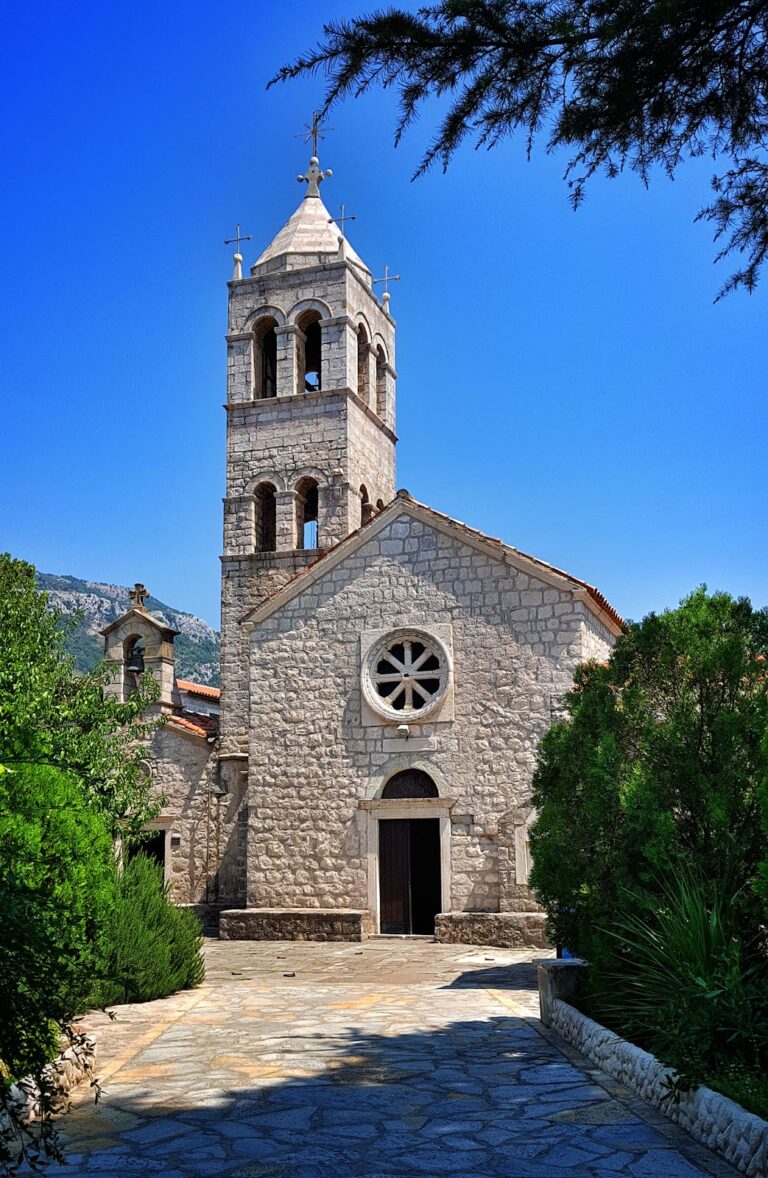
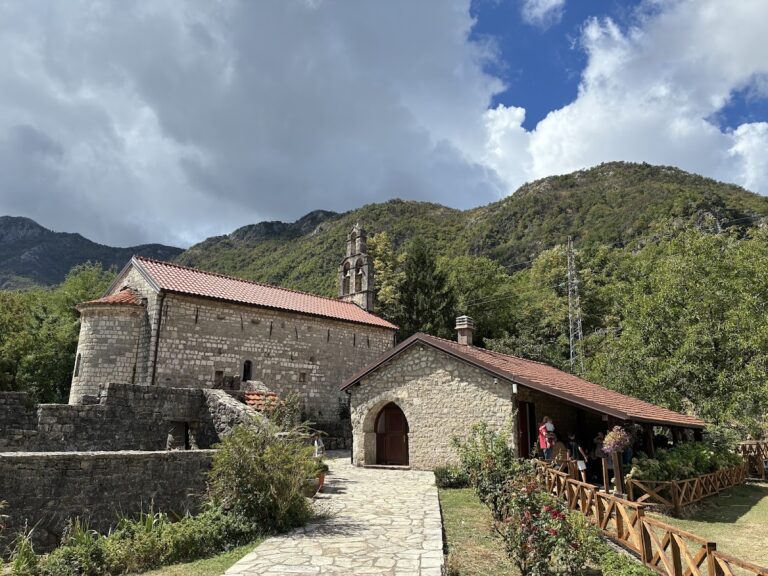
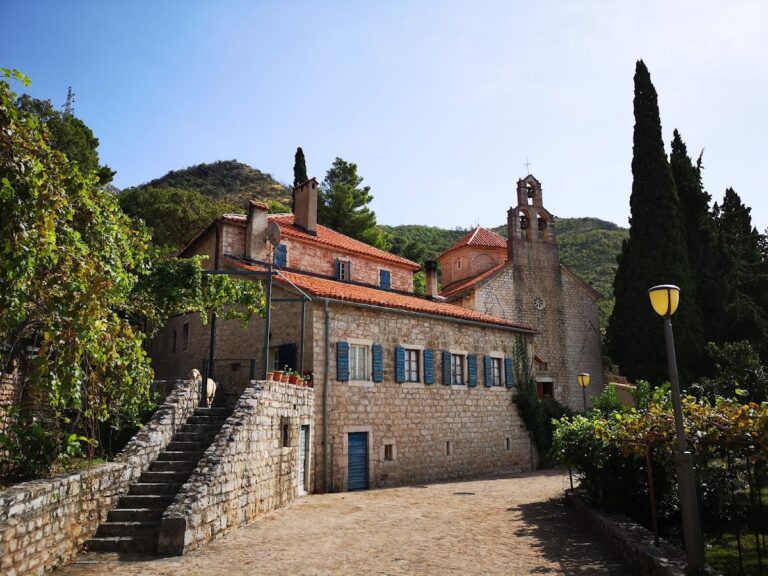
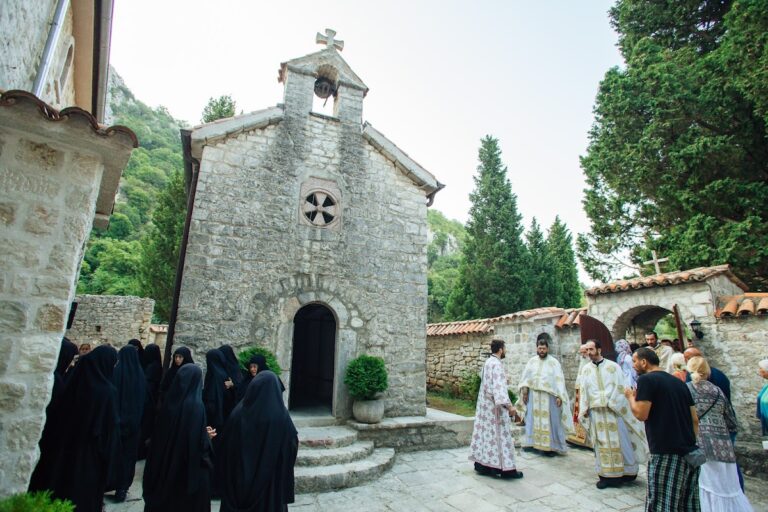
Gradište stands on a small elevation above the main road toward Bar at Buljarica near Petrovac. The complex comprises three churches, a monastic residential building, and a cemetery. The Church of St Nicholas occupies the central position, while the Church of St Sava stands on the same general plateau and dominates the complex. The Church of the Dormition of the Mother of God is set on a higher platform within an active village cemetery.
Defensive enclosure and monastic buildings
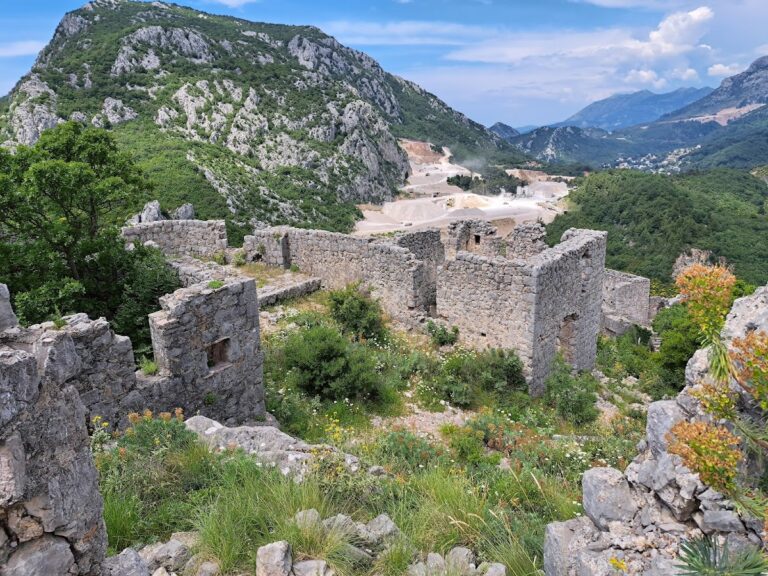
The monastery was once surrounded by a strong defensive wall with a tall tower and loopholes. The foundations of this enclosure and tower survive. The defensive tower also housed the monastery school during its earlier history, before teaching moved to the residential building. The monastic cells and residential building were restored in the twentieth century, although the building was damaged by the 1979 earthquake.
Church of St Nicholas
The Church of St Nicholas is the main and central church of the complex. It was built in the late sixteenth century under Metropolitan Ruvim Njeguš, a Montenegrin Orthodox metropolitan associated with the church’s construction, on the site of an older church traditionally said to have been built in 1116. A three-bell belfry rises above the entrance. An inscription above the doorway names the patrons Dionysius and Stefan Davidović and the painter, the priest Strahinja from Budimlje.
Strahinja of Budimlje frescoed the church in 1620. The paintings include scenes and figures from the Old and New Testaments, members of the Nemanjić dynasty, and monumental images of St Nicholas, the Dormition of the Mother of God, and St Mary of Egypt receiving Communion.
The church’s iconostasis, the decorated screen separating the sanctuary from the main body of an Orthodox church, was painted and carved by Vasilije Rafailović of Risan, a representative of the Rafailović-Dimitrijević school associated with the Bay of Kotor. It was completed in 1795. Among its unusual features is an icon of St Christopher with a donkey-like head, a form linked to an Eastern Christian legend that he prayed to lose his exceptional beauty so admirers would not trouble him.
Twelve square panels showing the Apostles surround the image of St Christopher. Six standing saints occupy the lower part, with an icon of St Nicholas beside them in the same row. Above the sovereign icons is a second zone with a frieze of the Apostles and a Deesis at its center, a devotional scene of Christ flanked by the Virgin Mary and St John the Baptist. The iconostasis has the central royal doors and one side door on the left.
Church of St Sava
The Church of St Sava was built in 1864 on the ruins of an earlier church dedicated to the same saint. St Sava founded the independent Serbian Orthodox Church and became its first archbishop. The later church has walls laid in courses of red and white stone and a three-bell belfry above the entrance. An inscription identifies Rade Markov Papan of Spič as its builder. Its iconostasis was painted in 1864 by the Greek iconographer Nikolas Aspiotis of Corfu. The church was destroyed in the 1979 earthquake and later restored.
Church of the Dormition
The Church of the Dormition of the Mother of God is the smallest of the three churches. It stands on the upper platform, outside the main monastic enclosure and within the cemetery area, and follows the form of a rural church. The Dormition is the Eastern Orthodox feast commemorating the death and bodily assumption of the Virgin Mary.
Strahinja of Budimlje painted the church’s frescoes in 1620. They depict Nemanjić saints, including Simeon the Myrrh-streaming, his sons Sava and Stefan the First-Crowned, Simeon the Hoarse, Milutin, Stefan Dečanski, and Queen Jelena. The church stands beside the cemetery where Rade Andrović was buried after the attack of 1785.
Nearby sites