Hagley Hall: An 18th-Century Neo-Palladian House and Park
Site at a Glance
- Popularity
- High
- Country
- United Kingdom
- Primary era
- Early Modern
- Eras represented
- Early Modern
- Civilizations
- British
- Site type
- Domestic
- Remains
- Elite Residence
On this page18 sections
History
The earlier estate and the Gunpowder Plot
Hagley Hall is an 18th-century country house in the United Kingdom, built from 1754 to 1760 for George Lyttelton in the Neo-Palladian style, an 18th-century revival of classical architecture inspired by the Italian architect Andrea Palladio. Before the present house, the site had a comfortable dwelling built mainly of timber. A park existed at Hagley during the reign of Edward III, king of England from 1327 to 1377.
In 1606, after the 1605 Gunpowder Plot, a conspiracy to destroy Parliament and kill King James I, the conspirators Robert Wintour and Stephen Littleton sought help from Humphrey Littleton at Hagley Park. They had been at large for about two months. John Lyttelton’s widow lived at Hagley, while Humphrey had use of the house. Cook John Fynwood alerted the authorities after becoming suspicious of Humphrey’s food consumption and seeing the two men. Humphrey denied sheltering anyone, but servant David Bate pointed out where the fugitives were trying to leave a courtyard for the countryside. They were captured at Hagley Park on 9 January.
George Lyttelton and the 18th-century estate
George Lyttelton, a politician and writer who had served as secretary to Frederick, Prince of Wales, commissioned the present hall. Sanderson Miller designed it with assistance from London architect John Sanderson. George began landscaping the grounds around 1739, before his father, Sir Thomas Lyttelton, died in 1751; work on the park continued to about 1764. Several designers, including John Pitt, Thomas Pitt, James “Athenian” Stuart, and Miller, contributed follies, decorative structures set in the landscape rather than built primarily for practical use.
Hagley became a subject of literary attention. James Thomson visited in 1743 and later revised his description of the grounds in the “Spring” section of The Seasons. Horace Walpole praised the landscape after visiting in 1753, and William Mason devoted part of his 1758 “Ode to a Water Nymph” to Hagley. The estate’s commemorative features included tributes to Thomson, Alexander Pope, and William Shenstone.
Among the park’s 18th-century structures, a reconstruction of the Temple of Theseus, named for a legendary Greek hero associated with Athens, was built from 1759 to about 1762. It cost £300 and was given by George’s half-brother, Admiral Smith. The Hagley Obelisk followed in 1764, built for Sir Richard Lyttelton. In April 1786, John Adams and Thomas Jefferson visited during a tour of notable houses. Adams called Hagley superb and admired the estate, while criticizing how such properties were financed and judging their embellishments unsuitable for America’s rugged landscape.
Later ownership, fire, and restoration
After Thomas Lyttelton, 2nd Baron Lyttelton, died in 1780, the hall was leased to Bernard Dewes until 1793. Hagley Cricket Club was formed in 1834 and remained associated with the Lyttelton family. From 1875 onward, family members and relatives were buried in the churchyard, with two earlier exceptions.
A fire on Christmas Eve 1925 destroyed much of the library and many pictures. Everyone inside escaped, despite molten lead falling through the house from the roof. The 9th Viscount and his wife restored the hall, but did not rebuild the upper floor of the servants’ quarters. Hagley Hall received Grade I listing in 1952, the highest category of listed-building protection in England. The Temple of Theseus has also spent several years on Historic England’s Heritage at Risk Register, which identifies heritage places considered at risk.
From the early 1970s, the estate accumulated debt and fell into disrepair. John Lyttelton, 11th Viscount Cobham, sold extensive areas of land to support it and meet the financial consequences of his divorce. His brother and successor, Christopher Lyttelton, 12th Viscount Cobham, began restoring the house and park. Work on the grounds began with the Obelisk in 2010; later projects rebuilt the Palladian Bridge and reopened a valley vista to the repaired Rotunda.
Remains
The surviving estate includes the hall, a stable complex to its north, a church west of the house, and landscaped grounds containing monuments and decorative structures. The house has a restrained classical exterior, while the park combines a deer-park landscape with classical follies and a sham medieval ruin.
The hall and associated buildings
Hagley Hall
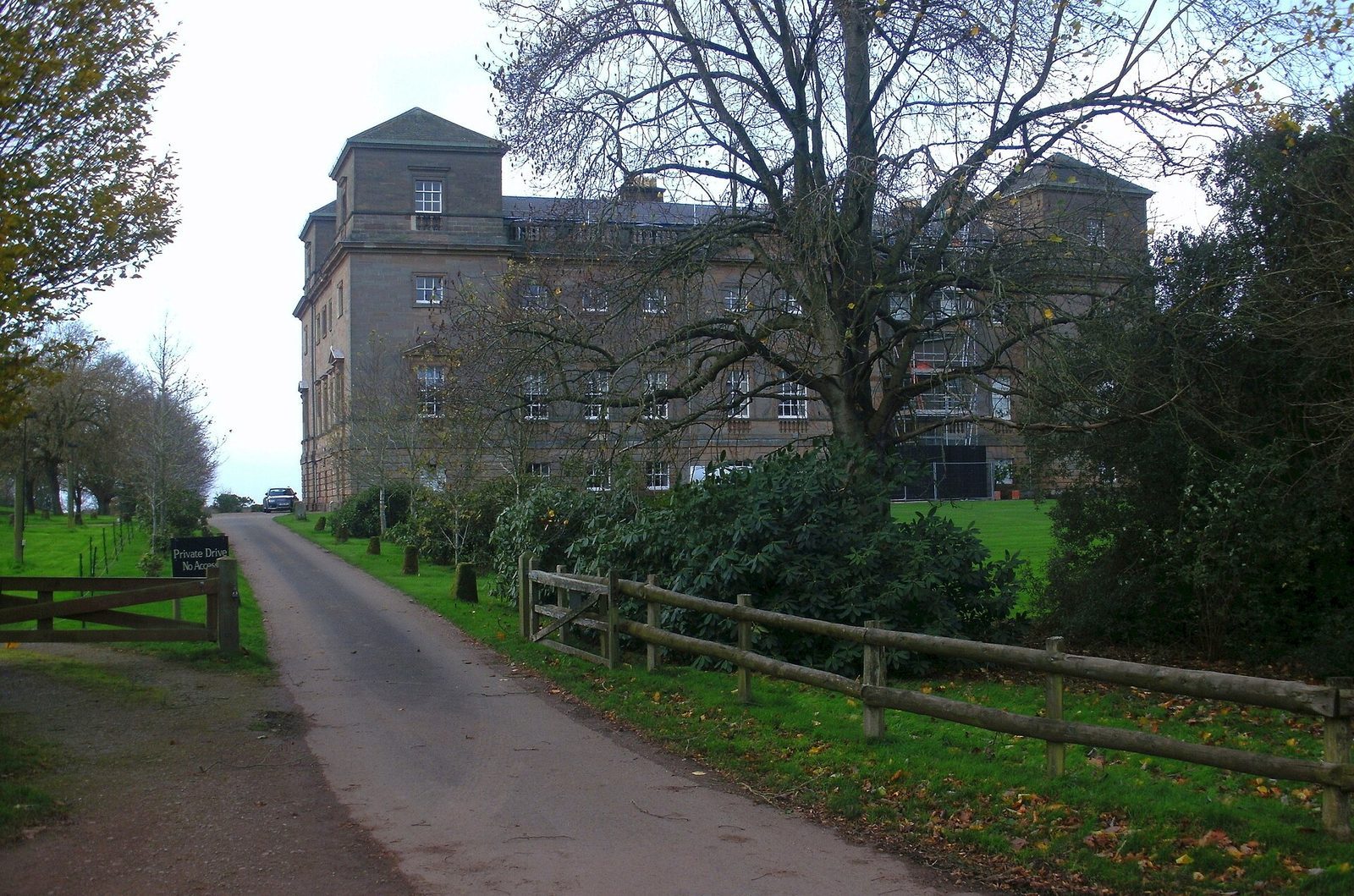
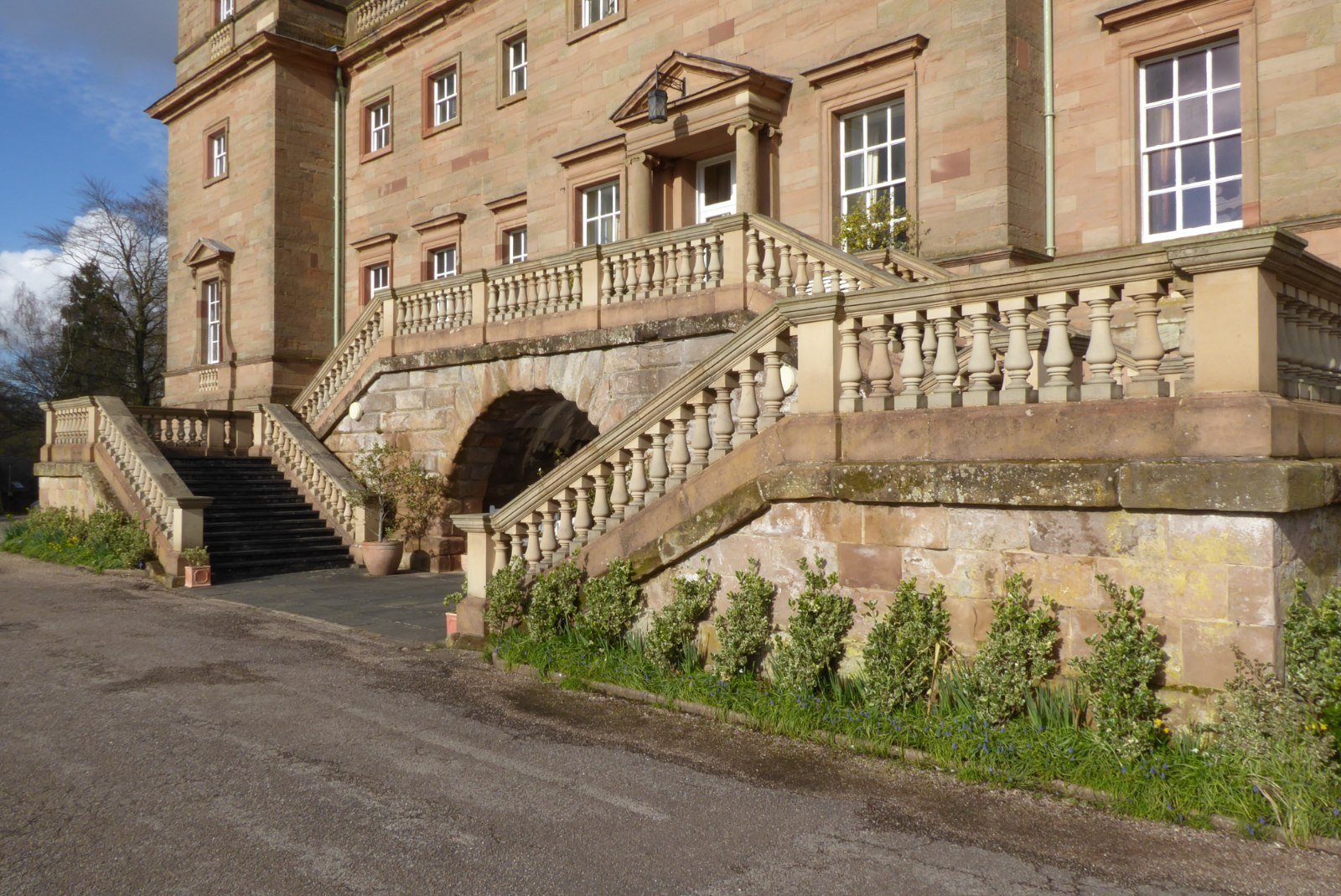
The hall’s plain exterior has corner towers capped by pyramidal roofs and Venetian windows, each with a large central arch flanked by narrower openings. The form of the towers recalls a feature used by Inigo Jones at Wilton House. Between the towers, the roofline is lower than it was originally because the upper floor of the servants’ quarters was not restored after the 1925 fire.
Inside, Rococo plasterwork, an ornate style popular in the 18th century, is attributed to Francesco Vassali. The rooms also contain 18th-century Chippendale furniture and family portraits, including paintings by van Dyck, Joshua Reynolds, Cornelius Johnson, and Peter Lely.
Stable block
The extensive stable block stands north of the hall, across the narrow Hall Drive. Its buildings are arranged around two courtyards. The complex no longer functions as stables and is used as a business park for small local businesses.
The park and its features
Deer park and landscape
The landscaped deer park covers 350 acres and is grazed by herds of fallow deer. Wychbury Hill forms part of the estate. The grounds include classical follies and Hagley Park Castle, a structure designed to resemble a medieval ruin.
Hagley Obelisk
The Obelisk stands on Wychbury Hill and can be seen for many miles.
Temple of Theseus
The temple is a reconstruction of the classical building associated with Theseus and is in poor condition.
Four Stones
The Four Stones, also known as Ossian’s Grave, stand on the summit of Clent Hill. Ossian was a legendary Gaelic bard whose name became widely known through 18th-century poetry.
Palladian Bridge and Rotunda
The Palladian Bridge is a bridge in a classical style associated with Palladian architecture. The Rotunda is a circular building, usually with a domed roof. The park’s reopened valley vista leads to the repaired Rotunda.
Commemorative monuments
Monuments in the park commemorate the writers Alexander Pope, William Shenstone, and James Thomson.
Church and cricket ground
St John the Baptist and the churchyard
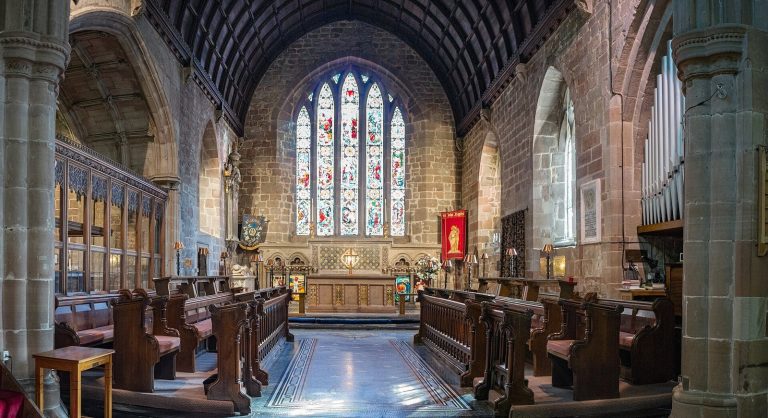
St John the Baptist parish church stands a short distance west of the hall, facing its rear façade. A churchyard surrounds it, and its older section contains a Lyttelton family burial plot. From 1875, family members and relatives were buried there, apart from two earlier exceptions.
Cricket ground
The cricket ground lies immediately beside the church and has a separate clubhouse. It is associated with Hagley Cricket Club, founded in 1834.