Selly Manor Museum: A Relocated Historic House in Birmingham


Site at a Glance
- Rating
- 4.6
- Popularity
- Low
- Country
- United Kingdom
- Primary era
- Medieval
- External website
- Open
- Eras represented
- Medieval, Early Modern
- Civilizations
- English
- Site type
- Domestic
- Remains
- Manor House
On this page10 sections
History
Selly Manor Museum is a heritage site in Birmingham, United Kingdom, centered on a timber-framed house with records reaching back to 1476. The house originally stood elsewhere before being dismantled and moved to Bournville, where it became a museum in 1917. Its history reflects changes in domestic life, ownership, housing, and heritage preservation from the medieval period to the twentieth century.
From Smythes Tenement to family home
The earliest surviving records name the property Smythes Tenement. In 1476 it stood on land belonging to William Jenette, lord of the sub-manor of Selly, who leased it to the local farmer John Othe’field. The building’s central area was a medieval hall, a large room that commonly served as the main living and dining space in a medieval English house.
In 1561, attorney and bailiff John Setterford, his wife Phylis, and her son William Pritchett leased the house. The Setterford family prospered and later acquired it. Phylis Setterford outlived her husband and died in 1608. An inventory prepared after her death describes the contents and arrangement of the house, including its medieval hall.
The central section had been replaced by a three-storey brick structure by 1664. This change is indicated by hearth-tax returns, records created for a tax assessed according to the number of fireplaces in a household. Phylis Setterford’s descendants continued to own and occupy the property until 1699.
Decline and division into cottages
After 1699, the house passed through several absentee landlords, owners who did not live at or directly manage their property. Their limited investment contributed to the building’s decline. The house became increasingly unfashionable, and in 1795 it was sold separately from the land associated with it.
By 1853, the deteriorating building had been divided into three cottages and was known as The Rookery. The three parts consisted of an end cottage, a middle cottage, and the remaining cottage. In 1861, ten members of the Davis family occupied the smallest end cottage, four members of the Thompson family lived in the middle cottage, and seven members of the Williams family occupied the other cottage.
Rescue, relocation, and museum use
Following the death of its owner, Edward Olivieri, The Rookery was offered at auction in 1907. George Cadbury acquired it that year to prevent its destruction. He intended the building to become a museum complementing the public buildings of Bournville, the garden village associated with his chocolate factory.
The house was carefully dismantled and relocated to Bournville. Architect William Alexander Harvey managed the work and recorded each stage of the project. The relocation began in 1909 and was completed in 1916, and the building opened as a museum in 1917.
Minworth Greaves was also moved to the museum grounds, arriving from Minworth in 1932. Selly Manor and Minworth Greaves are operated together as Selly Manor Museum by Bournville Village Trust, the organisation responsible for the museum’s heritage and community role. Selly Manor received Grade II listed status in 1952, a statutory category in England for buildings of special architectural or historic interest that provides legal protection against unauthorised alteration or demolition.
The Laurence Cadbury Collection
The museum houses the Laurence Cadbury Collection of furniture and domestic objects dating from 1500 to 1900. Laurence Cadbury, George Cadbury’s fourth son, began collecting while studying at Cambridge around 1908 and continued into the mid-1930s. Much of the collection had previously been displayed at his house, The Davids, in Northfield, Birmingham. Selly Manor became a setting for the earlier furniture and domestic objects that particularly interested him. His separate papers, including diaries, letters, and maps, are held at the Cadbury Research Library at the University of Birmingham.
Remains
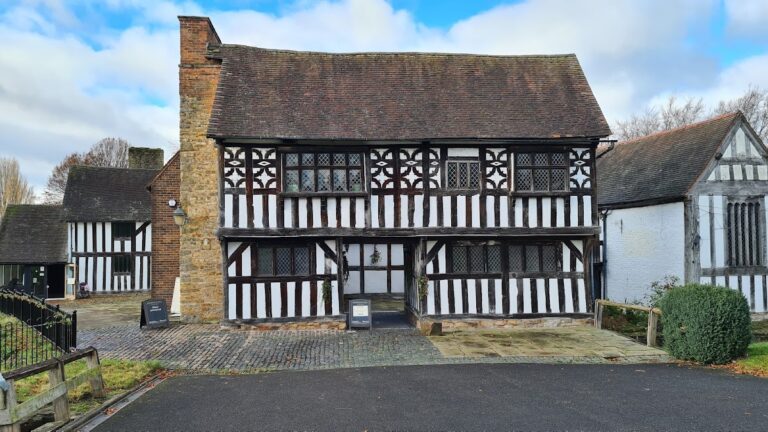
The museum grounds bring together the relocated Selly Manor and the adjacent Minworth Greaves. Selly Manor is a timber-framed building, meaning that its structure is formed by a framework of timbers with the spaces between them filled or clad with other materials. The house retains the three-storey brick section that replaced its former medieval hall, while its division into three cottages remains part of its later physical history as The Rookery.
Relocated buildings
Selly Manor
Selly Manor originally stood at another location before being dismantled and reconstructed in Bournville between 1909 and 1916. Its surviving form combines the timber-framed historic house with the later three-storey brick middle section. The former single dwelling was divided into three cottages by 1853, creating the end, middle, and remaining sections associated with The Rookery. The building now forms the principal historic structure of the museum.
Minworth Greaves
Minworth Greaves stands beside Selly Manor in the museum grounds. It was brought from Minworth and relocated to this setting in 1932, forming a second historic building within the museum complex.
Historic interiors and objects
The Laurence Cadbury Collection includes sturdy oak chests, carved furnishings, a tapestry, unusual utensils, and other domestic objects dating from 1500 to 1900. The objects are arranged to suggest the interior character of a seventeenth-century house, complementing the historic fabric of Selly Manor.
The collection’s highlight is an 18-foot table dating from the 1630s. It came from Crooke Hall in Lancashire, a building that has since been demolished. Alongside the chests, furnishings, tapestry, and utensils, the table helps convey the kinds of objects associated with the period that the museum’s interior arrangement evokes.
Nearby sites