Weoley Castle: A Medieval Fortified Manor House in Birmingham


Site at a Glance
- Rating
- 3.9
- Popularity
- Low
- Country
- United Kingdom
- Primary era
- Medieval
- External website
- Open
- Eras represented
- Medieval, Early Modern
- Civilizations
- Anglo-Saxon, English
- Site type
- Military
- Remains
- Castle
On this page10 sections
History
Weoley Castle is the ruined remains of a fortified manor house in Birmingham, United Kingdom, developed from an earlier Anglo-Saxon landscape and rebuilt in timber and stone between around 1000 and the fifteenth century. Historically known as the Manor of Welegh, it became a substantial medieval residence with a moat, enclosing wall, great hall, kitchen, and chapel.
Anglo-Saxon origins and early buildings
The land was associated with Wulfwin, an Anglo-Saxon landholder from the period before the Norman Conquest of 1066. An earth platform occupied the site, and it may also have supported a pre-Christian religious temple. Around 1000, a timber building was erected there. Hearths had been added by about 1100, showing that the structure was in active use.
The first building burned down around 1200. It was replaced by a complex with a moat and a stone hall, while a kitchen was added on the south side. This early phase continued until the hall was demolished in 1260, after which the manor underwent a major rebuilding programme.
Roger de Somery’s fortified manor
On 16 March 1264, Roger de Somery received a royal licence to crenellate the Manor of Welegh. This permission allowed him to fortify the residence with defensive features such as battlements. His works deepened the moat and enlarged the manor, probably during the 1270s. The surrounding deer park, an enclosed medieval hunting ground managed for game, was described as well stocked by 1273.
Somery’s buildings used timber, stone, and early forms of vertical and horizontal weatherboarding, in which overlapping boards were fixed to a building’s frame or walls. Joan de Somery inherited the estate after John’s death in 1322. By 1380, the remaining timber buildings had been demolished and replaced with stone structures.
Late medieval ownership and decline
After a dispute between Maurice Berkeley and Lady Bergavenny on 16 August 1424, the site was surveyed and a plan was prepared. The outline of the complex and its main arrangement were last altered around this time. By then, a large curtain wall, meaning an enclosing defensive wall, and a moat surrounded the manor, which contained a great hall, kitchen, and chapel.
William Berkeley owned Weoley Castle in 1485. The following year, Henry VII granted the estate to Jasper Tudor, who sold it ten days later to John, Lord Dudley. The king confirmed Dudley’s ownership by 1495, regained control of the estate in 1501, and then granted it to Richard Berkeley.
Richard Jervoise purchased the estate around 1531 and leased it to John Churchman. The Jervoise family had abandoned Weoley Castle by 1603 at the latest, and the site was described as a ruined castle by 1631. A farmhouse was built around this period in the area now occupied by the education room. Thomas Jervoise retired there and died in October 1654.
Canal-era changes and modern preservation
During the eighteenth century, the Dudley Canal was dug along the northern boundary, and soil from the excavation was placed in the moat. Stone from the ruins was later reused in canal bridges from 1798 onward. Daniel Ledsam purchased the ruins around 1809. Ownership passed subsequently to his nephew Joseph Ledsam, a local businessman and deputy chairman of the London and North Western Railway. James Coddington Ledsam, the last private owner, sold the estate to the City of Birmingham in 1929.
A residential estate called Weoley Castle was built across the former deer park between 1929 and 1933–34. The ruins became a Scheduled Monument in 1934, a legal designation protecting an archaeological or historic site in England, and the remains were listed at Grade II on 25 April 1952. Weoley Castle was later placed on Historic England’s Heritage at Risk Register and removed from it in 2009 after repair work. Birmingham City Council now owns the site, which is administered as a community museum by Birmingham Museums Trust.
G. M. Bark excavated Weoley Castle in 1932, followed by further work by Adrian Oswald between 1955 and 1962. These investigations clarified the sequence of building and revealed the outlines of the stone complex, giving the ruined site its present archaeological importance.
Remains
Manor layout and surviving fabric
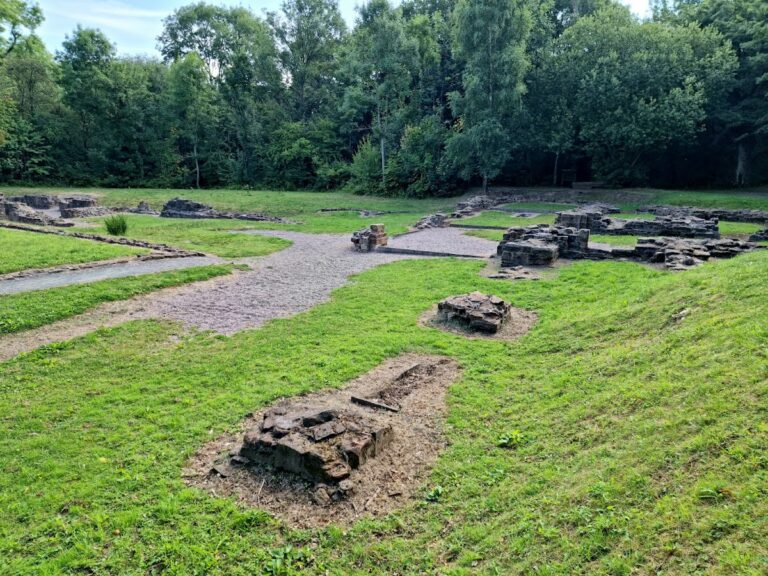
The surviving site is organized around the foundations of a medieval manor enclosed by a curtain wall and a moat. Between 1200 and 1260, the complex comprised a large timber and later stone hall, with a kitchen on the south side. By 1424, the rebuilt manor followed a broader arrangement that included a great hall, kitchen, and chapel within the defended enclosure.
The moat was supplied originally by the southern source of a tributary of the Bourn Brook, which runs near Weoley Castle. It has since been drained. The surviving foundations include those of the wooden kitchen demolished in 1260, preserved by waterlogging. Waterlogging can protect buried timber by limiting oxygen and slowing decay. The brick wall along the right-hand arm of the moat and several apple trees survive from the later farmhouse built beside the ruins.
Excavated structures and objects
Walls, altar, and stone buildings
Excavations uncovered the curtain wall, the remains of an altar, and the outlines of all the stone buildings. These remains define the principal medieval structures and show how the hall, kitchen, and chapel were arranged within the enclosed manor. The buildings combined timber and stone construction, with weatherboarding used as exterior cladding on some structures.
Recovered domestic and chapel material
Coins found during excavation date from 1210 to 1483. Other recovered material includes pottery and glassware from across Europe, a fourteenth-century chess piece, and glass and floor tiles associated with the chapel. Together, these objects illuminate the household’s connections, activities, and religious furnishings across the later medieval period.
Nearby sites