Church of St John the Baptist, Bromsgrove: A Medieval Parish Church


Site at a Glance
- Rating
- 4.4
- Popularity
- Very Low
- Country
- United Kingdom
- Primary era
- Medieval
- External website
- Open
- Eras represented
- Medieval
- Civilizations
- English
- Site type
- Religious
- Remains
- Church
On this page8 sections
History
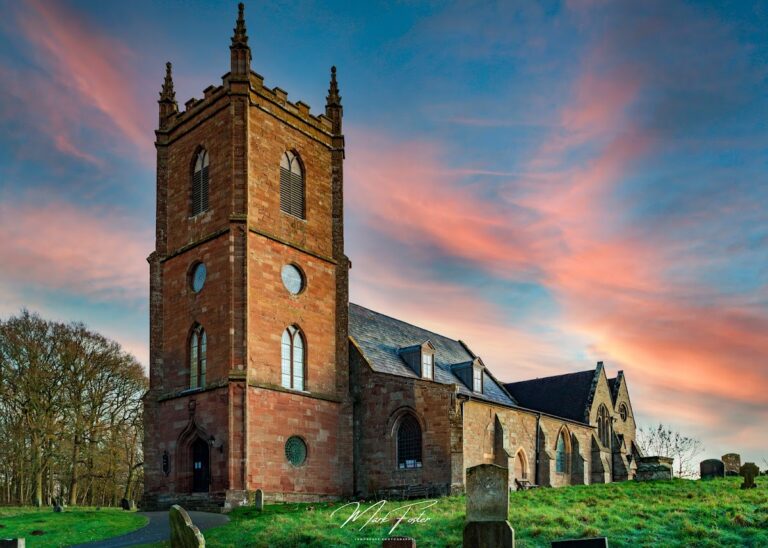
The Church of St John the Baptist is a Church of England parish church in the United Kingdom, dedicated to St John the Baptist and dating from the twelfth century. It is administered within the Diocese of Worcester, the Archdeaconry of Dudley, and the Bromsgrove Deanery, and was previously Roman Catholic. Although the building began in the twelfth century, most of its surviving fabric belongs to the fourteenth and fifteenth centuries.
Royal patronage and monastic administration
During the early Norman period, the church served a particularly large parish. Henry III, king of England from 1216 to 1272, arranged for the church and its lands to be granted to Worcester Priory. The grant supported remembrance of his father, King John I, who ruled from 1199 to 1216 and was buried at Worcester Cathedral. Worcester Priory administered the manor and collected its rents and other income until the Dissolution of the monasteries. After that change, the lands passed to the new Dean and Chapter.
Religious disputes in the seventeenth century
In February 1643, during the reign of Charles I, the king ordered the removal of Bromsgrove vicar John Hall as a rebel. Disputes over the vicarage continued during the Interregnum, the period without a monarchy after Charles I’s execution, and the Protectorate, the republican government led first by Oliver Cromwell and then by Richard Cromwell. Hall returned as vicar and remained in office until 1652.
Hall’s successor, John Spilsbury, had been a fellow of Magdalen College and was unpopular with some Bromsgrove churchgoers, who tried unsuccessfully to remove him. Following the Restoration of the Monarchy in 1660, Spilsbury was removed. He refused to conform to the Act of Uniformity of 1662, which required ministers to follow the Church of England’s authorized forms of worship, and left the established church with about 2,000 other ministers from the Commonwealth period. He was confined to his house, banished from the county, and later imprisoned for nonconformity. Spilsbury eventually returned to Bromsgrove, received annual visits from Hall’s son John, an Anglican bishop, and in 1672 was licensed as a Congregationalist teacher in Bromsgrove. He died in 1699.
Restoration and continuing commemoration
The church was restored in 1858 by George Gilbert Scott, a prominent English Gothic Revival architect. Two years earlier, in 1855, Holy Trinity Church at Lickey had been built as a chapel of ease, a church serving parishioners who lived at a distance from the main parish church. The church’s bells are recorded from the 1690s, while the first recorded mention of a clock dates from 1684.
A memorial to Bishop John Hall stands inside the church, and the eighteenth-century antiquarian Treadway Nash recorded that a memorial to Hall’s father was also present there. The church became a Grade I listed building on 28 April 1952. Grade I is England’s highest level of statutory protection for buildings of exceptional architectural or historic interest.
Remains
Medieval fabric and monuments
The surviving church combines its twelfth-century origins with predominantly fourteenth- and fifteenth-century construction. The north chapel contains alabaster monuments from the thirteenth century and the early sixteenth century. Alabaster, a soft stone widely used for medieval and early modern English monuments, also forms an effigy in the chancel dated 1517.
Memorial and organ
Inside the church, a large cast-metal memorial commemorates Bromsgrove men killed in the First World War. Its inscriptions include Captain Noel Chavasse, VC and Bar, MC, who lived from 1884 to 1917. Chavasse was a British medical officer and Olympic athlete, and received the Victoria Cross twice. The church also preserves a pipe-organ tradition that began with a small organ installed by Thomas Elliot in 1808. Bishop Simms gave the opening recital. Later rebuilding and renovation produced the present three-manual and pedal organ, made largely by the Malvern firm of Nicholson.
Churchyard burials
The churchyard contains the graves of engine driver Thomas Scaife and fireman Joseph Rutherford, who died when a locomotive boiler exploded at Bromsgrove station on 10 November 1840. Their graves lie side by side, and their gravestones carry reliefs of steam locomotives. The locomotive involved in the explosion was experimental and was not one of the types represented on the stones.
The church is also associated with the burials of Sir Humphrey Stafford and his wife Eleanor; Gilbert Talbot and his first wife, Lady Elizabeth Talbot, who died in 1490; John Talbot, who died in 1549, and his wives Margaret Troutbeck and Elizabeth Wrottesley; and Ralph Greystoke, 5th Baron Greystoke.