Hagia Sophia: A Medieval Orthodox Cathedral in Thessaloniki


Site at a Glance
- Rating
- 4.8
- Popularity
- Medium
- Country
- Greece
- Primary era
- Medieval
- External website
- Open
- Eras represented
- Medieval, Early Modern
- Civilizations
- Byzantine, Ottoman
- Site type
- Religious
- Remains
- Cathedral
On this page10 sections
History
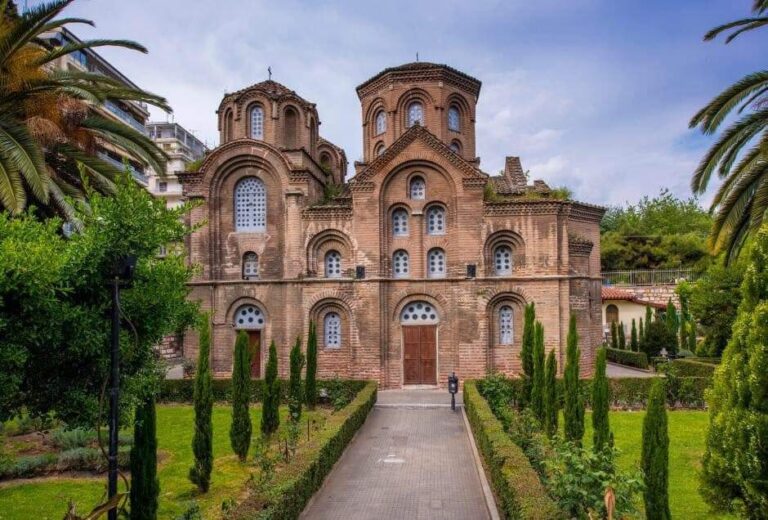
Hagia Sophia is a medieval Orthodox cathedral in Thessaloniki, Greece, built by the Byzantine civilization between approximately 690 and 730 in a late seventh- to early eighth-century architectural setting. Dedicated to Holy Wisdom, a Christian reference to divine wisdom rather than to a female saint named Sophia, it remains an active cathedral under the Greek Orthodox Church and the Ecumenical Patriarchate of Constantinople. Its annual feast is celebrated on 14 September, the Feast of the Exaltation of the Holy and Life-Giving Cross.
An earlier Christian complex
A large five-aisled basilica dedicated to Saint Mark stood on the site during the first half of the fifth century. Saint Mark is traditionally regarded as the author of the Gospel of Mark and one of the four canonical evangelists. Alongside adjacent buildings, the basilica formed a religious complex covering more than 8,000 square metres. An earthquake probably destroyed it around 618 to 620.
The present church rose over the earlier basilica’s ruins during the reign of Emperor Leo III the Isaurian, whose rule was associated with the first imperial phase of Byzantine Iconoclasm. This was a controversy over the legitimacy of venerating religious images. The church’s restrained figural decoration reflects the period’s preference in some settings for crosses and ornamental designs. Its first written mention appears in a letter written in 795 by Theodore the Studite, a Byzantine monk, theologian, and monastic reformer.
Byzantine cathedral and periods of change
During the Byzantine period, administrative and religious buildings surrounded the church. By the tenth century, Hagia Sophia was considered one of Thessaloniki’s prominent churches and had become the cathedral of the Thessaloniki diocese. It served as the city’s metropolitan church from 1246, when Thessaloniki came under the Empire of Nicaea, until its conversion into a mosque in 1523 or 1524.
The Fourth Crusade captured Thessaloniki in 1204, and Hagia Sophia then became the Catholic cathedral of the Kingdom of Thessaloniki. This arrangement ended in 1224, when forces of the Despotate of Epirus took the city. The building subsequently returned to Orthodox episcopal use. Archbishop Gregory Palamas, a fourteenth-century Byzantine theologian and archbishop who later became a major saint of the Greek Orthodox tradition, was buried there in 1357.
Ottoman and modern history
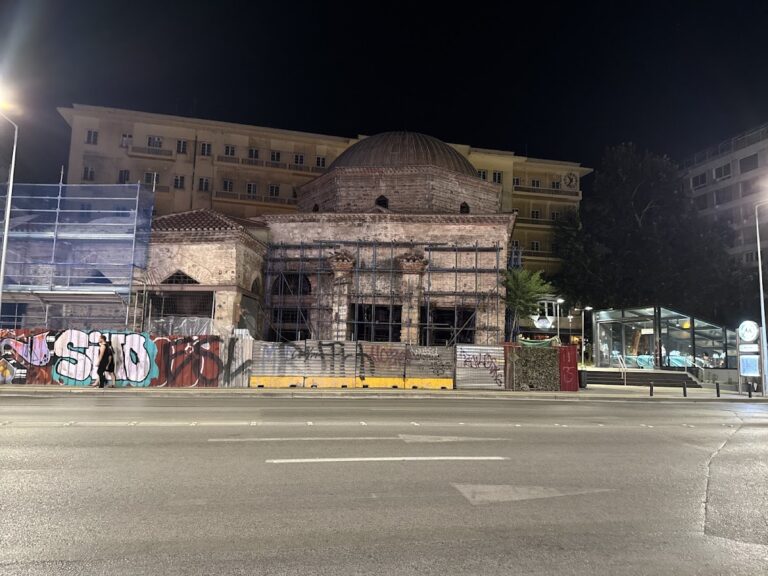
After the Ottoman conquest of Thessaloniki, Ibrahim Pasha Pargalı, an Ottoman statesman and grand vizier, oversaw the church’s conversion into a mosque in 1523 or 1524. The exterior was altered, the bell tower became a minaret, and a second Ottoman-style minaret was added later. In 1890, a major fire badly damaged the building while it was still a mosque. Restoration between 1907 and 1909, directed by the Byzantine scholar Charles Diehl, repaired the damage and led to the discovery of the dome mosaic. Diehl also directed work on other surviving interior surfaces.
Thessaloniki passed to Greece during the First Balkan War in 1912. Hagia Sophia returned to Christian worship, its Ottoman minarets were demolished, and the bell tower was restored to an earlier appearance. On 29 June 1913, Metropolitan Gennadios Alexiadis of Thessaloniki, together with the metropolitans of Kampania and Amisos, reconsecrated it for Orthodox worship.
In 1917, an archaeological commission established a collection in the church courtyard and brought architectural fragments from across Thessaloniki into it. The collection included numerous sculptural works, some of which were later transferred to the Rotunda of Saint George. A 1978 earthquake caused serious damage, followed by restoration lasting about twenty years. The dome was restored in 1980, and archaeological excavations took place within the church and around it.
Hagia Sophia was placed on Greece’s World Heritage candidate list in 1987 and recognized as a candidate in September 1988. Later that year, it was inscribed within the UNESCO World Heritage property “Paleochristian and Byzantine Monuments of Thessaloniki,” under identification number 456 and criteria (i), (ii), and (iv). The church is also protected as an archaeological site in Greece, while the wider World Heritage property covers 5.327 hectares.
Remains
Plan and structure
The church is approximately 42 metres long and 35 metres wide. Its design combines a domed basilica with features of a cross-domed church and a three-aisled basilica. The central columns are pushed outward, allowing the main space to form an isosceles cross. This arrangement represents a transition between the domed basilica and the inscribed-cross church, a more compact Byzantine plan that became dominant from the tenth century onward.
The dome is about 10 metres across, and the cross above it rises roughly 16 metres from the ground. Pendentives, curved triangular surfaces that transfer the dome’s weight onto its supports, carry the dome above the columns. The building has three aisles, although the side aisles do not align directly with the apses. A rectangular drum, the structural section supporting the dome, stands above the lower supports, while semi-cylindrical vaults carry the main dome. Its nearly square form, rounded at the corners, and other irregularities have been interpreted as signs that the architect was adapting the basilican form to a newer design. The church also revives sixth-century traditions and has been compared with Hagia Irene in Constantinople and with a Constantinopolitan building commissioned under Emperor Justinian I.
Later additions and surviving surfaces
An extensive western narthex, or entrance hall, was added during an eleventh-century rebuilding. The earlier entrance gates were dismantled, and frescoes decorated the narthex’s eastern wall. During the Ottoman period, a colonnaded structure replaced the façade. The bell tower was turned into a minaret and another minaret was later built. Interior furnishings were covered with plaster rather than destroyed, a change that helped protect the medieval mosaics beneath the later surface.
Interior decoration and burials
Mosaics and frescoes
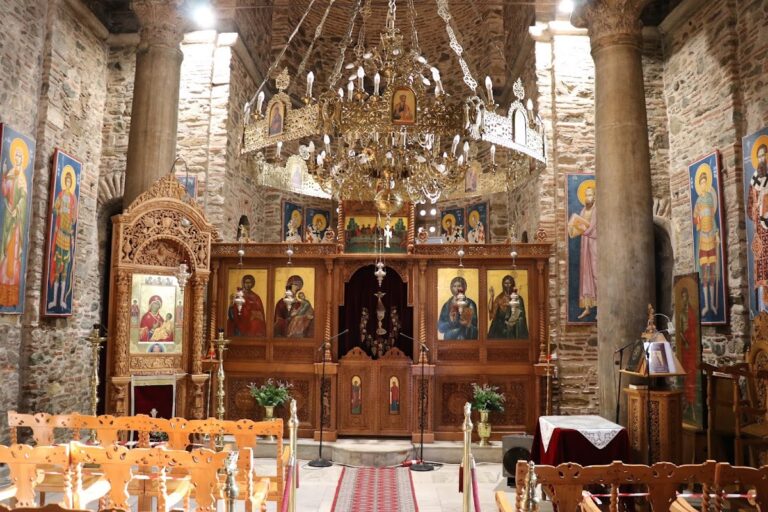
The mosaics belong to three principal periods. Aniconic mosaics, meaning decoration without human or animal figures, survive in the sanctuary vault from the Iconoclast period. A large gold cross once filled the quarter-sphere of the apse, the curved sanctuary ending, before being replaced between 787 and 797 by an image of the Theotokos, a title for the Virgin Mary meaning “God-bearer” or “Mother of God.”
The dome carries an Ascension of Christ mosaic with the inscription, “Men of Galilee, why do you stand looking toward heaven?” from Acts 1:11. The scene includes the Twelve Apostles, the Virgin Mary, and two angels. Its date remains uncertain and has been placed in either the seventh or ninth century. An eleventh-century mosaic survives in the apse, while other frescoes from that century show monks, saints, and Saint Theodora of Thessaloniki near the north entrance. Additional mosaics represent Constantine VI, his mother Irene of Athens, and Theophilos, the bishop and saint of Thessaloniki. A Virgin and Child image dates approximately to the eleventh or twelfth century.
Episcopal burials
In 1981, the remains of Archbishop Basil of Thessaloniki, who dates to the ninth or tenth century, were found behind the choir stalls of the right choir. Their position reflects the practice of burying bishops within cathedral churches.
Nearby sites