Guildhall: The Historic Town Hall of King’s Lynn


Site at a Glance
- Rating
- 4.6
- Popularity
- Low
- Country
- United Kingdom
- Primary era
- Medieval
- External website
- Open
- Eras represented
- Medieval, Early Modern, Modern
- Civilizations
- British, English
- Site type
- Civic
- Remains
- Town Hall
On this page8 sections
History
Guildhall, in the United Kingdom, is the historic town hall of King’s Lynn, built in the fifteenth century for the Guild of the Holy and Undivided Trinity. After an earlier guildhall was destroyed by fire on 23 January 1421, the replacement Stone Hall was constructed between 1422 and 1428 as the meeting place of this religious guild formed by local merchants.
From religious guildhall to civic building
The building’s original purpose changed after King Edward VI’s Reformation-era government suppressed chantries, religious foundations supporting prayers and masses, and religious guilds in 1547. In 1571, the eastern part of the undercroft, a vaulted lower floor beneath the main building, was converted into a prison. The western part became a house of correction in 1618, an institution where people were confined and subjected to disciplinary labour.
A western extension with a ground-floor porch was added in 1624. Municipal offices were built farther west along Queen Street in 1895 on the site of a former public house, creating the larger complex now generally known as King’s Lynn Town Hall.
Municipal and judicial use
The complex remained the meeting place of King’s Lynn Borough Council until 1974. It then became the headquarters of West Norfolk District Council, which was renamed King’s Lynn and West Norfolk Borough Council in 1981. The council moved its main offices to King’s Court on Chapel Street that year but continued to use the town hall for meetings. Magistrates’ court hearings continued at the Guildhall until the courts moved to a new courthouse in College Lane in 1982.
Extensive restoration was completed in 2017. The Guildhall is a Grade I listed building, while the 1895 extension has a separate Grade II listing. These designations recognise the historic and architectural value of the different parts of the complex.
Remains
Stone Hall and later extensions
The medieval Stone Hall
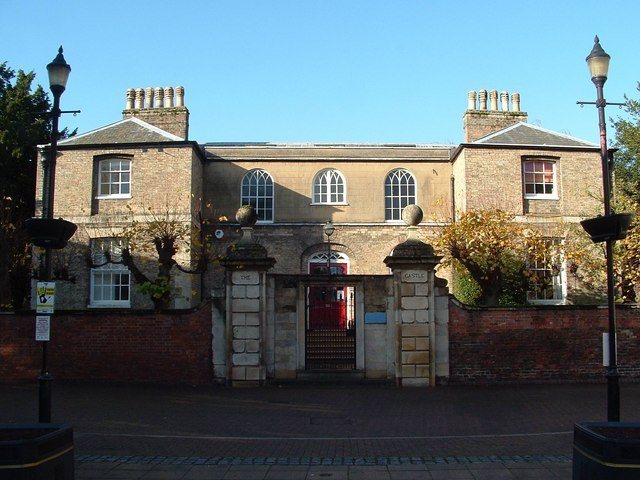
The original Stone Hall forms the medieval core of the complex. Its surviving architecture includes a steeply arched roof, a large window, and an exterior arranged in a chequered pattern. At the eastern end, the Guildhall is attached to 10–11 Saturday Market Place, a seventeenth-century building that forms part of the surviving group.
The western porch and municipal offices
The 1624 western porch extension repeats the chequered exterior pattern of the Stone Hall. In the same year, the arms of Elizabeth I, removed from St James’ Church, were placed above the main window over the porch. The arms of Charles II were added to the gable in 1664. Farther west, the 1895 municipal-office extension runs along Queen Street and completes the larger town-hall complex.
Objects preserved in the Guildhall
The building contains the charter granted by King John to the burgesses of Lynn, dating to about 1204. Other historic objects include the medieval King John’s Cup, dating to about 1325, a fifteenth-century window sill from the house of Walter Coney, a former mayor of Lynn, and the first portrait painted of King George VI and Queen Elizabeth, dating to about 1937. George VI was king from 1936 to 1952, and Queen Elizabeth later became known as the Queen Mother.