Burgruine Flügelsberg: Ancestral Castle of the Schenken of Flügelsberg


Site at a Glance
- Rating
- 4.6
- Popularity
- Very Low
- Country
- Germany
- Primary era
- Medieval
- External website
- Open
- Eras represented
- Medieval, Early Modern
- Civilizations
- Duchy of Bavaria, Holy Roman Empire
- Site type
- Military
- Remains
- Castle
On this page10 sections
History
Burgruine Flügelsberg is a medieval castle ruin in Germany, above Meihern in the Flügelsberg district of Riedenburg, Lower Bavaria. Built as a hilltop fortress during the medieval period, it was the ancestral seat of the Schenken of Flügelsberg, a noble family whose name was connected with the court office of the Schenk, traditionally responsible for serving wine or managing a lord’s beverages. The castle probably existed before 1228, when Lutold Schenk of Flügelsberg witnessed a charter issued by Duke Ludwig I of Bavaria.
The Schenken of Flügelsberg
The Schenken of Flügelsberg were ministeriales, dependent nobles who served a higher lord in military, administrative, or court functions. They served the Counts of Grögling-Hirschberg, whose comital line ended in 1305 with Count Gebhard VII. The family’s coat of arms displayed a pair of wings, a motif associated with the castle and its lords.
In 1290, the castle became involved in a conflict among the Bavarian dukes Ludwig the Strict, Otto, Ludwig, and Stephan of Lower Bavaria. Dietrich I Schenk of Flügelsberg supported Otto, Ludwig, and Stephan, and the castle was badly damaged during the struggle. Later changes in ownership divided the complex between members of the family and their relatives. In 1340 or 1347, Elspet, the widow of Dietrich II, transferred one-third of the castle to her daughter Margareta, who was married to Konrad Muracher. Dietrich III retained the other two-thirds, and the castle experienced a period of prosperity under his ownership. After his death in 1403, the Murachers acquired those two-thirds in 1410.
Conflict with Nuremberg
The Murachers of Flügelsberg became associated with raids on merchant caravans travelling through the Altmühl Valley. Their attacks and plundering brought them into conflict with the Imperial City of Nuremberg, a self-governing urban power within the Holy Roman Empire. In 1446, Nuremberg mounted a campaign against Flügelsberg and other castles associated with raiding nobles in the area. Its forces captured the castle and its tower, then sacked and burned the complex. The Chapel of St Thekla was spared during the attack.
The Murachers later rebuilt the castle. Ownership then passed gradually to the Parsbergs. Through a marriage in 1460, they acquired one-third of the property, and through an inheritance in 1480 they obtained the remaining two-thirds. Hans III of Parsberg had married Sidonia of Murach in 1460, linking the two families directly.
The Löwler War and later ownership
The Parsbergs of Flügelsberg and Lupburg supported nobles who rebelled against Duke Albrecht IV of Bavaria during the Löwler War, a late-fifteenth-century revolt by Bavarian nobles against the duke. Albrecht attacked Flügelsberg after the uprising and captured it following fierce resistance in early January 1492. Hans of Flügelsberg and Georg of Lupburg were taken prisoner and held in Munich until May of that year. The castle was stripped and burned.
Reconstruction was authorized later in 1492. Views from 1568 and 1701 show the rebuilt castle on the summit. From the sixteenth century, however, the Parsbergs lived below Flügelsberg as the “Lords of Meyern,” using a former farm estate that had been converted into a manor house. Virtually nothing of that manor survives. The male line of the Parsbergs ended in 1579 with Joachim von Parsberg. Flügelsberg and Meihern then passed through marriage to the barons von Seyboltsdorf, who retained them until 1648.
Decline and later preservation
Johann Erhard Muggenthal renovated the former Chapel of St Thekla in 1680, after the castle had undergone a prolonged period of decline. The chapel was abandoned during the eighteenth century. In 1760, an unnamed sculptor from Neuburg an der Donau supplied it with a crucifix and two altar candlesticks. The castle building reconstructed on the summit during the sixteenth century collapsed in the nineteenth century.
The history of the Flügelsberg family also survives beyond the castle itself. Members of the family were buried in the Church of St John the Baptist at Altmühlmünster Monastery, where two fourteenth-century grave slabs associated with them remain. The castle site is protected both as an archaeological monument for subterranean remains in the area of the medieval ruins and as a listed architectural monument.
Remains
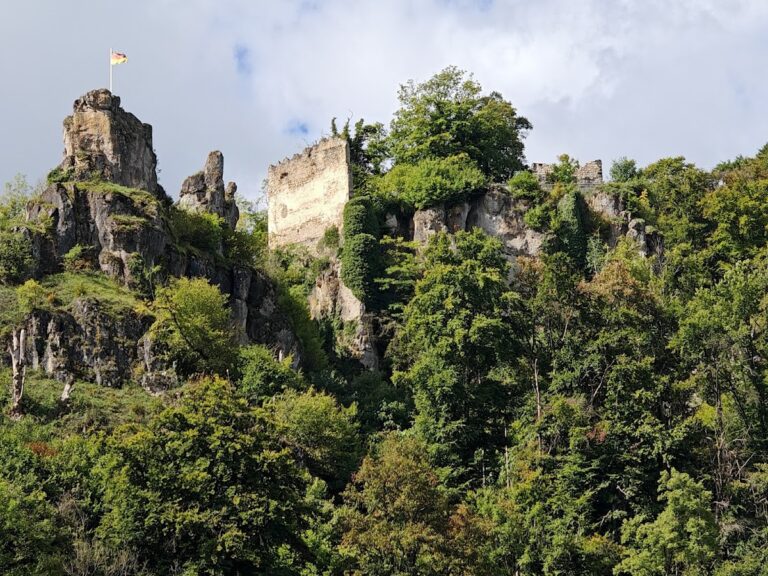
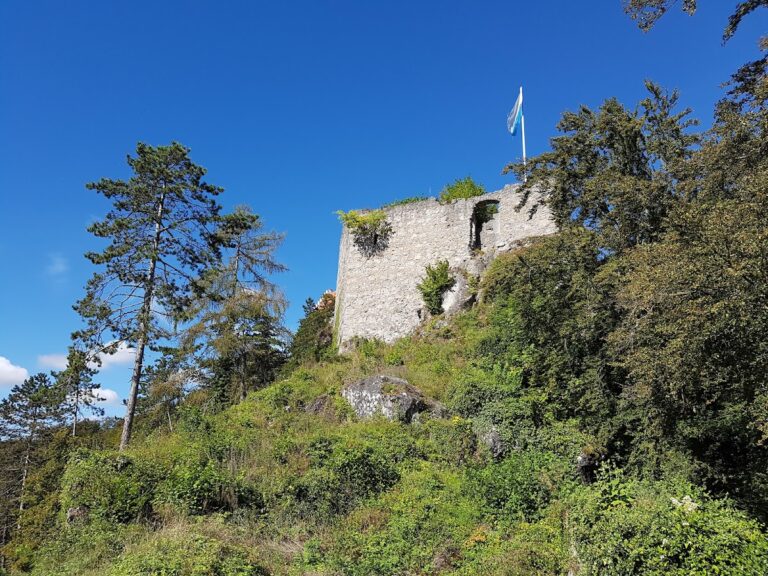
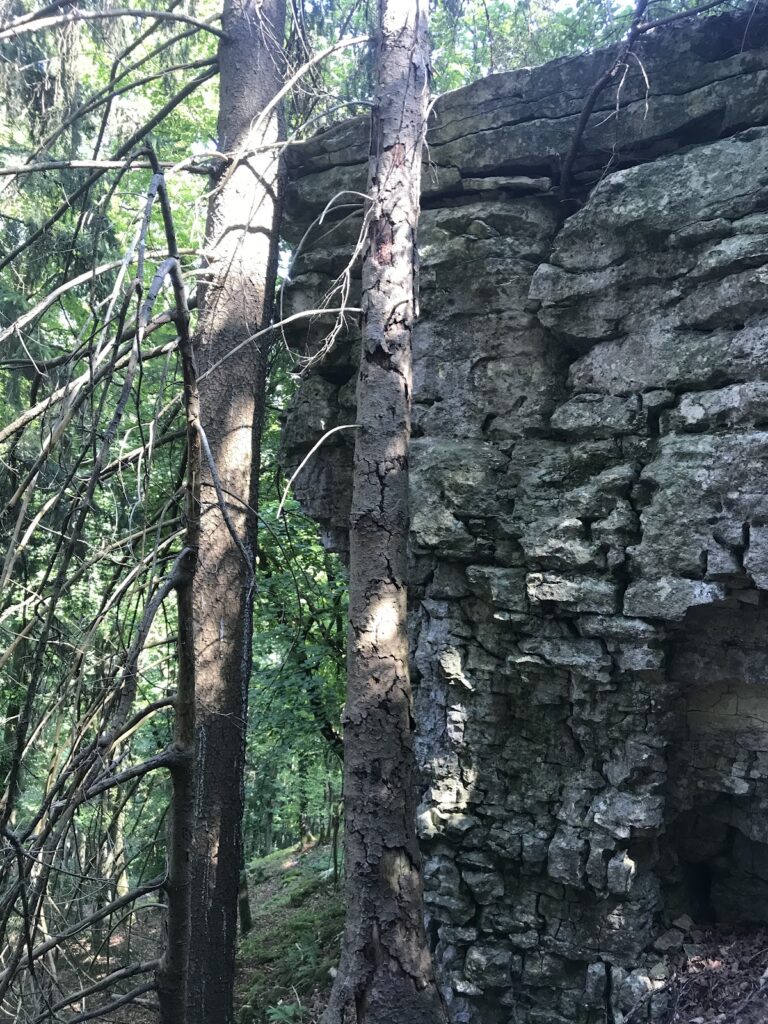
Flügelsberg is a spur castle, a fortified site built on a projecting ridge or rocky spur that uses steep natural slopes as part of its defenses. The castle occupied a rocky summit about 470 metres above sea level. The summit projects southwest into the Altmühl Valley and lies west of the Flügelsberg settlement, above Meihern. The complex covered approximately 70 by 90 metres. Its surviving layout is defined chiefly by three section ditches, which were defensive cuts across the approach to the projecting spur, together with fragments of an enclosing ring wall and other wall remains.
Defensive earthworks and walls
The three section ditches divide the castle summit from the approach and express the defensive organization of the site. A ring wall enclosed the castle complex, while additional fragments preserve parts of the medieval masonry. The surviving stonework dates from the twelfth century and probably also from the sixteenth century, reflecting the castle’s earlier construction and later rebuilding. These remains occupy the rocky summit that formed the core of the former fortress.
Tower and summit buildings
The castle included a tower that was captured and burned during the Nuremberg campaign of 1446. It was part of the complex attacked alongside the other castle buildings, while the Chapel of St Thekla was spared. A castle building reconstructed on the summit in the sixteenth century is shown in views dated 1568 and 1701. That building later collapsed during the nineteenth century, leaving the summit ruins as the principal physical evidence of the castle’s later form.
Chapel of St Thekla
The Chapel of St Thekla served as the castle chapel and survived the destruction of 1446. Johann Erhard Muggenthal renovated it in 1680, and it was later abandoned during the eighteenth century. In 1760, a sculptor from Neuburg an der Donau provided a crucifix and two altar candlesticks. The chapel’s present condition is not established.
Family memorials at Altmühlmünster
Two fourteenth-century grave slabs connected with the Flügelsberg family are preserved in the Church of St John the Baptist at Altmühlmünster Monastery. They are associated with the castle’s former lords and provide surviving material evidence of the family’s burial connections beyond the hilltop site.
Nearby sites