Mas-d’Azil Cave: A Prehistoric Site in France
Site at a Glance
- Popularity
- High
- Country
- France
- Primary era
- Stone Age
- Eras represented
- Stone Age, Modern
- Civilizations
- French
- Site type
- Domestic
- Remains
- House
On this page17 sections
History
Prehistoric occupation
Mas-d’Azil Cave, a prehistoric site in the Plantaurel massif of France, lies about 1 km south of the village. People occupied it during the Aurignacian, Solutrean, Magdalenian, Azilian, and Neolithic periods. Use was brief in the first two periods and more sustained later.
The Aurignacian, Solutrean, and Magdalenian belong to the Upper Palaeolithic, the later part of the Old Stone Age. The Azilian is an Epipalaeolithic culture, a late Palaeolithic tradition around the transition to the Mesolithic. It took its name from the cave and is dated to about 12,000–9,500 years BP. In archaeological dating, BP means “before present,” counted from 1950. The Azilian falls between the Magdalenian and Mesolithic and spans the transition from the last glacial hunters to the first Neolithic groups.
Religious use and seventeenth-century conflict
In the third century, persecuted Christians established a place of prayer in the cave. It may also have provided shelter for Cathars, a medieval Christian movement distinct from the Roman Catholic Church, during the thirteenth century, although this remains uncertain.
Protestants took refuge inside during the unsuccessful 1625 siege of Mas-d’Azil, led by Marshal de Thémines, a senior French military commander. The Peace of Alès, a settlement between the French crown and Protestants, required the cave’s fortifications and the ceiling of its Temple Room to be destroyed. The fortifications were demolished in 1632.
Road construction and nineteenth-century research
Construction of an imperial road along the Arize began in 1857 and greatly altered the cave, shifting large amounts of sediment. Archaeological remains were exposed on the river’s right bank. Jean-Jacques Pouech studied the cave for nearly forty years, from the late 1840s to the late 1880s, primarily in search of fossil bones. He surveyed its full extent and called the Theatre Room the “reindeer stable.”
Félix Garrigou visited in 1862 and published an article in 1867 that helped bring the cave to wider attention in France. After a flood of the Arize in 1875, Félix Régnault and Tibulle Ladevèze organized further excavations. From 1887 to 1894, Édouard Piette explored the Rotunda and the furnace now called Piette’s Furnace. He developed a prehistoric chronology based on changes in artistic production and introduced the name Azilian. Henri Breuil later examined the cave art in the early twentieth century but did not establish its age.
Twentieth-century use and archaeological work
Marthe and Saint-Just Péquart resumed research in the mid-twentieth century. In 1937, they explored the Flint Gallery and identified a Magdalenian habitation site. From the mid-1930s into the 1950s, Joseph and Marthe Mandement cleared galleries and cavities on the cave’s right bank, including previously unexplored spaces. Their work revealed the Bear Gallery, and in 1948 they found the skull later called Magda.
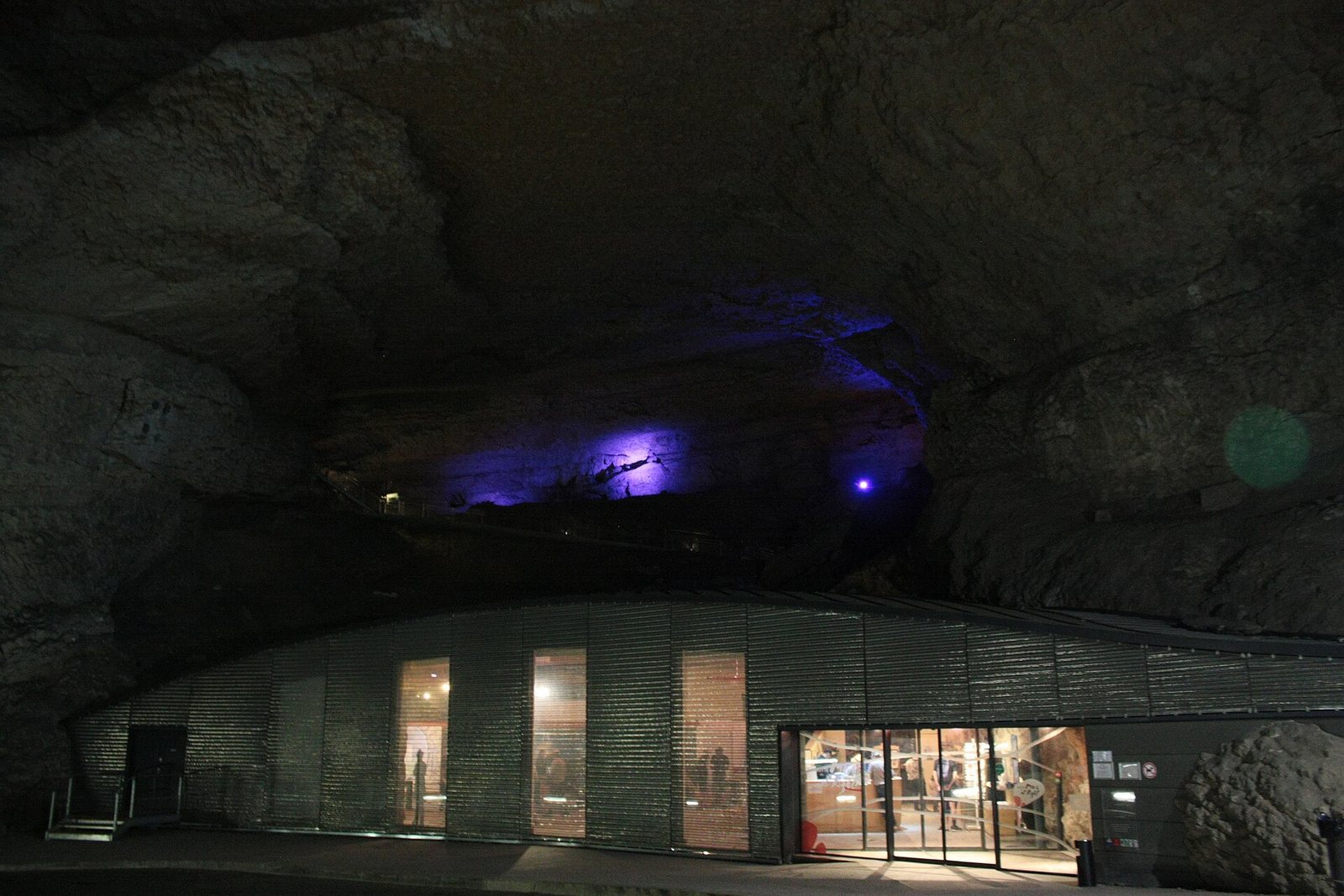
On 1 June 1940, the cave was requisitioned for the Société nationale des constructions aéronautiques du Midi, an aircraft manufacturer formerly known as Dewoitine. The company planned to make aircraft parts there, and levelling, building, and lighting work began. Work stopped in early July after France’s defeat. German occupying forces later considered aircraft-repair workshops in the cave alongside a planned Junkers factory at Bédeilhac. The project was abandoned by spring 1944 after French authorities objected, chiefly because it would obstruct traffic. The cave was also used to store and repair aircraft. It was classified as a historic monument in 1942 and as a protected site in 1943.
After the Second World War, an influx of holidaymakers encouraged by Popular Front policies helped prompt tourist improvements, including the installation of electricity. André Alteirac carried out excavations and studies in the 1960s and 1970s. In 1977 he invited Denis Vialou to study the art in the Breuil Gallery, and in 1981 he established the Museum of Prehistory in the village. François Rouzaud prepared a cave plan for the Ministry of Culture in the 1980s, but the work remained unfinished after his death.
Preventive excavations carried out during works from 2011 to 2013 exposed Aurignacian habitation remains dating to about 35,000 years BP. Since 2013, a research team coordinated by Marc Jarry, Laurent Bruxelles, Céline Pallier, and François Bon has surveyed the cave and surrounding massif through mapping, geological study, and archaeological research. The creation of the Pyrénées Ariégeoises Regional Natural Park in 2009 also brought the surrounding area under the park’s protective rules.
Remains
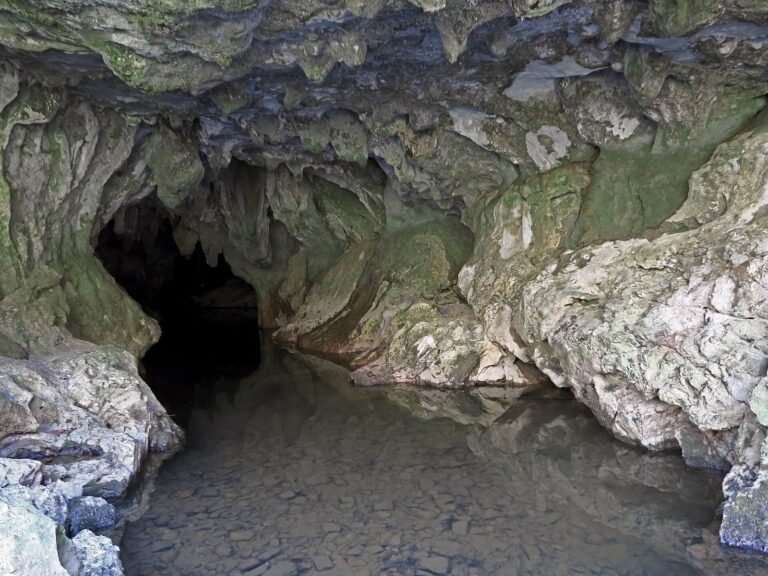
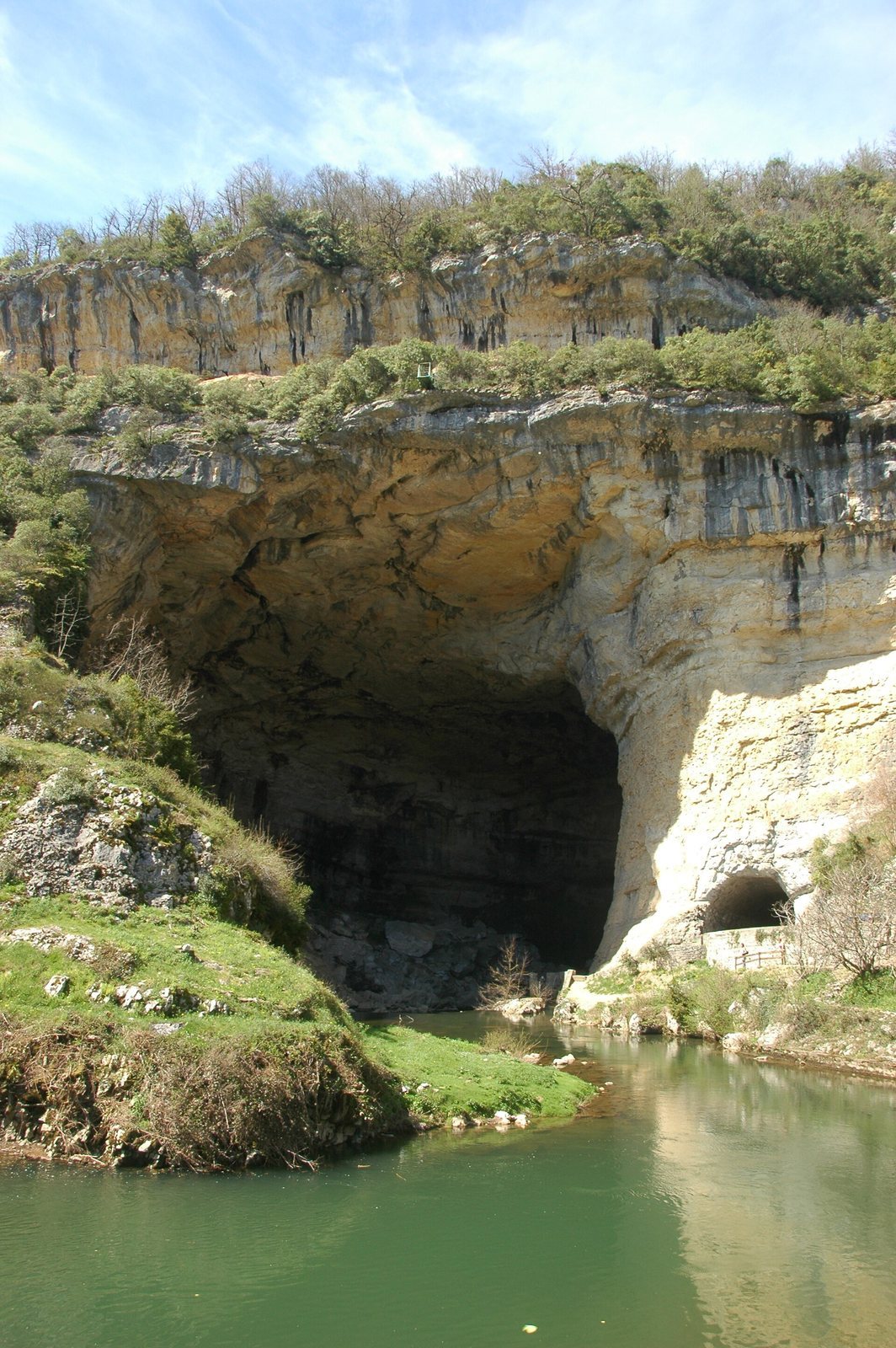
The Arize flows through the cave, which occupies the river’s eastern bank. Its principal natural tunnel is about 450 m long and 30–50 m wide; the D119 road passes through it and follows the river for about 410 m. The southern entrance, called the Porte de l’Arize, forms a porch about 51 m high and 48 m wide, at an elevation of roughly 370 m. At the northern entrance, the river re-emerges. The cave’s known passages extend for about 2,100 m, with galleries at several levels on either side of the river.
River formation and galleries
The cave opens in Paleocene limestone, and the boundary between the Cretaceous and Paleogene periods can be seen inside. The Arize formed the cave by eroding the limestone: the river once flowed about 60 m above its present level, then cut down into the rock, widened cracks, and removed Cretaceous marl. About 500–600 m of passage are attributed to this erosion. During glacial phases, debris accumulated and could raise the river over its own deposits, blocking the main passage. In warmer intervals, the river cleared the passage and reopened the route. Upper galleries above flood level contain prehistoric habitation remains, while many traces of occupation are thought to remain in sediment near the entrance.
Prehistoric objects
Tools and carved objects
Animal bones from the inner galleries include remains of woolly mammoths, cave bears, and woolly rhinoceroses. Finds also include Magdalenian harpoons, spear-throwers and hooks for spear-throwers, some decorated with animals. A spear-thrower is a handheld device for launching a spear or dart. Azilian finds include small stone tools and flat harpoons; other stone tools include points and borers. Ivory animal figures, engraved or incised bone objects, and unfinished animal heads cut from reindeer shoulder blades add to the range of carved finds. Two Magdalenian human-like figurines include one known as the Venus of Mas-d’Azil.
Magdalenian carvings
The Fawn with Birds is a decorated spear-thrower from the Middle Magdalenian, dated to about 15,000–13,500 years BP. Another carved shoulder-blade fragment shows a hunting scene with a rudimentary human figure. A button bears a female aurochs, an extinct wild cattle species, on one face and her calf on the other. A further spear-thrower has three carved horse heads representing different ages; it was made from wood or deer bone.
Magda
Magda is the label given to a human skull about 14,000–15,000 years old, associated with a Magdalenian IV burial. It had been placed on a narrow rock ledge, resting on a small raised support, with two bone plates inserted into its eye sockets to simulate eyes. The head appears to have been forcibly separated, though whether this happened during life is unknown. Execution is considered unlikely in view of the elaborate burial. The skull was not reconstructed with plaster.
Painted pebbles, pottery, and dolmens
Azilian painted pebbles, a characteristic find, are marked with red ochre, often in circular spots, and date to about 10,000 years ago. The meaning of these markings remains uncertain. Pottery found at the cave entrance includes material attributed to the Gauls. Around the cave stand the Neolithic dolmens of Bidot, Cap-del-Pouech, and Seignas, prehistoric structures made from upright stones supporting a capstone and dating to about 4,000 years ago.
Cave art
Breuil Room
The Breuil Room contains images of bison, horses, deer, and fish, along with a possible feline and geometric signs.
Reindeer Gallery
Numerous animal engravings overlap across the walls of the Reindeer Gallery.
Oven Room
The Oven Room includes a horse’s hindquarters, an ibex head, and a human face shaped along a natural contour of the rock. An engraved vulva lies in a hard-to-reach passage. By 1992, nine human representations had been counted in the cave.
Other images and preservation
Other cave images include mammoths, aurochs, woolly rhinoceroses, bison, horses, deer, and wild boar. A human-like image is known as the “face in the rock.” Bat colonies alter the cave’s climate and trigger chemical reactions that can reshape a gallery and threaten the cave art.