Château de Crampagna: A Medieval Castle Overlooking the Ariège Valley

Site at a Glance
- Rating
- 4.6
- Popularity
- Very Low
- Country
- France
- Primary era
- Medieval
- External website
- Open
- Eras represented
- Medieval, Early Modern
- Civilizations
- French
- Site type
- Military
- Remains
- Castle
On this page13 sections
History
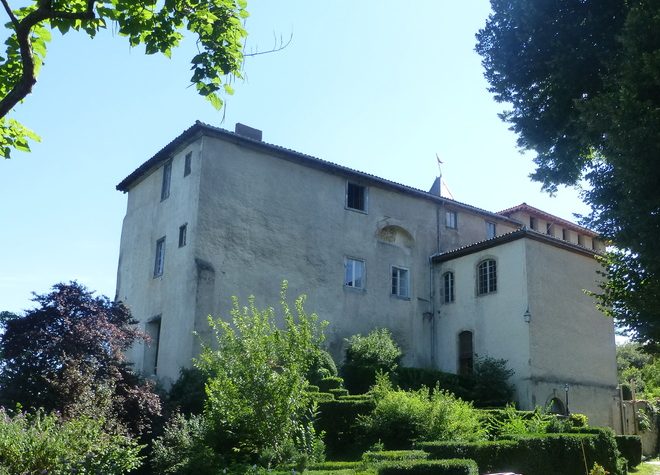
Château de Crampagna is a historic castle in Crampagna, France, overlooking the Ariège valley from a strategically important hill. Its oldest surviving element is a thirteenth-century watchtower built on a rocky outcrop, while later construction in the fourteenth, fifteenth, seventeenth, and eighteenth centuries created the complex seen today. The hill had already been occupied during the Roman period, when its burial mound was levelled.
Medieval origins and expansion
The square watchtower, also known as the watchtower, dates from the thirteenth century and was built with stone from Vernajoul. It served as a lookout and was inhabited by cousins of the Count of Foix. In the fourteenth century, a rectangular building was added to the complex. Its south side contained a semicircular window, while its north side had a trefoil window, an opening shaped with three lobes.
The Pontéjac family oversaw further development in the fifteenth century, when the south and north sides were constructed around the earlier work. These additions formed the castle’s central section. A sixteenth-century building was later attached to the north side, adding another stage to the site’s long architectural development.
Lordship and the Wars of Religion
Crampagna, also known as Crampaignac, passed successively to the Roquefort and Comminges families. During the French Wars of Religion, a series of sixteenth-century conflicts between Catholic and Protestant factions, the castle became the scene of sustained military action. In 1585, the Protestant Audou, identified with Jean-Claude de Lévis-Léran, lord of Bélesta and governor of the County of Foix for Henri IV, captured it. Henri IV was then a Protestant leader who later became king of France and converted to Catholicism.
The lord of Pontégnan later recovered the castle, but fighting directed by Audou and Rieux de Pelleport continued. In 1586, the castle surrendered after 107 cannon shots. Audou’s campaigns continued until 1588, chiefly against the clergy, placing Crampagna within the wider religious and political struggles of the period.
Seventeenth- and eighteenth-century changes
In the first half of the seventeenth century, Raimond de Comminges, Baron of Pontéjac and Arignac, lost the estate after being condemned by the Parlement in 1614. He died either in prison or by execution. The property subsequently passed to François de Minut, Baron of Castéra and seneschal of Rouergue. A seneschal was a senior official responsible for administrative and judicial matters in a territory.
François de Minut’s widow and heir, Anne-Catherine du Bouzet de Roquépine, married Marc-Antoine de Galard-Terraube in 1647. The Galard-Terraube family retained the lordship of Crampagna until the French Revolution. Catherine de Roquépine built a third section in 1712, and the eighteenth-century work gave the castle additional large rooms and open spaces on its south side.
Revolutionary and modern history
After Antonin Galard de Terraube emigrated to the United States, the castle became national property during the Revolution. It was later acquired by Stanislas Proszynski, an engineer in the French Bridges and Roads service who installed most of the railway lines in Ariège. His son, the sculptor Henri Proszynski (1887–1969), lived and worked at the castle intermittently.
The Chanchevrier family purchased Château de Crampagna in 1996, and the property remains privately owned. The building’s archives are held in Pau, in the Pyrénées-Atlantiques. Its facades and roofs entered the register of historic monuments in 1977, and protection was extended to the entire castle in 2015.
Remains
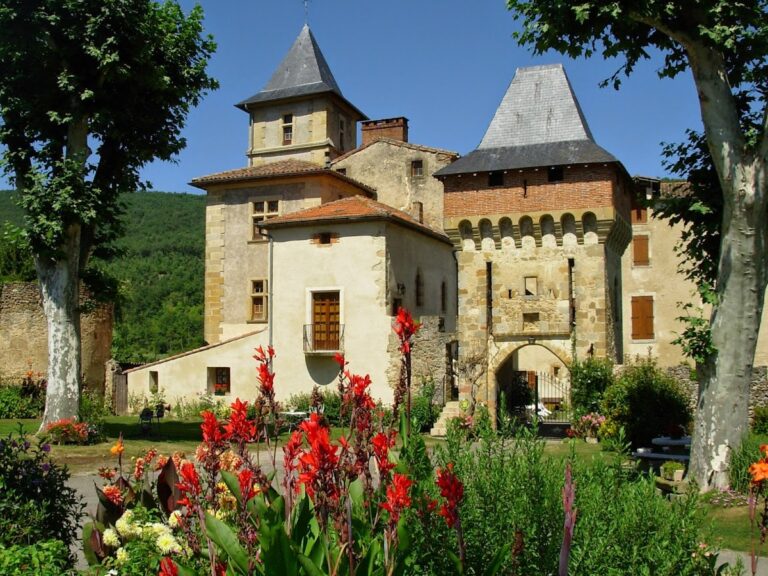
Château de Crampagna occupies a hill above the Ariège valley and is partly built on a rocky outcrop. Its surviving fabric brings together a medieval tower, rectangular and later residential sections, a chapel, defensive features, and elements of the former fortified enclosure. The different materials and forms reflect repeated rebuilding from the thirteenth through the eighteenth centuries.
Medieval and central buildings
Square watchtower
The square watchtower is the oldest part of the castle. Built in the thirteenth century from stone quarried at Vernajoul, it stands on the rocky outcrop and retains the defensive character of the earliest complex. At the corner of the street is the location of the first keep, where a spiral staircase and a dungeon survive.
Fourteenth- and fifteenth-century block
The fourteenth-century rectangular block includes a semicircular window on its south side and a trefoil window on its north side. The south and north sides added in the fifteenth century form the central part of the castle, linking the earlier block with the later sections.
Later additions and religious spaces
Eighteenth-century section
The eighteenth-century section is constructed from large natural stones. On its south side are open spaces dating from the Renaissance, while the interior contains large rooms covered by barrel vaults. These rooms form part of the residential and architectural expansion that followed the castle’s medieval origins.
Chapel
The chapel contains a room with pointed vaulting, formed by intersecting pointed arches, and carved ribs that articulate and reinforce the vault. A Gothic doorway provides access to this part of the complex and preserves a distinct religious element within the castle’s varied architecture.
Defensive remains
A sixteenth-century building adjoins the north building and contributes to the castle’s later defensive and residential arrangement. Among the remains of the old fortified enclosure, an enceinte, or surrounding defensive wall, is a gargoyle. Together with the first keep, the tower, and the rocky foundation, these elements preserve the defensive framework of Château de Crampagna.
Nearby sites