Megalithic Tombs in Haldensleben Forest: Neolithic Burial Monuments in Germany
Site at a Glance
- Popularity
- Medium
- Country
- Germany
- Primary era
- Stone Age
- Eras represented
- Stone Age
- Civilizations
- Unclassified
- Site type
- Burial
- Remains
- Necropolis
On this page13 sections
History
Neolithic communities and tomb building
The Megalithic Tombs in Haldensleben Forest are a group of Neolithic burial monuments spread across about 20 square kilometers in the present-day municipalities of Haldensleben, Hohe Börde, and Altenhausen in Saxony-Anhalt, Germany. Their builders belonged to communities associated with deep-incised pottery, a group within the Funnel Beaker culture, a Neolithic tradition named for its distinctive pottery. The Neolithic was a prehistoric period when farming and settled communities spread through Europe. The tomb group is one of the densest concentrations of megalithic burials in Europe.
A revised inventory counts 78 recognizable tombs and 38 more known from records but destroyed, mainly during the nineteenth and twentieth centuries. Archaeologists have investigated 20 tombs or their remains. Settlements associated with the tomb builders were identified at Probsthorn in 1977 and at Rosmarienbreite, where Philipp Wegener excavated in 1895. The tombs received additional burials and were also used for sacrificial practices during the Neolithic and later periods.
Early surveys and excavations
Research began in the second half of the nineteenth century. The Aller-Verein, founded in 1864, appointed Gustav Maass as its first chairman. In the years that followed, Maass recorded and mapped 50 megalithic tombs and 70 burial mounds, although the results were not published. Wegener excavated at Rosmarienbreite in 1895 and probably investigated seven tombs between 1896 and 1898; only part of his research appeared in print.
Wilhelm Blasius published a systematic survey of 82 tombs in 1902, describing their locations and construction. During the 1930s, Karl Stuhlmann prepared plans for 102 findspots. Eighty-nine of these are now regarded as megalithic tombs, and Stuhlmann assembled his work in a 1934 manuscript. In the same period, Paul Grimm and Franz Niquet excavated DÖN 5 and DÖN 13. Niquet published a brief account of the work at DÖN 5 in 1935.
Quarry investigations and renewed surveys
Quarry expansion led to further investigations. At Dönstedt, Friedrich Schlette, Joachim Preuß, and Alexander Häusler examined DÖN 8 and DÖN 9 in 1958 and 1959. Later, expansion at Bebertal required work on five more tombs, ALV 14, ALV 33, ALV 39, ALV 40, and ALV 42. Preuß directed these investigations from 1966 to 1969, publishing preliminary reports in 1970 and a full account in 1973. Bruno Rahmlow subsequently catalogued 86 surviving and 48 destroyed tombs; his inventory helped support their legal protection. From the 1950s onward, Walter Saal, and from the 1990s Siegfried Kuhnert, assembled plans, sketches, and comparison lists at the State Museum of Prehistory in Halle.
Thomas Witzke and Reinhard Möws created early extensive digital records of the tombs in the 2000s. Between 2009 and 2013, a German Research Foundation program, supported by Germany’s principal research-funding organization, brought together Kiel University and Saxony-Anhalt’s heritage and archaeology office to investigate early monuments and social differences. Work established in 2009 that HUN 15 was a burial mound altered in modern times, not a megalithic tomb. HUN 14, also known as Küsterberg, received extensive investigation in 2010 and 2012–13 under Kay Schmütz. Barbara Fritsch led work at DÖN 10 in 2011–12, and Christoph Rinne directed an investigation of AHA 34 in 2012.
Rinne led surveys of the tombs in 2010–13 and again in 2016. His 2019 publication revised the inventory and removed several locations previously classified as megalithic tombs. Surveys by Matthias Lindemann, Reuter, and Rinne also showed that Steineiche, once treated as two neighboring tombs, is a single monument. In 2014, Karin Schwerdtfeger investigated DÖN 11 because a proposed bypass threatened much of it. The road alignment was moved, but tree-felling indicated that construction would still affect a substantial part of the stone-bounded mound.
Remains
Common form and construction
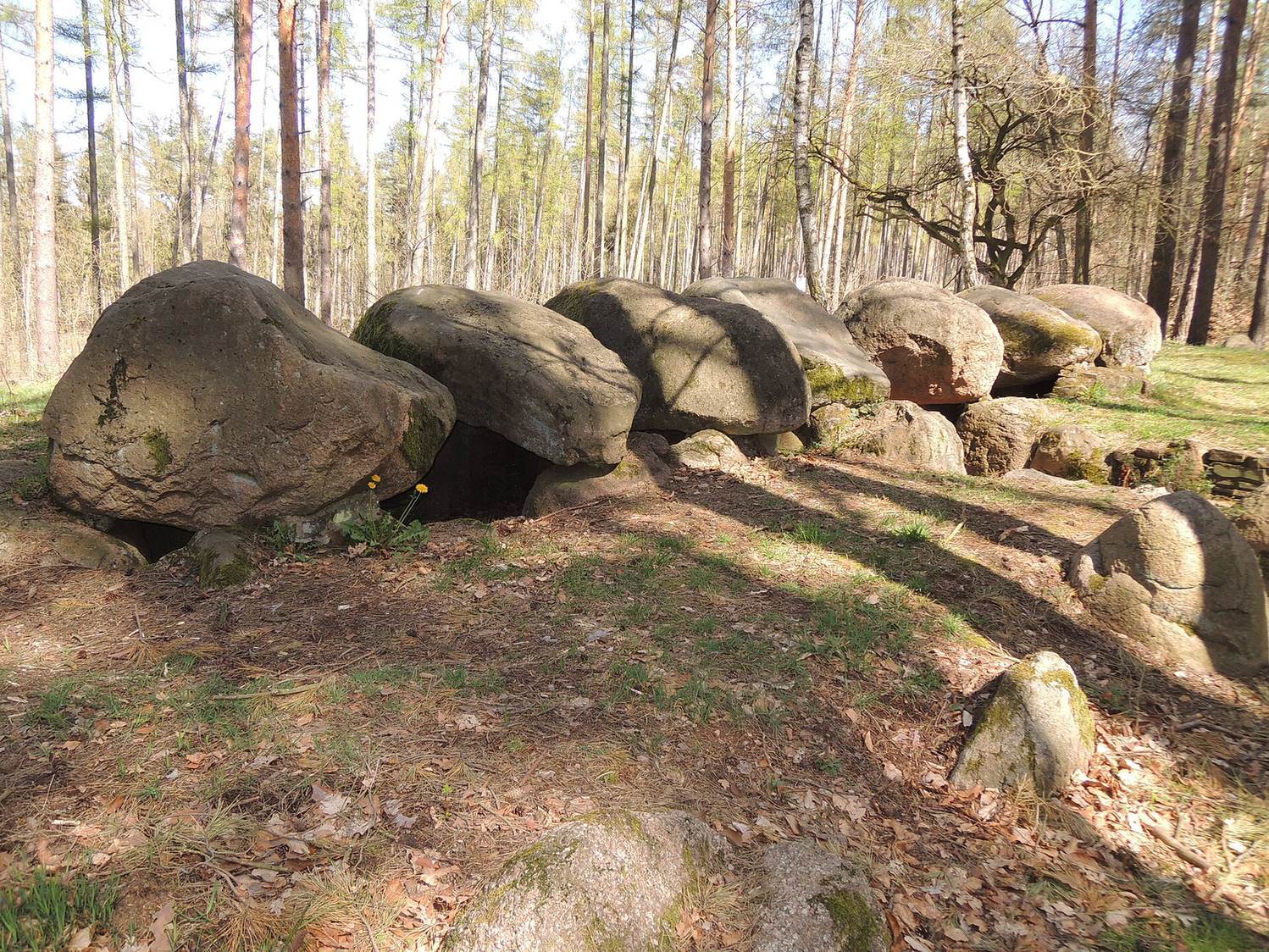
Most tombs are passage graves, burial chambers reached through a passage. Their chambers are generally larger than those in the Altmark, a historic region of northern Saxony-Anhalt. Builders used glacially transported Nordic granite boulders. A chamber commonly has eight or nine pairs of supporting stones, with some reaching twelve pairs, as well as two stones closing its ends. There are often fewer capstones than pairs of supports, so a capstone does not always span each pair.
The chamber mound was usually enclosed by a trapezoidal line of stones, forming a long, stone-bounded mound with the chamber commonly set in its wider end. Most tombs are aligned west to east, although orientations vary. A typical passage began on the south side of the enclosure and entered the chamber slightly off center. Passages were about 2–3 meters long, 0.6 meters wide, and 0.75 meters high; chambers averaged about 1.2 meters in height, with more interior space generally on the west side. Stone slabs paved the floors. Some floors also had a clay or loam layer and gravel, while slab-like masonry filled gaps between wall stones.
Individual tombs
Devil’s Kitchen
The Devil’s Kitchen is an east–west-aligned extended dolmen, a long burial chamber built from upright stones and capstones. Its rectangular chamber measures 6.2 meters long and 3.3 meters wide externally, and 3.7 meters long by 1.42–1.5 meters wide inside. The surviving chamber includes two end stones, four stones along the north side, two along the south, and both capstones. Its entrance is at the southeast corner, with one passage stone standing in front. The tomb was reconstructed in 1992. A stone axe was found nearby in 1950.
King’s Grave
The elevated King’s Grave, south of the forest keeper’s house at Eiche, is among the largest and best-preserved tombs in the area. Its trapezoidal stone boundary runs north-northwest to south-southeast and encloses a mound 33 meters long and 6.1–8.2 meters wide. Most of the perimeter stones survive. The rectangular passage-grave chamber follows the same alignment. It measures 13.5 meters long externally and 10.8 meters internally, with an interior width of 1.5–2 meters. Ten wall stones remain on the eastern side and eight on the western side, along with the end stones; four capstones also survive.
Kitchen Firs
The Kitchen Firs tomb is a reconstructed passage grave enclosed by a stone boundary. Its chamber is longer than that of the Devil’s Kitchen.
Küsterberg
Küsterberg is an elevated, well-preserved tomb with a rectangular enclosure aligned east to west. Its mound measures 30 by 8 meters, while the stone perimeter measures 18.9 by 5 meters. Seven stones remain along the north side and two along the south. The rectangular chamber is 9.3 meters long and 1.1–1.3 meters wide internally. Six northern and nine southern wall stones survive, together with both end stones and five capstones. The entrance lies just west of the midpoint on the south side, where a pair of stones forms the passage. The tomb was investigated in 2010 and 2012–13 and restored in 2025.
Steineiche
Steineiche has a northeast–southwest alignment. Its stone-bounded mound measures 17 by 8 meters and remains 0.5 meters high, with a few boundary stones surviving. The passage-grave chamber is 4.6 meters long and 1.2–1.4 meters wide internally. Five wall stones and two capstones remain.
ALV 31
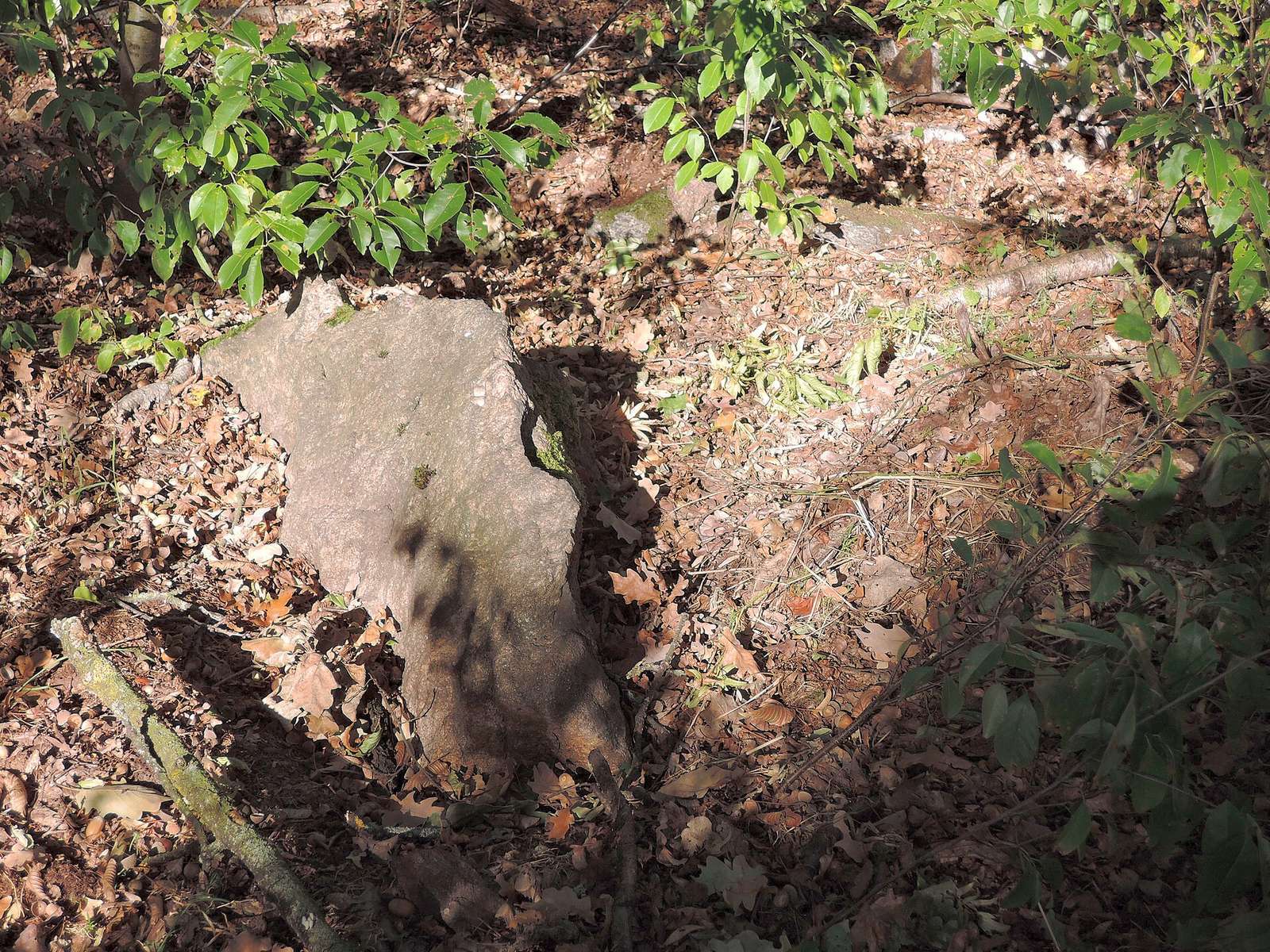
At ALV 31, the mound stands 0.3 meters high. Seven wall stones and one capstone lie in disarray.
Across the group, the condition of the remains ranges from well-preserved tombs to heavily disturbed structures and isolated stones.