Megalithic Tombs near Steinfeld: Middle Neolithic Burial Sites in Germany
Site at a Glance
- Popularity
- Very Low
- Country
- Germany
- Primary era
- Stone Age
- Eras represented
- Stone Age
- Civilizations
- Unclassified
- Site type
- Burial
- Remains
- Tomb
On this page7 sections
History
The Megalithic Tombs near Steinfeld are two surviving Middle Neolithic burial monuments near Steinfeld, in Zeven, Germany, associated with the Funnel Beaker culture and dating to about 3500–2800 BCE. This Neolithic culture takes its name from its distinctive funnel-shaped pottery.
Neolithic tombs and later loss
The original number of tombs is unknown. Several more between Steinfeld and Wilstedt were destroyed during the eighteenth or nineteenth century, leaving two known survivors.
Descriptions and restoration
The antiquarian Martin Mushard first described the graves in the first half of the eighteenth century. He also recounted a story about Justus Kelp, an official from nearby Ottersberg, who ordered several men to dig beneath a monument at Steinfeld. In the tale, Kelp later said that three men appeared to him at night. One had a single eye, and they warned him not to disturb them, saying they had died as heroes for their country and that he would have neither good fortune nor luck if he continued.
By about 1841, Johann Karl Wächter recorded that only two tombs remained. On 29 August 1930, prehistorian Ernst Sprockhoff surveyed them for his atlas of German megalithic tombs and assigned them the numbers 649 and 650.
Tomb 1 was restored in 1983–84, followed by Tomb 2 in 1986–87. The work returned some displaced stones to the chambers and reinstated features of their construction.
Remains
The two tombs stand in separate wooded locations east of Steinfeld. Tomb 1 lies northeast of the village in a group of trees on the east side of Landesstraße 132; Tomb 2 is in Steinfelder Holz, about 950 metres south of Tomb 1. The Nartum megalithic tomb lies about 2.6 kilometres southeast of Tomb 2. Both monuments have stone burial chambers that were likely covered by mounds. Tomb 1 is a passage grave, a burial chamber reached through a passage. A double-edged Funnel Beaker battle axe made from amphibolite was found in a depression in formerly marshy ground about 400 metres from one of the graves, probably Tomb 1. With no known settlement finds from the spot, the axe may have been deliberately deposited in a bog.
The burial chambers
Tomb 1
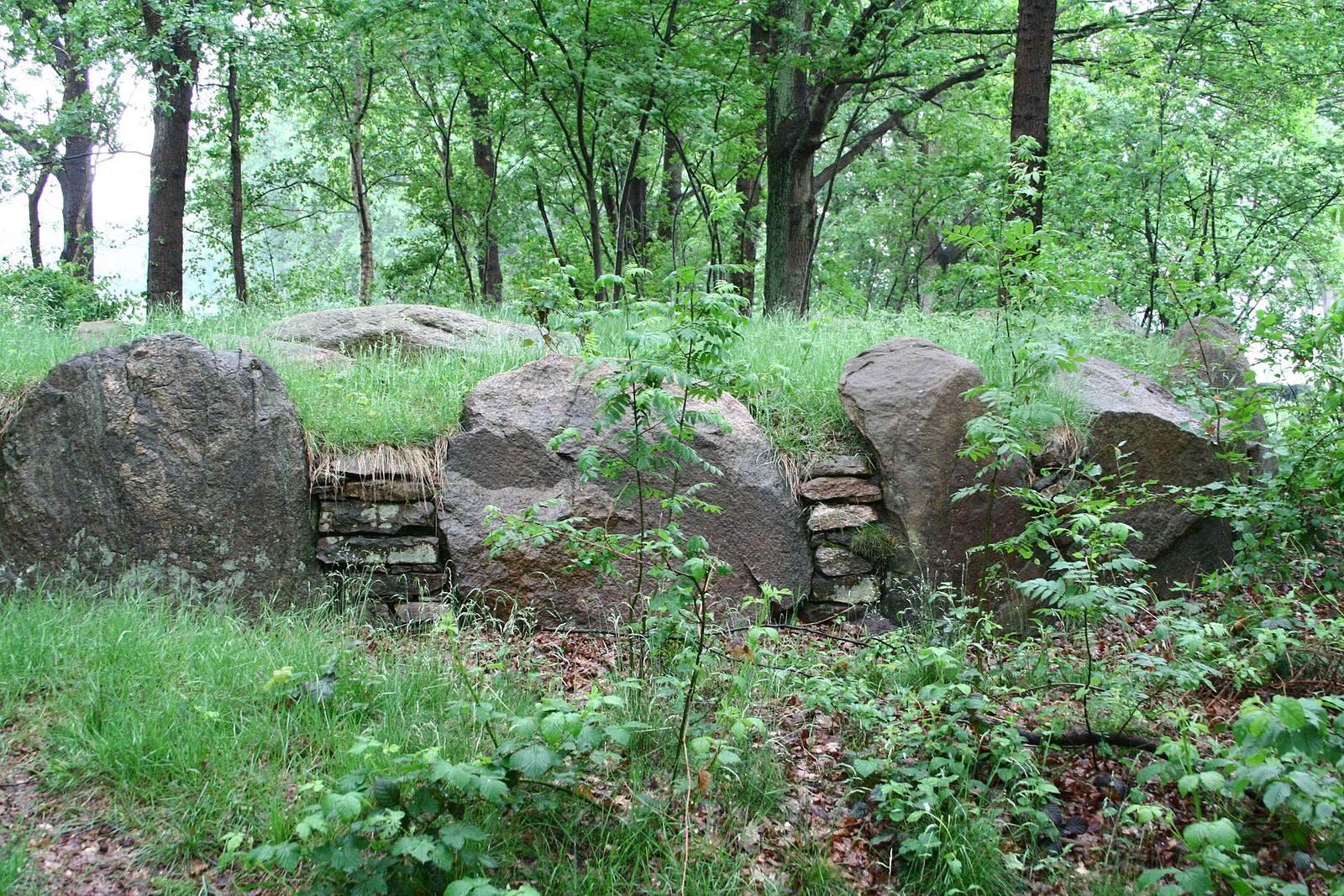
Tomb 1 is a well-preserved chamber oriented northeast–southwest, measuring 5.2 metres long and 1.9 metres wide. Four pairs of upright stones form its long sides, with an end stone at each short end; these stones remain in their original positions. The chamber was once covered by a round mound, an unusual form in the region. Seventeen stones from the mound’s perimeter survive, although only the southwesternmost remains in its original position.
Slabs laid without mortar filled the spaces between the chamber walls and perimeter stones, and restoration reinstated this arrangement. The westernmost wall stone on the northwest side, which Sprockhoff could not locate in 1930, was later reset in its original position. A narrow opening halfway along the southeast side served as the entrance; two of the passage’s original four wall stones remain.
Sprockhoff recorded four capstones in 1930: two still resting on the walls and two fallen inside the chamber. Three are now present, with two on the walls and one beside the chamber. The tomb may originally have had five capstones.
Tomb 2
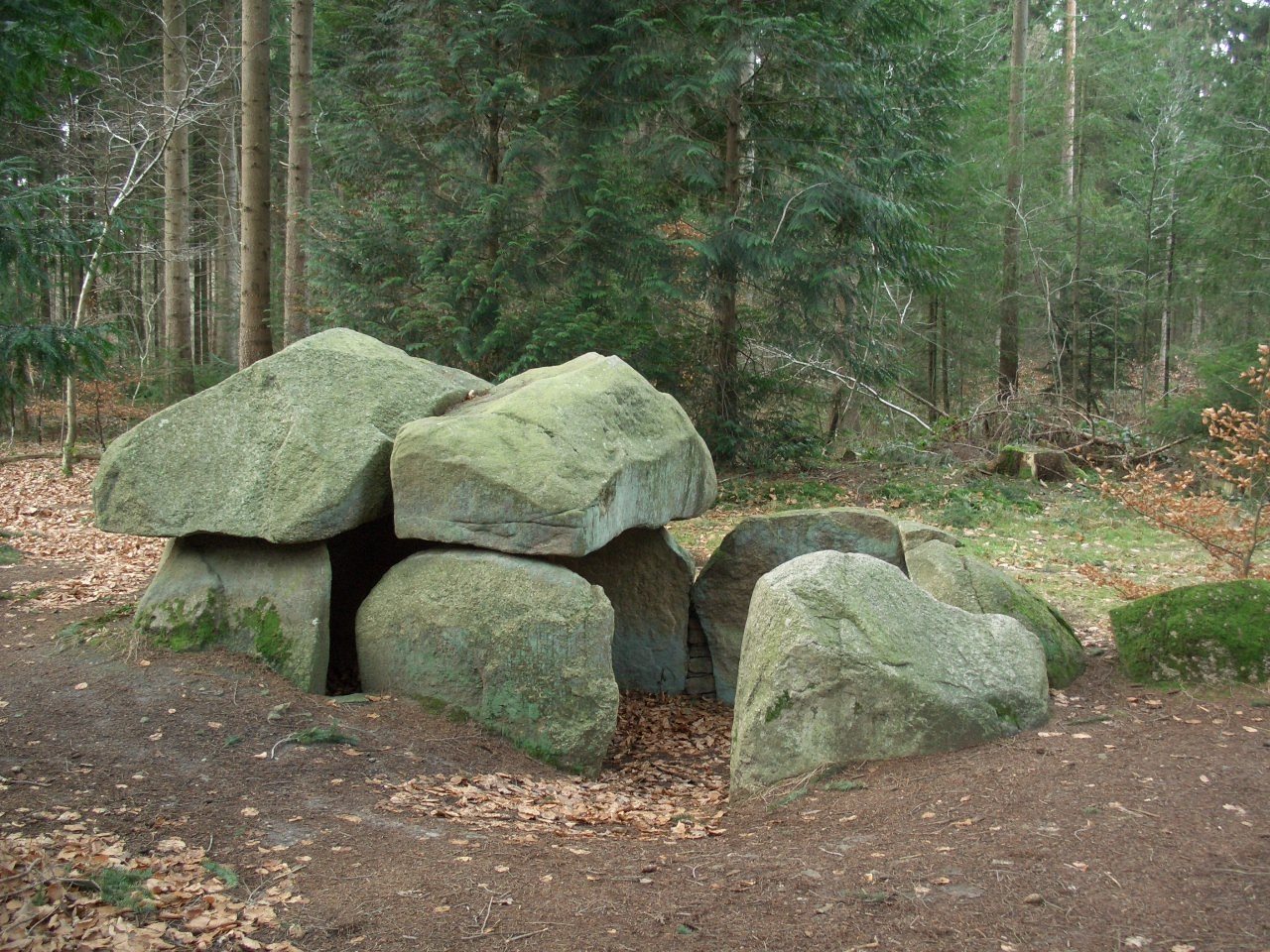
Tomb 2 has a north–south-oriented chamber, probably a passage grave, and was likely covered by a mound. Its original arrangement appears to have included three pairs of wall stones along the long sides, an end stone at each short end, and three capstones.
At Sprockhoff’s 1930 survey, the southern end stone, the two adjoining long-side stones, the middle eastern wall stone, the northern western wall stone, the northern end stone, and the southern and middle capstones were present. The southern capstone remained on the walls; the middle one had partly fallen into the chamber. The northern eastern wall stone, the middle western wall stone, and the northern capstone were then missing. A stone north of the chamber may be a fragment of that capstone.
Sprockhoff interpreted a gap on the west side as the entrance. Restoration added two wall stones and reset the middle capstone on the walls, leaving a gap between the middle and northern stones on the east side. The entrance was probably on that eastern side. It is uncertain whether the two added stones had escaped Sprockhoff’s notice or were put in place during restoration.