Megalithic Tombs near Klein Berßen: Neolithic Burial Monuments in Germany
Site at a Glance
- Popularity
- Very Low
- Country
- Germany
- Primary era
- Stone Age
- Eras represented
- Stone Age
- Civilizations
- Unclassified
- Site type
- Burial
- Remains
- Necropolis
On this page6 sections
History
The Megalithic Tombs near Klein Berßen are a group of burial monuments in Lower Saxony, Germany. Built around 3500 to 2800 BC, they belong to the Neolithic, when farming and settled communities became established in the region, and to the Funnel Beaker culture, a northern European farming culture named for its distinctive pottery.
Two tombs survive: Klein Berßen 1, also known as Wahrsteene, and Klein Berßen 2, also called Berßener Stein. In the early nineteenth century, Heinrich Bödiker excavated the second tomb and recovered a stone axe and a Funnel Beaker vessel, among other objects. The third tomb was still relatively well preserved around 1825, but was later destroyed during the nineteenth century.
Remains
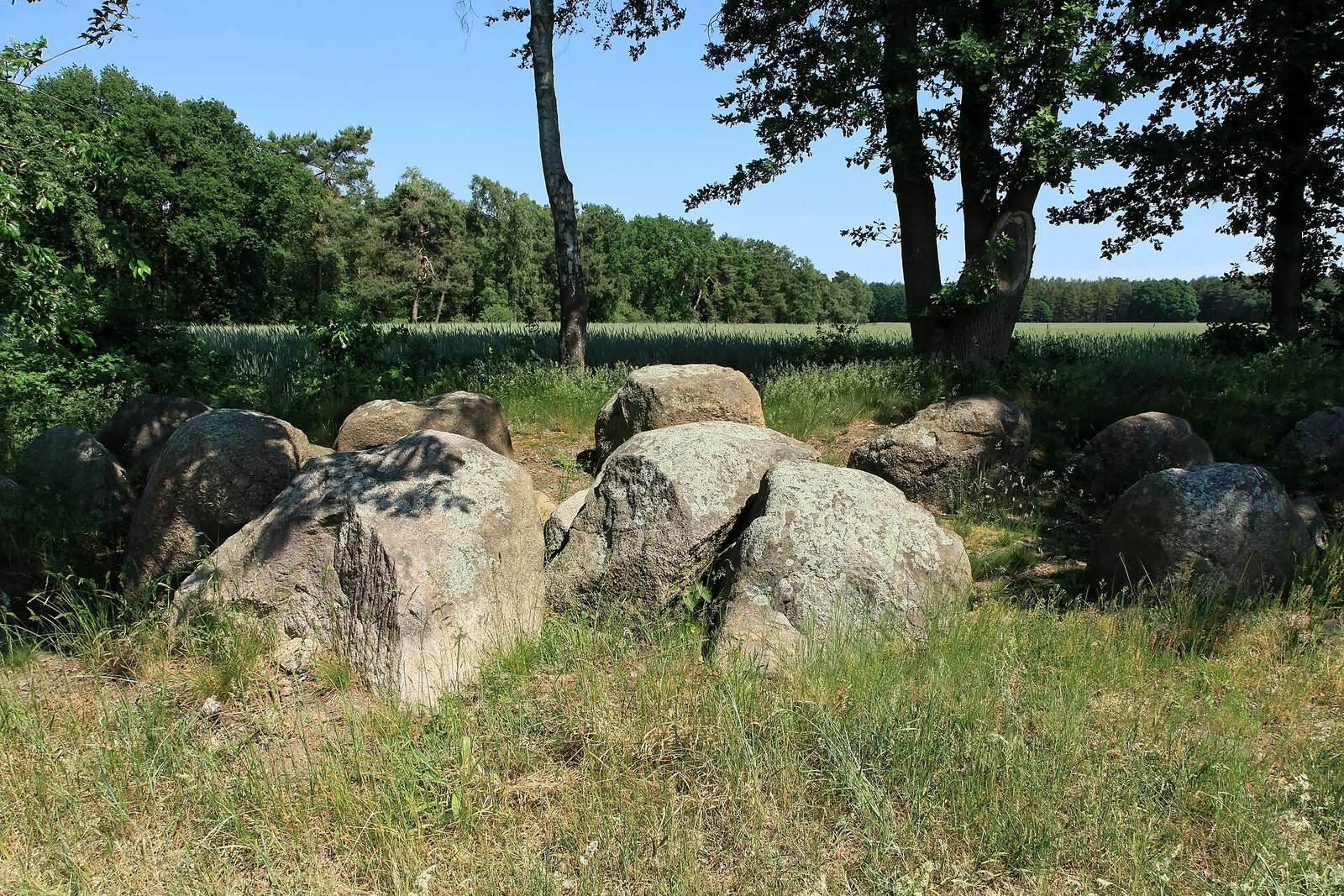
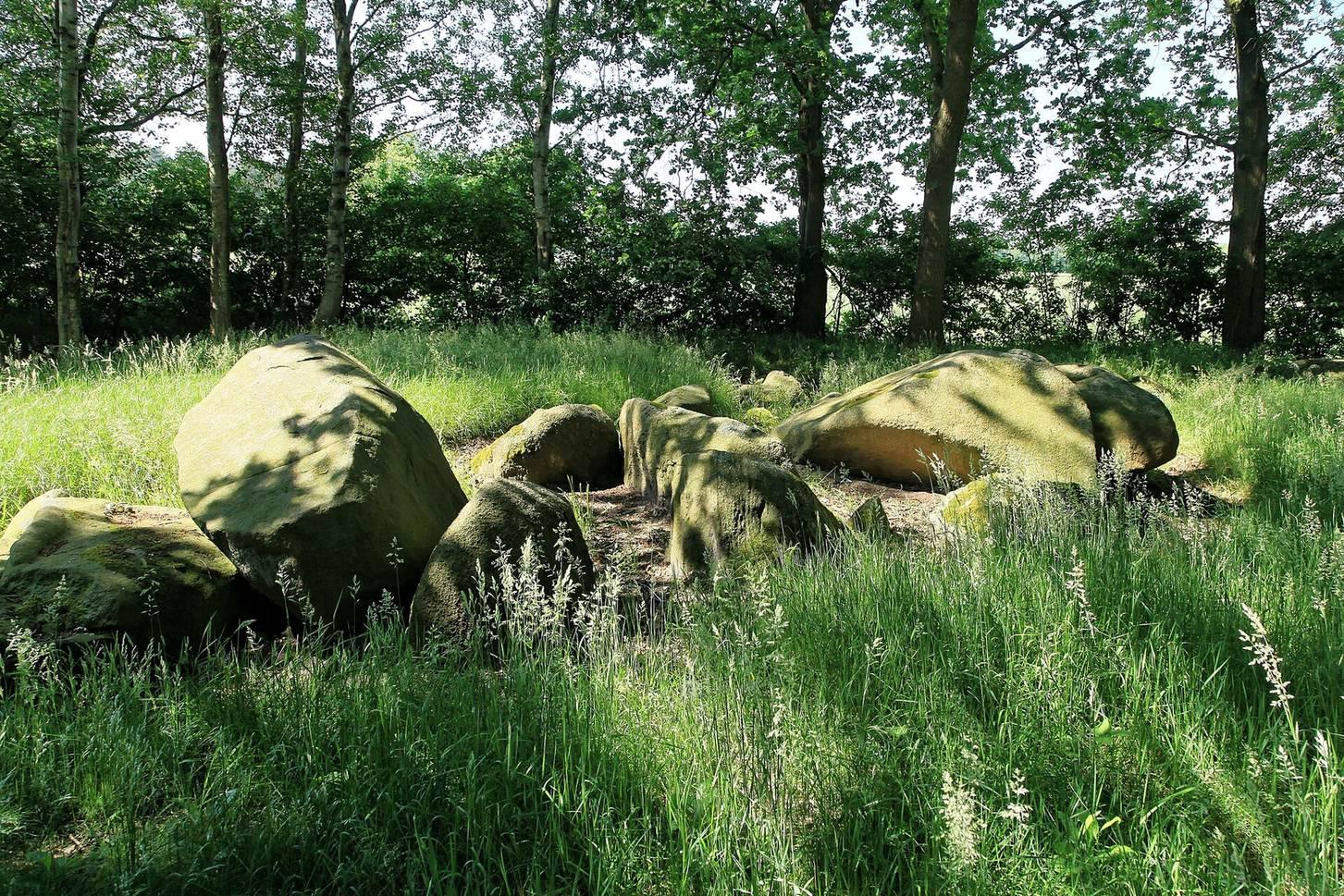
The two surviving tombs have elongated stone chambers whose upright wall stones once supported large capstones. A faint mound covers Klein Berßen 1, while Klein Berßen 2 retains much of its chamber walling. Other nearby prehistoric monuments include the Groß Stavern tombs, just over 2 km southwest of Klein Berßen 1; the Düvelskuhlen tombs, 2.2 km northeast; the Groß Berßen tombs, 2.7 km east; and the Mansenberge burial-mound field, 420 m southeast.
The tombs
Klein Berßen 1
At the edge of a field about 3 km north of the village, a barely visible east-west mound measures 23 by 11 m. Beneath it is a passage grave, a burial chamber reached through a stone-lined passage. The chamber is 12 m long and 1.6 m wide. Its passage opens halfway along the south side and measures 3.5 m long by 0.7 m wide; a niche lies just east of the entrance.
The chamber originally had seven wall stones on its north side and eight on its south, end stones at both short ends, and seven capstones. The passage had three pairs of wall stones and three capstones. At the western end, the end stone and two southern wall stones remain in place, with a capstone fragment inside. In the eastern half, four northern wall stones, the eastern end stone, and four southern supports stand in place; another southern support has tipped outward. Four capstones there have fallen into the chamber. The passage survives only at its outer third, with its eastern wall stone standing and its western wall stone and capstone fallen.
Klein Berßen 2
The chamber runs approximately east to west and narrows toward the east. It is 10 m long, 2.4 m wide at the west end, and 1.8 m wide at the east. Remnants of what was probably an oval stone enclosure were identifiable in the early nineteenth century.
Originally, six pairs of stones formed the long sides, with an end stone at each short end and six capstones above. Nearly all the wall stones remain in place. A small fragment of the removed western end stone lies near its original position; the eastern end stone is cracked but still stands. The capstones were blasted apart, and several large pieces remain inside the chamber.
Two smaller stones lie beside the south wall, in front of the second and third wall stones counted from the east. Johannes Heinrich Müller and Jacobus Reimers interpreted them as stones from a passage. Ernst Sprockhoff considered them fragments of blasted capstones, while allowing that a passage may have opened at the middle of the south side. The tomb’s plan is therefore uncertain: it may have been a passage grave or a large dolmen, another type of megalithic tomb.
Klein Berßen 3
This tomb stood about 3 km south-southwest of the village near the Wittenfehn bog. Its east-west oval mound measured 6.7 by 4.7 m and had a stone enclosure. The chamber had six capstones.