Megalithic Tombs near Kläden: Neolithic Burial Monuments in Germany
Site at a Glance
- Popularity
- Very Low
- Country
- Germany
- Primary era
- Stone Age
- Eras represented
- Stone Age
- Civilizations
- Unclassified
- Site type
- Burial
- Remains
- Necropolis
On this page14 sections
History
The Megalithic Tombs near Kläden are a group of Neolithic burial monuments in Germany. The six tombs were built between 3700 and 3350 BCE by people associated with Deep-Pit Ware, a pottery tradition distinguished by deeply incised decoration. Only KS 15 survives; the other five were destroyed between the eighteenth and early twentieth centuries.
Historical records and changing fortunes
The historian Johann Christoph Bekmann mentioned tombs KS 12–14 in a work published in 1751. In 1838, Johann Friedrich Danneil identified KS 12 and KS 13 at that location; KS 14 had probably already been destroyed. Danneil also recorded KS 10 and KS 11 near Beesewege, but did not identify the surviving KS 15.
In the early 1890s, researchers Eduard Krause and Otto Schoetensack found KS 10 and KS 11 destroyed. KS 12 and KS 13 still stood, although gravel extraction had damaged them further. The researchers examined KS 13 and were the first to describe KS 15. They also assigned the KS numbering used for the tombs.
During the nineteenth century, cathedral canon Theodosius von Levetzow, a member of a cathedral chapter, bought the Kläden tomb and the tomb at Bülitz to protect them from destruction. In 1931, stones from KS 12 and/or KS 13 were taken for a war memorial in the village churchyard.
Survey and local tradition
In 2003–04, a joint project surveyed the surviving megalithic tombs of the Altmark, a historic region in northern Saxony-Anhalt. The work involved the State Office for Heritage Management and Archaeology of Saxony-Anhalt, the Johann Friedrich Danneil Museum in Salzwedel, and the Young Archaeologists of Altmark.
A local legend tells that giants at Kläden and Steinfeld shared an oven at Kläden, perhaps one of the tombs. When the Kläden giant struck a fly on his kneading trough, the sound reached Steinfeld. The giant there, whose dough was not yet ready, hurried over, only to find the oven unheated. Thinking he had been tricked, he quarreled with his neighbor. The two chased one another back to Steinfeld and threw stones; the tale says their fight formed the tomb there.
Remains
The tombs occupied three locations around Kläden, with recorded forms including stone chambers, mounds, and stone enclosures. KS 10 and KS 11 stood on opposite sides of the path toward Beesewege. KS 12–14 were close together on a sandy rise north of the road to Steinfeld. KS 15 lies about 1.5 km northeast of Kläden, west of the road to Grünenwulsch. Four stone axes are also attributed to the group, though their exact find locations are uncertain.
KS 15, the surviving tomb
Mound and enclosure
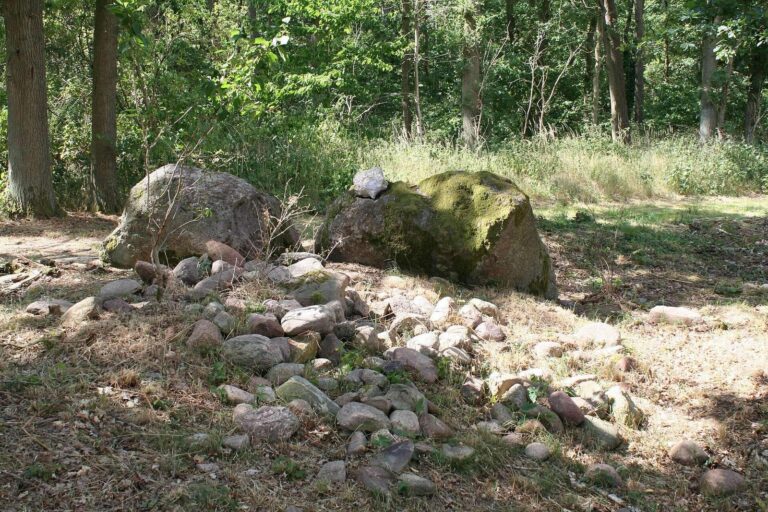
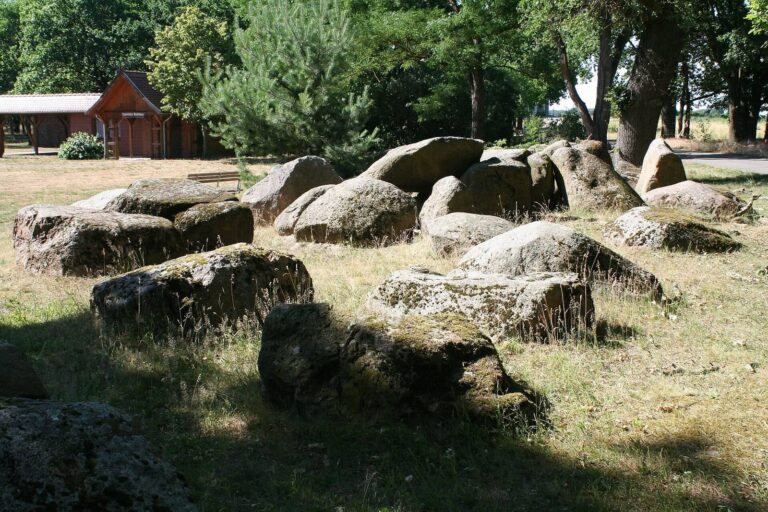
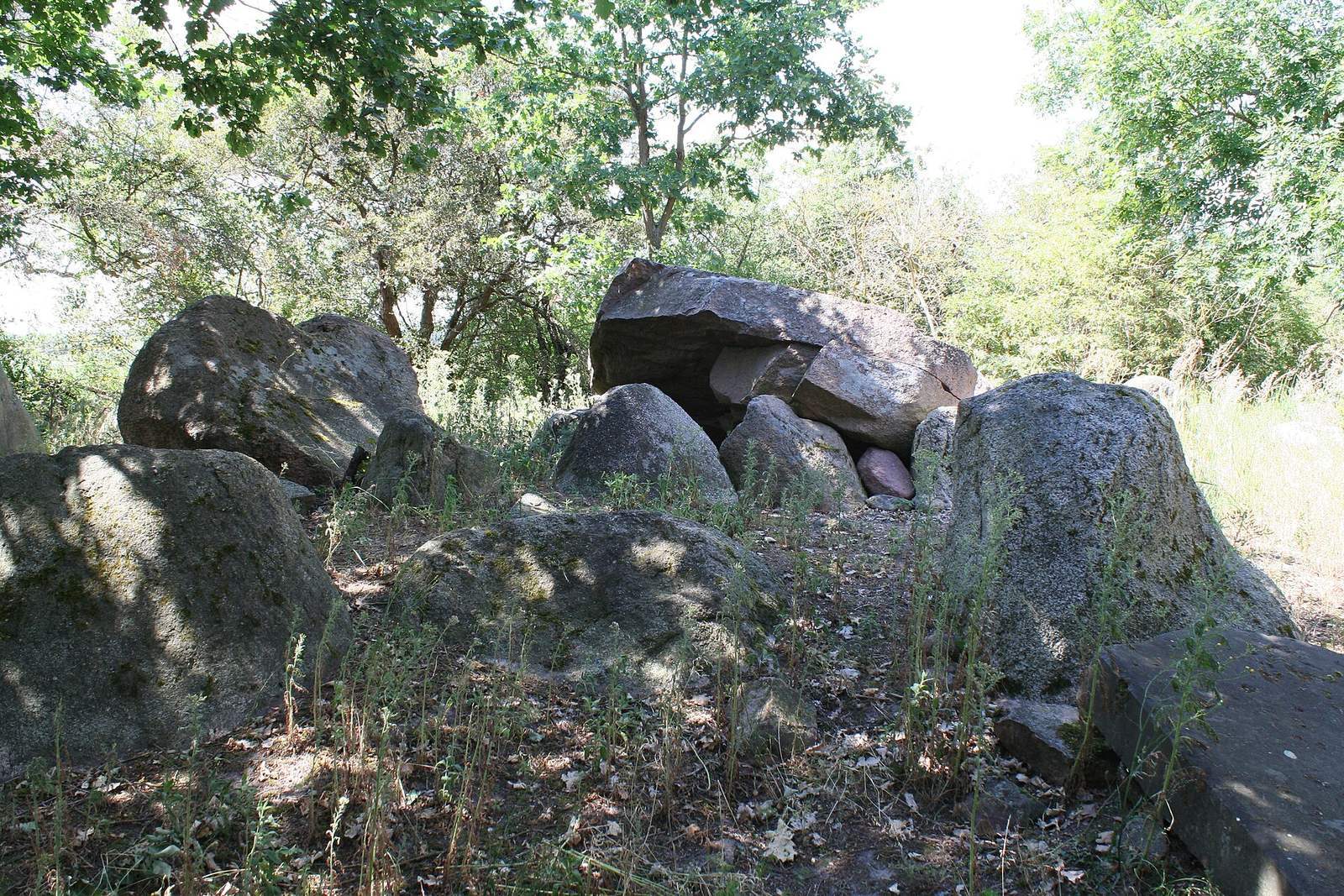
KS 15 is classified by Hartmut Bock, Barbara Fritsch, and Lothar Mittag as a large dolmen, a stone tomb with a large chamber. Hans-Jürgen Beier considered it probably a passage grave, a tomb whose chamber is reached through a passage. Its oval mound measures 29 m by 17 m and stands 0.8–1 m high. The northern side has slumped markedly. A south–north-oriented enclosure, probably slightly trapezoidal, measures 18 m by 7.5–8.2 m; 19 of what were probably 26 stones remain. Nearby stones cannot be confidently assigned to it.
Burial chamber
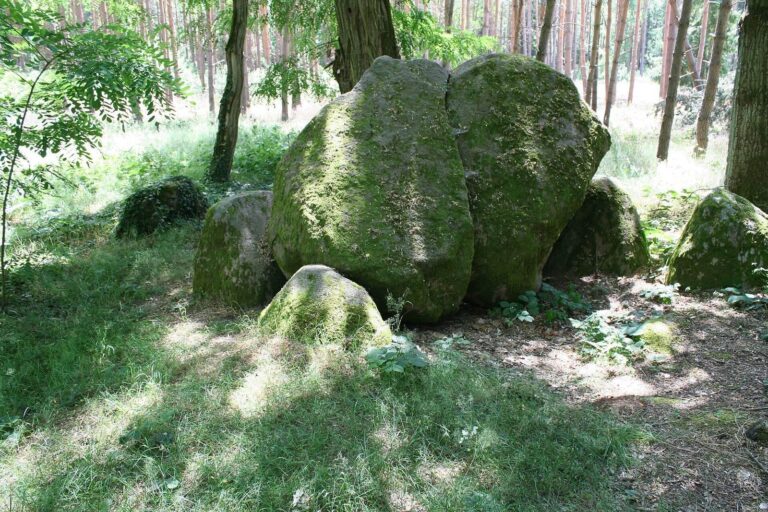
The chamber stands at the enclosure’s center and shares its south–north alignment. It is trapezoidal, measuring 11 m internally in length and 1.5–2.6 m across. It is the largest tomb chamber in Saxony-Anhalt. Twenty wall stones and six of the original seven capstones remain. Most surviving capstones are broken and have fallen into the chamber; one still rests in place and measures 2.7 × 1.6 × 0.8 m. A broken capstone bears a hook-shaped groove up to 6 cm wide, 7–20 cm deep, and 45 cm long. A gap between the eastern chamber wall and the enclosure is probably linked to the removal of a capstone, which had been taken away by 1893 at the latest.
Sandstone tablet
A broken sandstone tablet lies on the eastern side of the tomb. Around 1950, it was removed for intended use in a memorial to German communist politician Ernst Thälmann. It broke during the removal and was left at the tomb.
Destroyed tombs
KS 10
Before its destruction, KS 10 had a chamber measuring 6.6 m by 1.2 m. Danneil recorded all its chamber wall stones in place, along with one capstone. Its size suggests either a large dolmen or a passage grave.
KS 11
The enclosure of KS 11 measured 13.2 m by 3.5 m. By the time Danneil investigated it, several stones from the chamber and enclosure had already been removed.
KS 12
KS 12 had a south–north-oriented enclosure measuring 12 m by 6.6 m, with its chamber in the southern part. At Danneil’s survey, the chamber wall stones remained in place.
KS 13
The south–north-oriented enclosure of KS 13 measured 37.7 m by 12.6 m, and its chamber lay in the southern part. By Danneil’s survey, about half the monument had slipped down the slope. His partial excavation yielded decorated Deep-Pit Ware pottery fragments dated to 3500–3000 BCE. During a later examination, Krause and Schoetensack found only a few stones in their original positions. They also identified a possible Bronze Age secondary burial, represented by animal bones, an undecorated pottery fragment, small stones, badly decayed bones that may have been human, and a perforated bronze sheet.
KS 14
Bekmann described KS 14 as a long mound aligned south–north, with its chamber in the southern part.