Steinfeld Megalithic Tomb: A Neolithic Burial Monument in Germany
Site at a Glance
- Popularity
- Very Low
- Country
- Germany
- Primary era
- Stone Age
- Eras represented
- Stone Age
- Civilizations
- Unclassified
- Site type
- Burial
- Remains
- Necropolis
On this page10 sections
History
The Steinfeld Megalithic Tomb is a Neolithic burial monument in Germany, part of a group dated to 3700–3350 BC and associated with a culture whose pottery was decorated with deep incisions. Most of the group’s tombs were destroyed during the eighteenth and nineteenth centuries.
Neolithic Origins and Local Traditions
The surviving monument belongs to a prehistoric burial group associated with a Neolithic culture known for its deeply incised pottery. Local legends later offered explanations for how the tombs came to be formed.
In one tale, giants from Steinfeld and Kläden shared an oven in Kläden, possibly one of the megalithic tombs there. The Kläden giant signalled that the oven was ready by striking a baking trough. One day, a blow used to kill a fly on the trough sounded in Steinfeld. Mistaking it for the signal, the Steinfeld giant arrived with dough, found the oven cold, and accused his companion of deception. Their quarrel led to a chase and a fight in which they threw stones, supposedly creating the tomb. A second version says that Steinfeld and Schönfeld shared an oven in Steinfeld. When Steinfeld overslept, the angry giants fought with stones; one killed Schönfeld, and the village of Schönfeld is said to occupy the place where he fell.
Records and Destruction
Johann Christoph Bekmann first wrote about the tombs in 1751. He described three large monuments and mentioned an unspecified number of smaller ones. In 1843, Johann Friedrich Danneil’s systematic survey found the three large tombs intact, although he did not inspect one of them himself.
By the early 1890s, Eduard Krause and Otto Schoetensack recorded that only one tomb remained. The other two large monuments had been dismantled in the mid-nineteenth century. Some stones from one were reused in bridge construction, while unusually long stones from another were used for a bridge in 1853. Danneil’s survey also suggests that the smaller tombs had already been destroyed by 1843. In 2003–04, the surviving megalithic tombs of the Altmark, a historic region in what is now northern Saxony-Anhalt, were surveyed and measured in a joint project involving the state heritage office, the Johann Friedrich Danneil Museum in Salzwedel, and the Young Archaeologists of the Altmark association.
Remains
Surviving Tomb
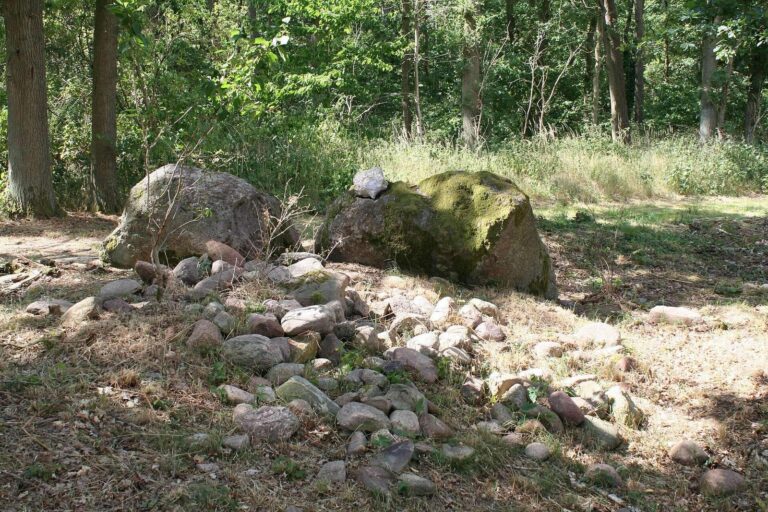
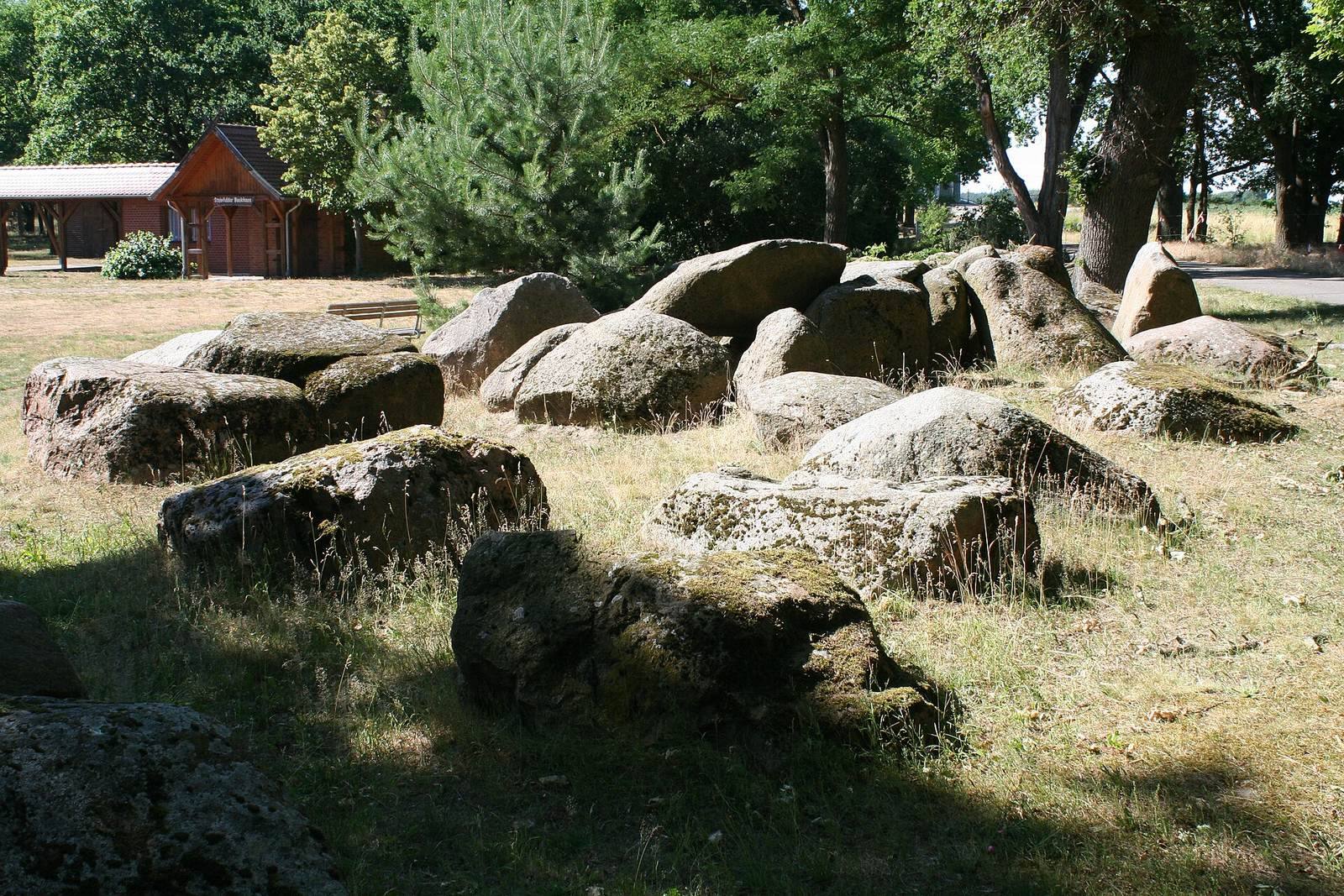
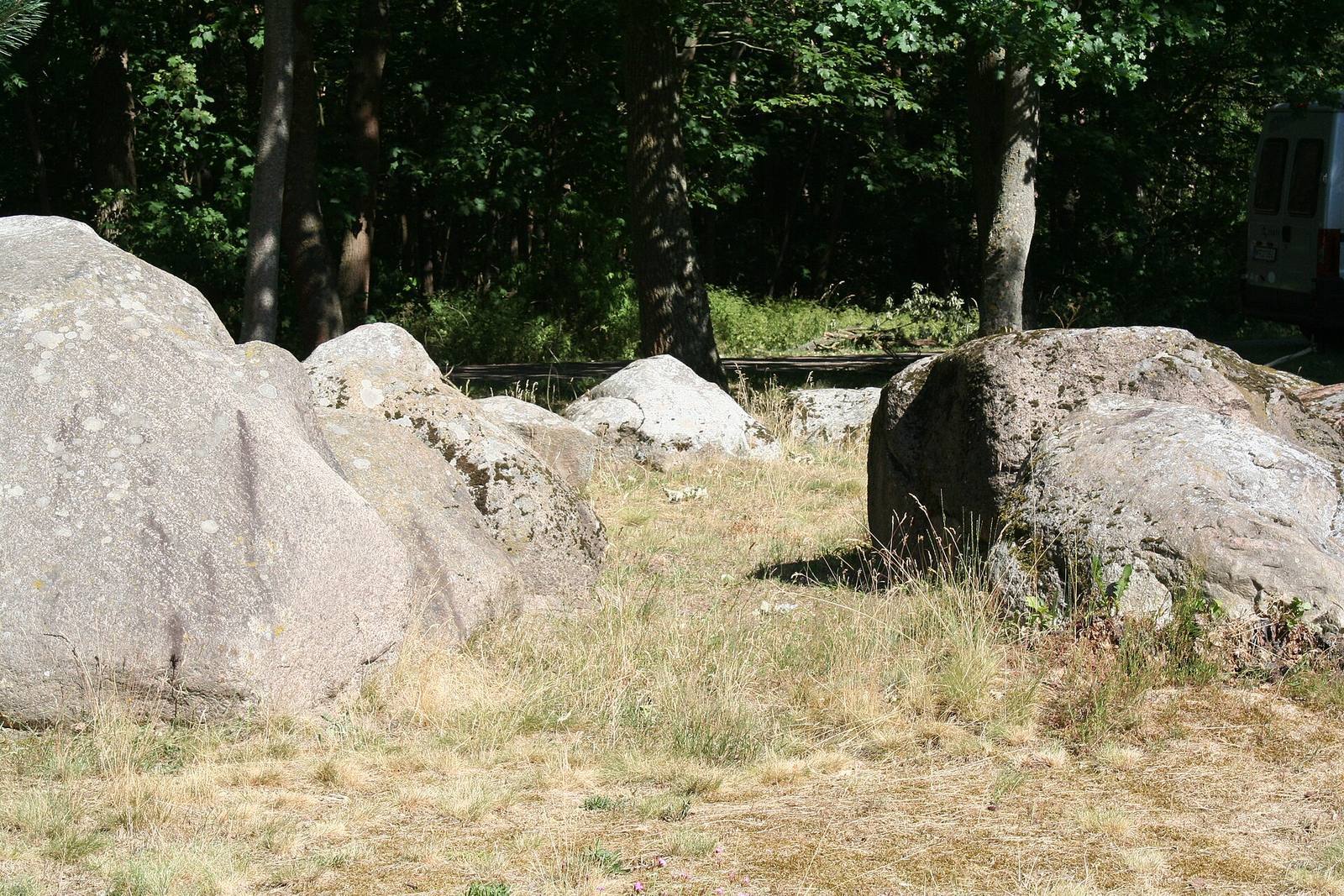
The surviving tomb stands at the northern edge of Steinfeld, about 250 m north of the church. It is a large dolmen, a tomb chamber made from upright stones, and sits within a long, trapezoidal stone enclosure. Both enclosure and chamber run north-northwest to south-southeast.
Stone Enclosure
The enclosure measures 46.5 m long and between 4.8 and 6.5 m wide. It is the longest surviving enclosure in Saxony-Anhalt. Of probably 60 original stones, 53 remain. The two stones at its southern corners serve as guard stones. One measures 2.3 by 1.6 by 0.8 m; the other is 2.5 by 1.8 by 0.6 m. Grooves cross the southwestern stone. Some may be natural, but they were deepened by people, and others were made entirely by human hands.
Burial Chamber
The rectangular chamber occupies the northern part of the enclosure and measures 8.5 by 2.0 m internally, with a height of 1.0 m. Its 17 wall stones and six capstones survive, although most of the capstones have sunk. The largest capstone measures 2.2 by 1.6 by 0.6 m. One measuring 2.0 by 1.5 by 0.6 m remains resting in place. It is known as the “ringing stone,” since it is said to sound higher when tapped with a small stone than the other wall stones and capstones.
Former Tombs
Two other large tombs once stood near the surviving monument. One was several hundred metres to its west or southwest, on a natural rise near a former windmill; another stood beside the road to Schinne.
Long Barrow
Danneil described one of the destroyed tombs as a north–south rectangular long barrow, an elongated prehistoric burial monument often bounded by stones. In 1843 it measured 47 m by 7.8 m. Its enclosure had 40 stones along each long side and ten along each short side, with a 12-stone burial chamber at the northern end. By the early 1890s, the enclosure stones had been taken away. Krause and Schoetensack could still make out a mound 53 m long and 15 m wide, with undecorated pottery fragments on its surface.
Other Tombs
Bekmann described another large monument as comprising “three grave altars,” probably referring to three capstones. It may have been a large dolmen or a passage grave, a chamber tomb reached through a passage, and was said to have been built from unusually large stones. Bekmann also noted smaller tombs near the larger monuments, each made up of 17 to 20 stones.