Goziyon Madrasa: An Educational Monument in Bukhara
Site at a Glance
- Rating
- 4.8
- Popularity
- Very Low
- Country
- Uzbekistan
- Primary era
- Early Modern
- Eras represented
- Medieval, Early Modern
- Civilizations
- Khanate of Bukhara, Timurid
- Site type
- Religious
- Remains
- Madrasa
On this page7 sections
History
Goziyon madrasa is an Islamic educational institution and architectural monument in Bukhara, Uzbekistan, known from the fifteenth century and represented by a building erected in 1730–1734 in the local Bukhara architectural style. It formed part of a long-lived educational quarter and is included within the UNESCO World Heritage listing of the historical center of Bukhara.
The twin madrasa complex
Goziyon madrasa is also known as Goziyon Kalon, meaning “Great Goziyon.” Together with Goziyon Khurd, or “Small Goziyon,” it formed a complex of twin madrasas associated with approximately 1535. The broader construction history of the site extends from the fifteenth to the seventeenth century, reflecting the development of the complex over several historical phases.
The Goziyon quarter took its name from the respected tomb of Imam Ghoziy. An imam is an Islamic religious leader; in this tradition, Imam Ghoziy was counted among Bukhara’s 44 martyrs and remembered as a fighter for the faith. The concentration of madrasas in the quarter indicates its role as one of Bukhara’s educational centers.
Rebuilding and educational use
The present building was constructed between 1730 and 1734 by Usta Fathulloh, a master craftsperson, with funds provided by Muhammad Sharif. Construction was completed in the fourth year after work began. During the eighteenth and nineteenth centuries, the madrasa functioned as a Muslim school attended by students from various cities. Its rooms provided student accommodation, while instruction took place at the Mullo Muhammad Sharif Madrasa in the same quarter.
The completion date is preserved in a poetic inscription. Its chronogram, an inscription whose wording encodes a date through a numerical system, gives the year 1146 AH, corresponding to 1733–1734. The verse honors both Muhammad Sharif, who financed the building, and Fathulloh, who constructed it.
Remains
Layout and architectural form
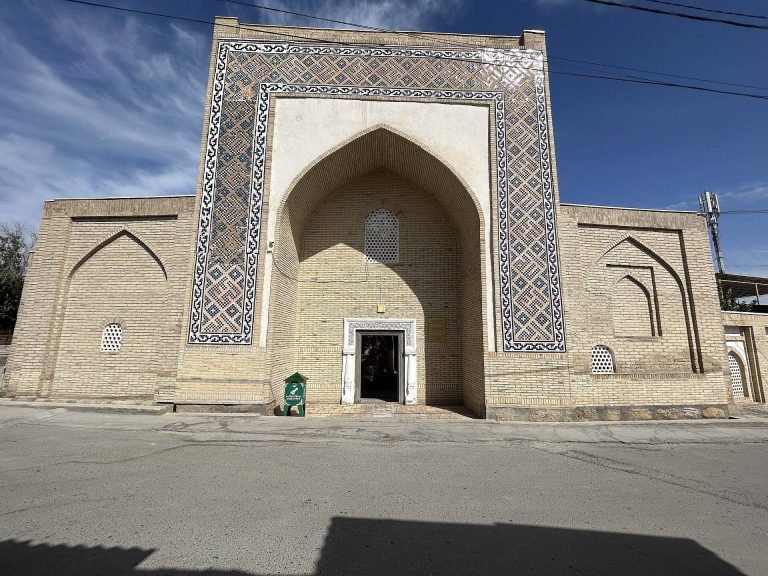
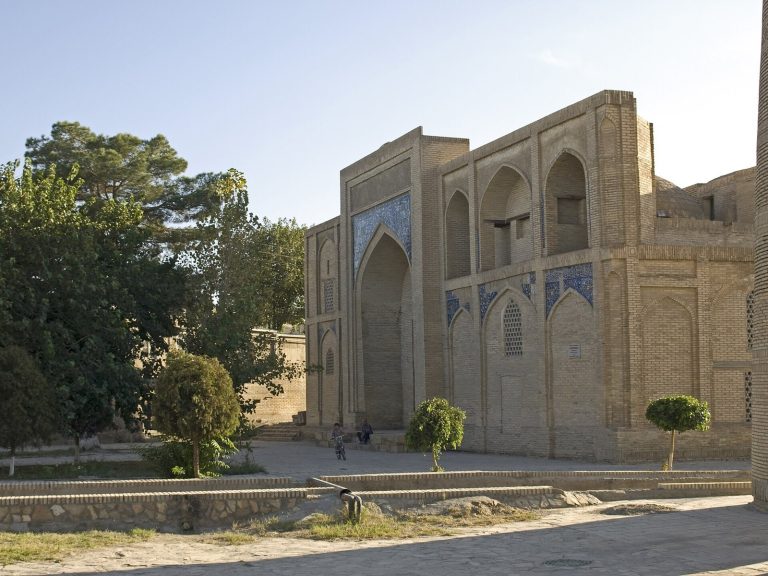
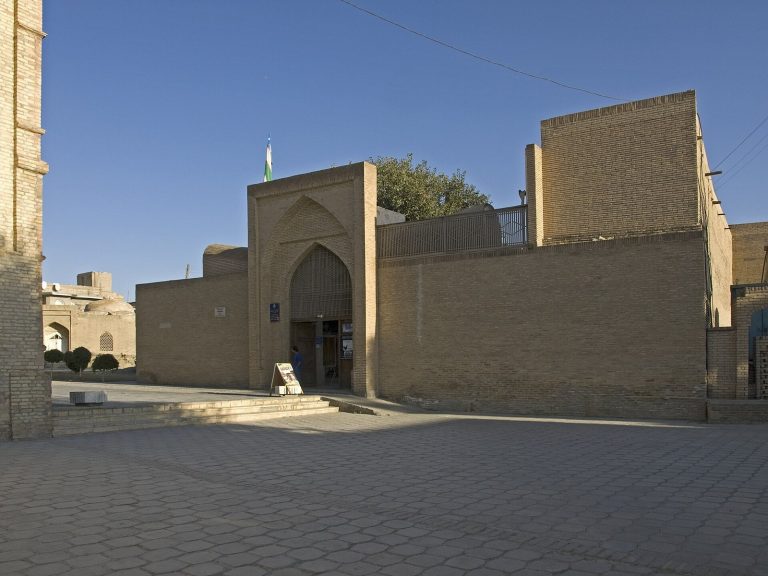
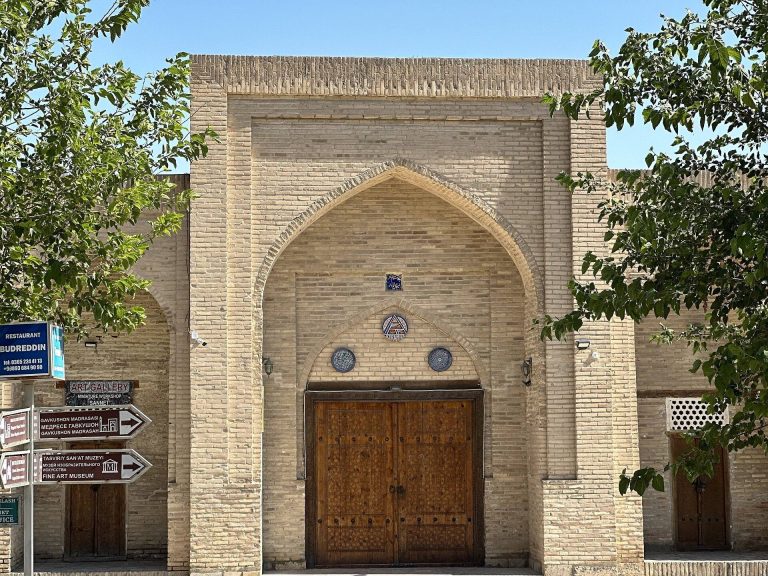
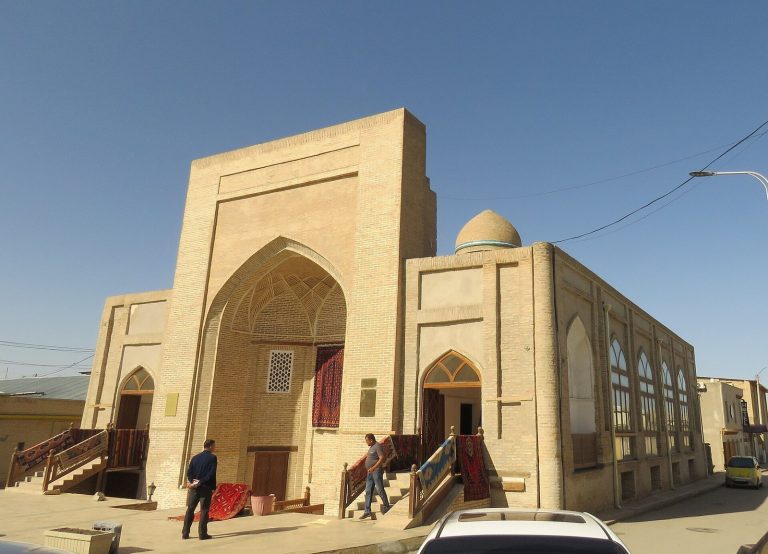
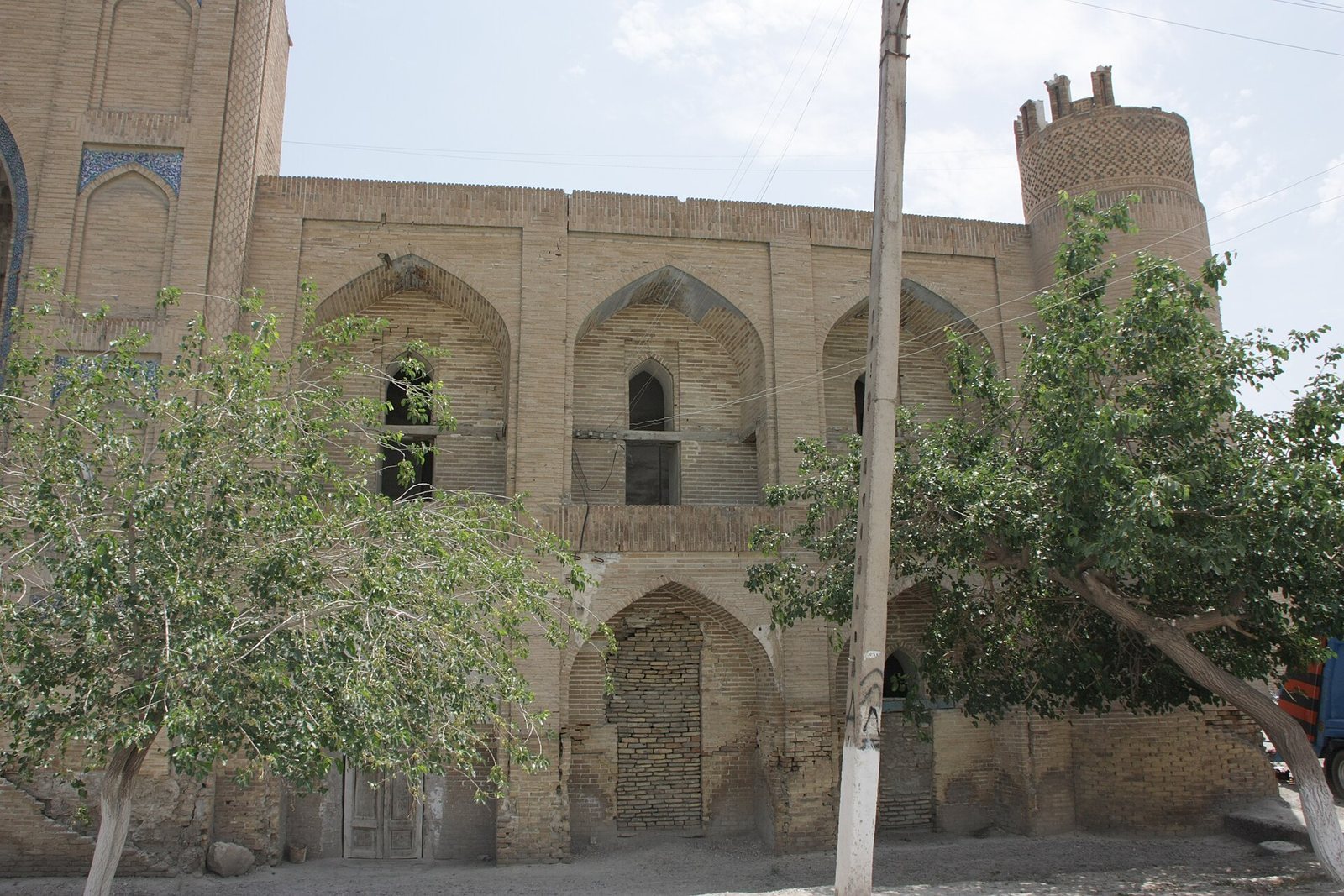
Goziyon madrasa stands in Bukhara’s ancient Goziyon quarter at the intersection of Jo‘yibor and Imam G‘azoliy Valiy streets. The small, single-storey building has an asymmetrical plan and brick walls. Compared with Bukhara’s other madrasas, it has a compact form, but its facade rises high and has a monumental character in the local Bukhara architectural style.
Arched facade
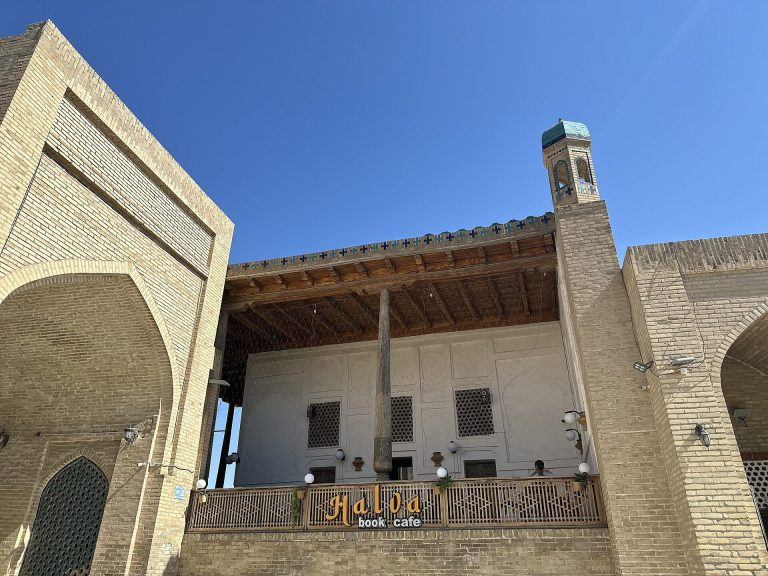
The older part of the madrasa has an arched front with partial ornament and a glazed arched facade. The building adjoins the half-timbered Chubin Madrasa and stands beside the Xoja-Govkushon architectural ensemble, placing it within a concentrated group of historic structures in the Goziyon quarter.
Dome and interior decoration
The highest interior point of the dome is decorated with gold and a majolica inscription. Majolica is a decorated glazed ceramic material used on architectural surfaces and inscriptions. The dome arch bears the verse “Az Muhammad Sharif be-in nishon,” translated as “This is a sign from Muhammad Sharif.” Its chronogram gives the completion date as 1146 AH, or 1733–1734. The ceiling of the madrasa’s outer room is decorated with carved marble.