Gortys: An Ancient Arcadian City in Greece
Site at a Glance
- Popularity
- Medium
- Country
- Greece
- Primary era
- Classical
- Eras represented
- Classical
- Civilizations
- Ancient Greek, Kingdom of Macedon
- Site type
- City
On this page10 sections
History
Gortys, also known as Gortyna, was an ancient Arcadian city in Cynuria, in the central Peloponnese of Greece, near modern Atsicholos. Its sanctuary of Asclepius and associated baths may indicate that the area served as a healing center.
Arcadian origins and decline
Greek tradition attributed the city’s foundation to Gortys, son of Stymphalus. Another tradition, associated with Plato, linked the Arcadian city with the founding and settlement of a Cretan city called Gortys. The city’s population declined after Megalopolis was founded in 371 BCE, when most of its inhabitants moved there. Gortys nevertheless remained inhabited, and its history continued into the early Byzantine period.
Hellenistic rule and conflict
In the third century BCE, Gortys belonged to the Achaean League, a federation of Greek communities. The city appears to have had a Macedonian garrison, and Macedonian construction is associated with its fortifications. In 219 BCE, during the Social War, a conflict between the Aetolian League and an alliance of Achaean and Macedonian forces, the Eleian general Euripidas captured Gortys. At the time, the city was subject to Thelpusa, another Arcadian city.
Roman-era and later occupation
Cicero alluded to the sanctuary when he mentioned a tomb near the Lusius River, associating it with one of three figures named Asclepius. In the second century CE, the Greek travel writer Pausanias described Gortys as a village rather than a substantial city. A public road connected it with Megalopolis. The ancient name also survives in modern place names, including Gortynia and Gortynos.
The French School at Athens excavated Gortys between 1940 and 1956, including campaigns in 1947–48 and 1950–52.
Remains
River setting and acropolis
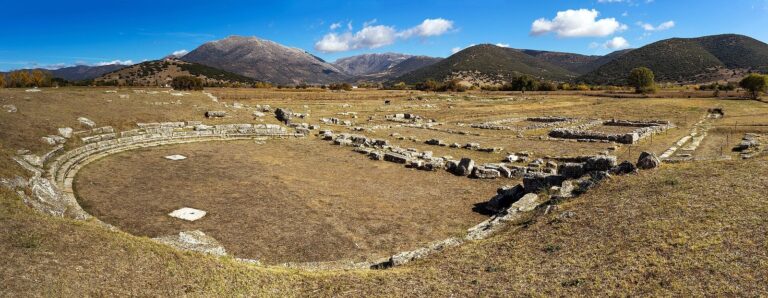
Gortys stood west of the Gortynios River, called the Lusius near its sources and now known as the Lousios. The river, a tributary of the Alpheios, was noted for its very cold water. Beside it, the city’s high fortified area, the acropolis (a high, often fortified part of a city), extends about 425 metres northwest to southeast and measures roughly 60 to 100 metres across. It comprises a northern main acropolis and a southern fortress, apparently built in different periods.
Sections of the acropolis walls, three gates and five round towers survive. The walls are mainly dated to the third and second centuries BCE. The southern fortress has rectangular towers and was probably built in the second century BCE; some of its stones may have been reused from the earlier acropolis walls. Other remains at the site include walls, gates, houses and a watchtower.
Sanctuaries and baths
Temple of Asclepius beside the river
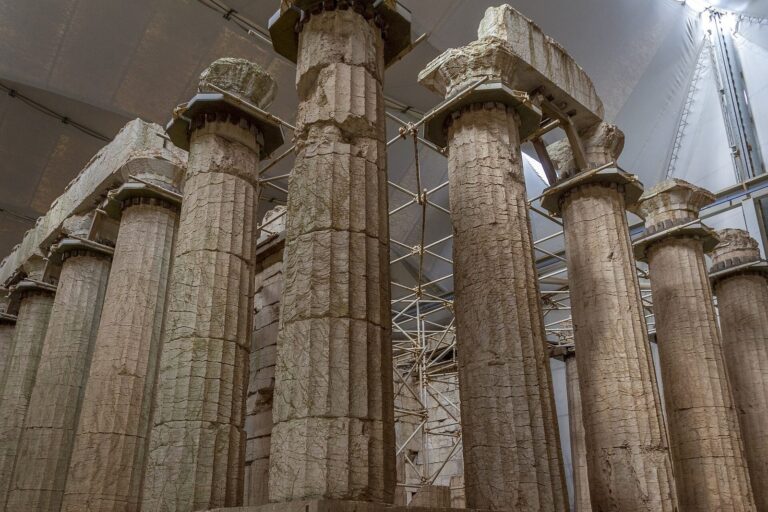
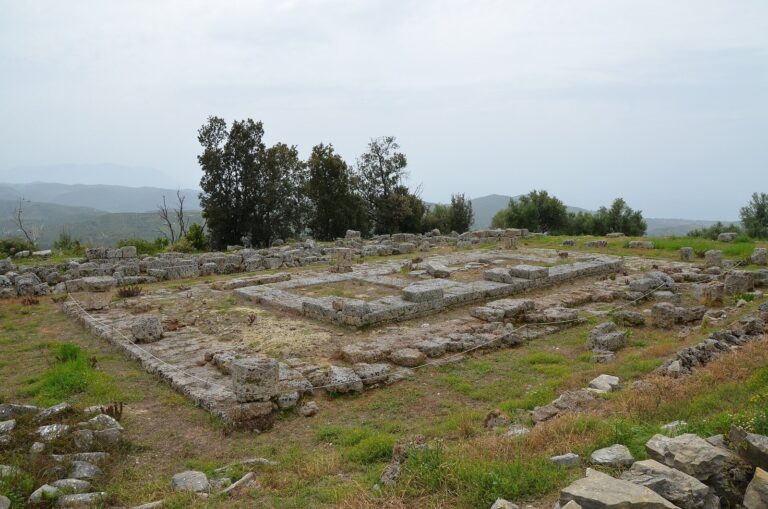
The best-known building at Gortys was a temple of Asclepius, built in the fourth century BCE north of the acropolis beside the river. Constructed from Pentelic marble, quarried on Mount Pentelicus near Athens, it measured about 23.6 by 13.2 metres. Its columns followed the Doric order, a Greek style of column design, and surrounded the building, with six across the front. Inside were a pronaos (entrance porch) and a naos (main sanctuary chamber), without a rear chamber or porch. The surviving remains include the foundations. The naos held statues of Asclepius, the god associated with healing, and Hygieia, the goddess associated with health. The sculptor Scopas made both statues.
Smaller temple and bathhouse
Ruins of a smaller temple and a bathhouse lie near the principal temple. The bathhouse dates to the fourth century BCE and had a large pool. An underfloor heating system, called a hypocaust, was added in the early third century BCE.
Sanctuary southwest of the fortress
A second sanctuary of Asclepius lay southwest of the southern fortress. Its temple, dated to the fourth or third century BCE, measured about 27.1 by 13.5 metres. The sanctuary also included a bathhouse.