Church of Hagia Theodora: A Byzantine Chapel in Greece


Site at a Glance
- Rating
- 4.9
- Popularity
- Medium
- Country
- Greece
- Primary era
- Medieval
- Eras represented
- Medieval
- Civilizations
- Byzantine
- Site type
- Religious
- Remains
- Chapel
On this page6 sections
History
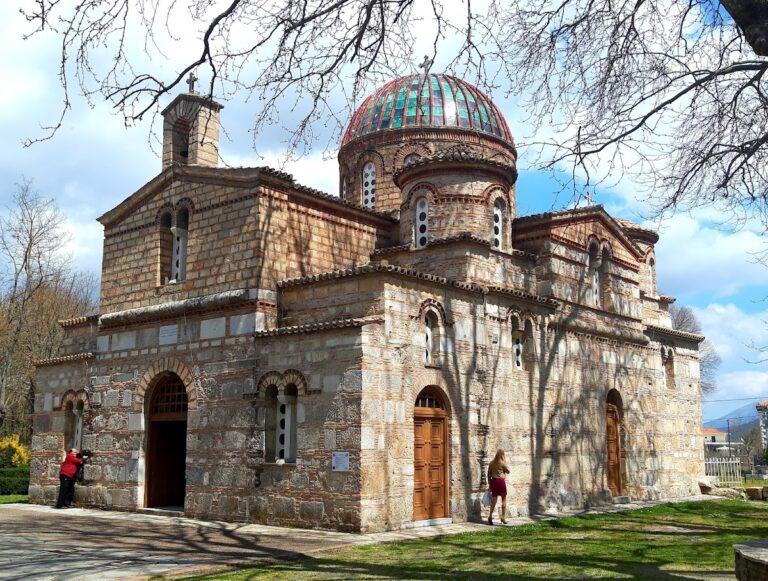
The Church of Hagia Theodora is an eleventh-century Byzantine-era Eastern Orthodox chapel in Greece, near Vastas in Arcadia. It remains a pilgrimage site under the jurisdiction of the Church and is celebrated on September 11. As a Byzantine monument, it is also under the responsibility of the competent Ministry of Culture.
Byzantine origins and traditions
The chapel was built during the eleventh century, within the long imperial period of the Macedonian dynasty, the Byzantine ruling house associated with the empire from the ninth to the eleventh century. Its name is linked to several traditions concerning the identity of Hagia Theodora.
One interpretation identifies her with Augusta Theodora, daughter of the Byzantine emperor Constantine VIII. She belonged to the Macedonian dynasty and is said to have ruled in her own right, though disguised as a man, from 1055 to 1056. Michael VI, who succeeded her after a coup, reportedly found her seriously ill and she later died. Another interpretation speculates that Michael VI murdered her and buried her at the site.
A separate local tradition presents Hagia Theodora as a woman who disguised herself as a man to meet her family’s obligations. Under the name Captain Theodore, she joined the Byzantine army. After a conspiracy led to a false accusation of unlawful acts, she was executed at the site. The tradition says that she prayed for her body to become a church, her hair to become trees proving the divine protection of her chastity, and her blood to become water that would nourish them.
The seventeen trees growing above the chapel are associated in this tradition with the seventeen years of Hagia Theodora’s life. Their survival through every wind is regarded as miraculous. This account is a religious legend rather than an established historical explanation.
Investigation and restoration
Earlier hurried and unprofessional rebuilding attempts had disturbed the chapel’s architecture. Before a new restoration, the Geophysics Laboratory of the University of Patras was commissioned in 1996 by the Directorate for the Restoration of Byzantine and Post-Byzantine Monuments. The investigation considered both the structural pressure produced by the vegetation and the religious importance attached to the trees.
Ground-penetrating radar, a method that detects hidden structures and voids with high-frequency signals, was used on the walls. Electrical tomography, which maps variations in electrical resistance to reveal cavities, provided a second check. Together, the methods established the route of the tree roots and supplied the information needed for a safe restoration.
Work took place between 1998 and 1999. The intervention aimed to protect the chapel while preserving the trees, whose roots had both strengthened parts of the structure and placed pressure on its masonry. It also addressed moisture entering the building beneath the substantial vegetation on the roof.
Remains
Setting and chapel structure
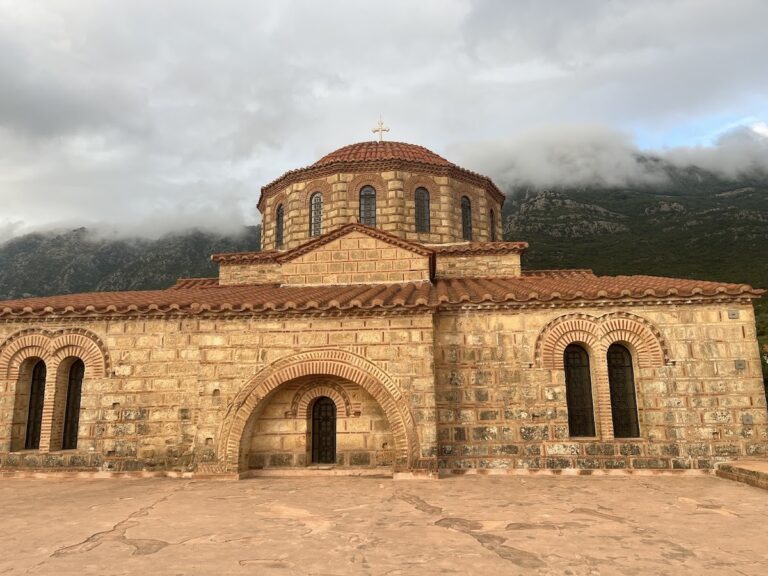
The small chapel stands in a densely forested ravine near Vastas, surrounded by very large oak trees. It is a small stone Byzantine building with a vaulted interior, and water from a spring emerges beneath its foundations. Soil on the roof has supported vegetation, creating the unusual physical condition associated with the church.
The seventeen trees now growing from the roof include holm oaks, maples, and terebinths. Their growth is understood as beginning with a holm oak that developed gradually and produced seeds, followed by the trees that formed the present vegetation. The roof and walls therefore carry a substantial living and accumulated load.
Roots, masonry, and conservation
A popular belief holds that the trees’ roots are invisible beneath the thin roof and cannot be seen either inside or outside the chapel. The 1996 investigation found instead that the roots pass through cavities in the lateral walls, which are nearly one metre thick, and continue down to the ground. Their system creates outward pressure between the stones. It also offers some resistance to the weight of the vegetation while damaging the stone walls. The south wall was almost intact, while a specific cavity was identified in the north wall.
During the restoration, the masonry was cleaned and repointed without cement injections, allowing the tree roots to retain moisture. Soil and accumulated leaves were removed from the roof to protect the wall paintings from dampness. A bituminous waterproofing membrane was placed around the base of each tree, with a collar fitted carefully so that the roots were not injured. A slate roof was then installed to reduce moisture penetration and help protect the building.
Nearby sites